

What is Bell Curve?
Bell Curve means a symmetrical, bell-shaped graph that showcases normal data distribution. In simple terms, bell curve is a graph that highlights how things are distributed such as the test scores, employee performance etc. The reason why it is called “bell” is because its shape resembles a bell where majority of people fall in the middle, and lesser people are either at the highs or the lows.
For example- Imagine a situation where a maths test is conduced and attempted by 100 students. Here, the majority of students scored between 70 to 80 percent, this can be classified as the peak of the bell. Another set of students scored below 50, comes under the left side of the bell curve. Finally, the ones who scored above 90 falls under the right side. Here the graph shows a combination of low score, average scores and high stores in the same line but different places
Why is the Bell Curve Used?
A bell curve is utilized for exploring and understanding how a large set of data is distributed in different streams. Especially in the case of value cluster where aspects range from average, low and extreme ends. Bell curve is mostly applied in education, performance management and specific statistics for identifying patterns, making a fair comparison and fostering informed decisions. Listed below are the major reasons why a bell curve is used widely-
- Standardization
It smartly helps in comparing individuals or a set or groups against a common benchmark. This fosters quick comparison and fair view of the data in one single glance.
- Performance Evaluation
Utilized widely in HR for categorizing or bifurcating employees in multiple segments such as high/top performers, average performers and low or poor performers.
- Predictability
Bell curve represents multiple natural and social phenomena such as test scores or height which follow a normal distribution.
- Decision-Making
To make informed and wise decisions, bell curve enables fair and data-driven decision-making capabilities which are specialized in the area's promotions, compensation, and resource allocation.
What is Bell Curve Performance Appraisal?
Bell curve performance appraisal, also known as bell curve appraisal, is a method used in Human Resources to evaluate employee performance. This system categorizes employees into different performance levels based on a distribution that resembles a bell-shaped curve.
In this approach, a small percentage of employees are classified as top performers, the majority fall into the average category, and a small percentage are identified as underperformers. The bell curve in HR helps organizations to systematically assess and rank their employees, ensuring that the distribution of performance ratings aligns with the expected norms.
HR departments use the bell curve performance appraisal to:
- Identify and reward top performers.
- Provide additional training and development for average performers.
- Address performance issues with underperformers through feedback and improvement plans.
This method aims to create a fair and balanced evaluation system, promoting a culture of high performance and continuous improvement within the organization.
How Does the Bell Curve Work in Performance Management?
Bell curve performance appraisal is a structured method used in performance management to categorize employees based on their performance. Here’s how the process works:
- Performance Evaluation: Managers assess the performance of their team members over a specific period. This evaluation is based on predefined criteria, such as meeting targets, demonstrating key competencies, and contributing to team objectives.
- Ranking Employees: Employees are then ranked from highest to lowest performance. This ranking is typically done by comparing individual performances relative to each other rather than against an absolute standard.
- Distribution: The ranked employees are divided into different performance categories following the bell curve distribution:
- Top Performers (Top 10-20%): These employees exceed expectations and deliver exceptional results.
- Average Performers (Middle 60-80%): These employees meet the expected performance standards.
- Low Performers (Bottom 10-20%): These employees fall below expectations and need improvement.
- Feedback and Development: Based on their ranking, employees receive feedback. Top performers may receive rewards and recognition, average performers get constructive feedback to maintain their performance, and low performers are given specific improvement plans and additional support.

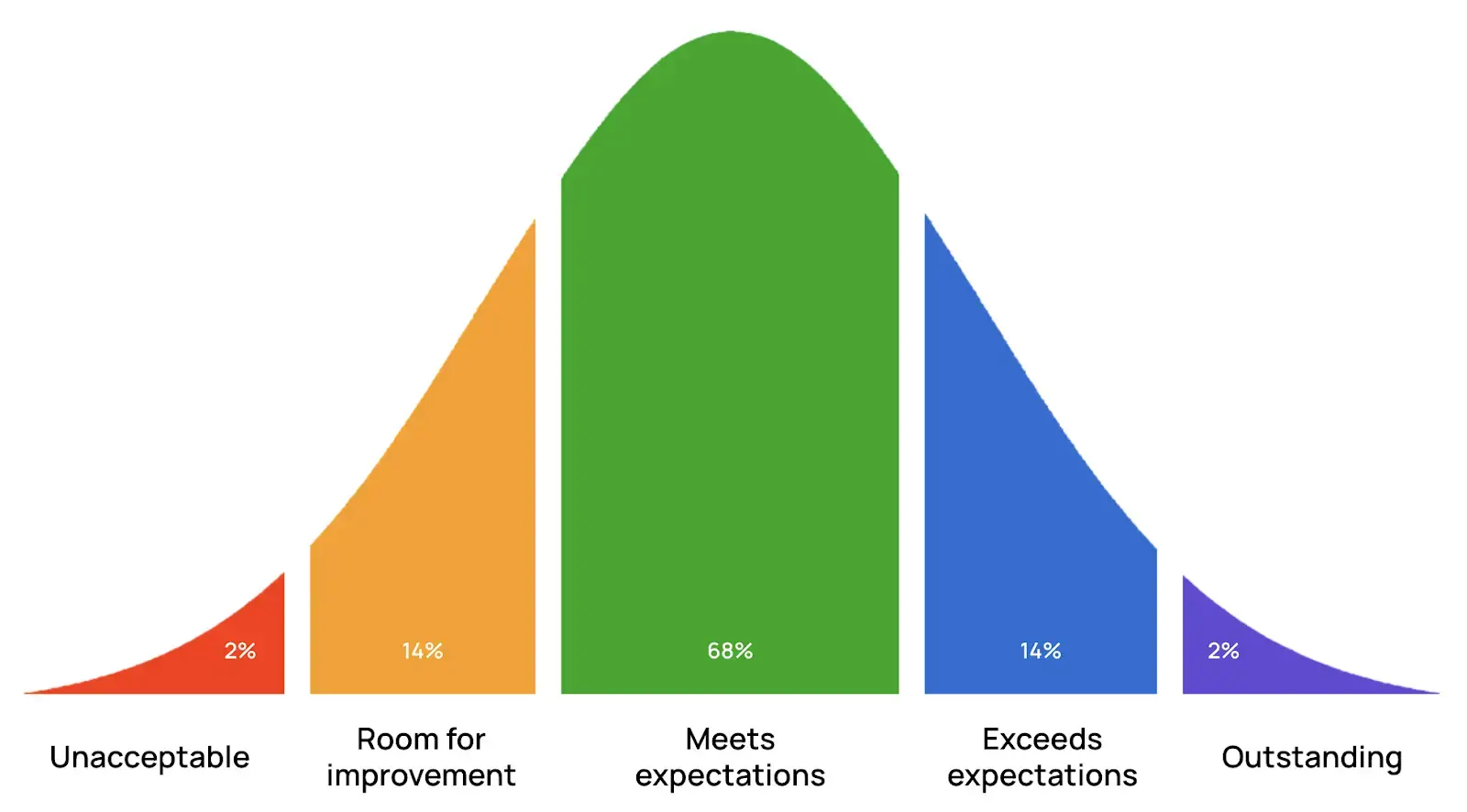
A Bell Curve graph typically looks like this:
The graph shows a small number of employees in the high and low-performance categories and a large number in the middle, forming the shape of a bell. This visual representation helps organizations understand how their workforce performance is distributed and make informed decisions about rewards, development, and support strategies.
The performance bell curve ensures a balanced and objective approach to employee evaluations, promoting fairness and encouraging continuous improvement across the organization.
The Bell Curve Formula and Tool
The bell curve performance appraisal uses a statistical formula to create a normal distribution of employee performance ratings. This formula calculates the mean (average) and standard deviation of the scores, plotting them to form a bell-shaped curve where most employees cluster around the average, with fewer at the high and low ends. Tools and software like SAP SuccessFactors, Oracle HCM, and Performance Pro can assist in implementing the bell curve by automating data collection, analysis, and visualization, making the appraisal process more efficient and accurate.
Bell Curve Formula
The formula for the bell curve is as per below:
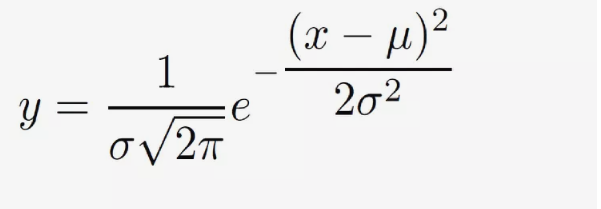
Where:
-
= Value for which you are calculating the probability
-
μ = Mean (average of the data)
-
σ = Standard deviation
-
π = Pi (~3.14159)
-
e = Euler’s number (~2.71828)
Advantages of Using Bell Curve in Performance Management
The bell curve performance appraisal method offers several benefits in performance management:
- Objective Evaluation: The bell curve provides a structured and objective approach to evaluating employee performance. By categorizing employees into predefined performance levels, it reduces biases and ensures fairness in assessments.
- Clear Differentiation: This method helps in clearly distinguishing between top performers, average performers, and low performers. This differentiation is crucial for making informed decisions about promotions, rewards, and development needs.
- Motivation and Competition: By recognizing top performers, the bell curve fosters a competitive environment that motivates employees to excel. Knowing that outstanding performance will be rewarded encourages employees to strive for higher achievement.
- Resource Allocation: The bell curve helps organizations allocate resources effectively. Top performers can be given challenging projects and leadership roles, while underperformers can be provided with targeted training and support to improve.
- Consistency in Appraisals: Using a standardized method like the bell curve ensures consistency across departments and teams. This uniformity helps maintain a cohesive performance management system within the organization.
For example, General Electric (GE) famously used the bell curve performance appraisal system to rank employees and drive performance improvements. By identifying the top 20% of performers, rewarding them, and addressing the bottom 10% through improvement plans or other measures, GE was able to maintain high standards of performance across the company.
These advantages make the bell curve performance appraisal a valuable tool for organizations seeking to enhance their performance management processes, ensuring that they recognize and nurture talent effectively.
Disadvantages of Bell Curve in Performance Appraisal
The bell curve method, especially in terms of performance appraisal is also popularly known as forced ranking, bell curve performance appraisal/ bell curve appraisal. This method is utilized to categorize employees into different aspects such as top, average, and low performers. However, the method also comes with possible disadvantages-
- Constant Struggle for Becoming High Performers
This is general case mostly in high performing teams where some employees, even if they are performing at a certain level are forced to be categorized as low performer in order to fit the curve. This can lead to resentment and disengagement among the competitive and capable employees.
- Limits Collaboration
When employees are always in a state of competition to be ranked as top performers, there are lesser chances of a teamwork spirit rather than a collaborative effort. The teamwork values and connectedness might suffer as individuals would focus on the self-first approach.
- Ignores Individual and Contextual Differences
It is widely said that bell curve appraisal model encourages a normal distribution, but this might not be true in all cases. It sometimes overlooks unique roles, complex challenges, or external factors that affect employee performance.
- Creates Anxiety and Fear
Employees involved in this method might feel pressurized or fearful for being labelled as poor performers or low performers. This creates stress amongst the employees, with reduced morale and even increase employee attrition rate at the same time.
- Hinder Talent Development
As managers might focus more on rankings, rather than giving an environment where employees can grow and learn. In this sort of setting, employees in average or low categories might not receive the right support which is required to let them grow and enhance their skills.
Understanding the Bell Curve in HR
The bell curve performance appraisal method holds significant meaning in HR as it provides a structured approach to evaluating employee performance. By plotting employee performance on a bell-shaped curve, HR professionals can identify top performers, average workers, and those needing improvement. This method ensures a balanced assessment, promoting fairness and transparency in appraisals. HR professionals can effectively use this method by aligning it with organizational goals, providing clear criteria for performance ratings, and using the insights gained to inform decisions on promotions, training, and development.
Bell Curve Performance Management System
A bell curve performance management system is a comprehensive framework used to assess and categorize employee performance based on a bell curve distribution. Its components include performance evaluations, ranking systems, feedback mechanisms, and development plans. This system integrates with overall performance management strategies by ensuring that performance assessments are consistent, objective, and aligned with organizational objectives. It helps in identifying high performers for rewards and growth opportunities, and low performers for targeted development and support, thereby driving overall organizational performance.
Also Read: Understanding the Basics of Performance Appraisals
Common Misconceptions and Criticisms
The bell curve performance appraisal method faces several misconceptions and criticisms. A common misconception is that it forces managers to rank a fixed percentage of employees as poor performers, regardless of actual performance. Critics argue that this method can create unhealthy competition, demotivate employees, and overlook team-based achievements. Additionally, it may not accurately reflect individual contributions in small teams or unique roles. Understanding these limitations is crucial for HR professionals to apply the bell curve method judiciously and ensure it complements other performance management tools and strategies.
Bell Curve and Normal Distribution
The bell curve performance appraisal is grounded in the statistical concept of normal distribution, where most data points cluster around the mean, forming a bell-shaped curve. This relationship is significant as it assumes that employee performance follows a similar pattern, with a majority performing at an average level, and fewer employees at the high and low extremes. The statistical significance lies in its ability to provide a visual representation of performance spread, aiding in objective decision-making. However, it's important to remember that not all workplace scenarios perfectly fit this distribution.
The bell curve performance appraisal method is a valuable tool in HR for objectively evaluating employee performance. By understanding its meaning, significance, and how to effectively implement it, HR professionals can ensure fair and balanced appraisals. While the bell curve system offers several advantages, such as clear differentiation and resource allocation, it also has its share of misconceptions and criticisms that need to be addressed. Understanding the statistical foundation of the bell curve helps in applying it effectively within performance management strategies, ultimately driving organizational success.
Request A Demo Now!
Frequently asked
FAQs
See it live
Ready to see HONO in action?
Book a 20-minute demo tailored to your team's HR stack.
Request a demo
About the author
Harshita Bhalla
Harshita Bhalla is an Assistant Manager - HR at HONO and a Certified HR Payroll Specialist with around 4 years of experience in HR operations, payroll, and employee lifecycle management. She has worked across domestic and international payroll functions and brings a detail-oriented, people-first approach to everything she does. Harshita is passionate about building efficient HR systems that support both people and business growth.