At a time when enterprises are under growing pressure to deliver faster growth, leaner operations, and measurable business outcomes, the role of HR is undergoing a fundamental shift. The conversation is no longer limited to engagement scores, hiring metrics, or operational efficiency. Increasingly, boards and business leaders are asking a sharper question: what real business value is HR creating?
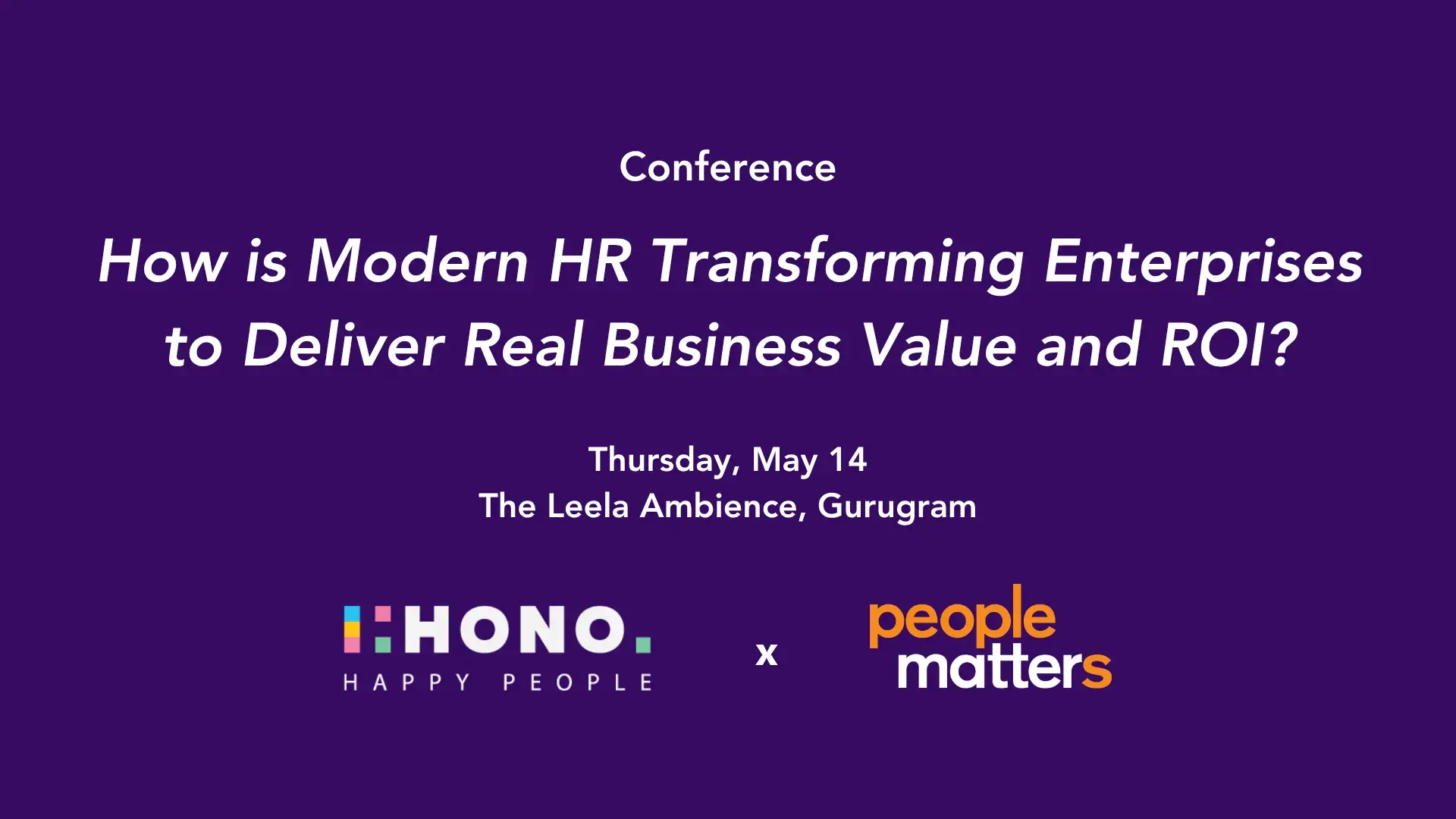
This formed the core theme of a closed-door leadership roundtable hosted by People Matters in partnership with HONO.ai, which brought together senior HR and business leaders from organisations across manufacturing, BFSI, healthcare, consumer, technology, and services sectors. The discussion was co-moderated by Amandeep, who heads the Presales and Operations at HONO.
The conversation moved well beyond conventional HR transformation conversations. Leaders debated how ROI is being redefined, whether AI adoption is truly creating enterprise value, how workforce strategy is becoming inseparable from business strategy, and what the future role of HR could look like in an increasingly AI-enabled enterprise.

ROI as a Business and HR Metric
One of the strongest themes emerging from the discussion was that HR can no longer operate as a support function disconnected from business priorities. Leaders repeatedly emphasised that every HR initiative today must be linked directly to measurable business outcomes.
Whether the focus is learning and development, attrition management, workforce planning, or employee engagement, organisations increasingly expect HR teams to demonstrate productivity impact, business contribution, and operational value. In manufacturing environments, leaders spoke about evaluating initiatives through strict ROI frameworks, particularly for large-scale digitisation and AI investments. In BFSI, attrition itself has become one of the most critical ROI metrics because of the direct impact employee movement has on business continuity and growth.
At the same time, the discussion highlighted that ROI itself has evolved. Organisations are no longer only measuring productivity per employee or cost optimisation. The metrics now include succession readiness, leadership pipeline strength, internal mobility, workforce agility, quality of hire, speed of execution, and the organisation’s ability to respond quickly to changing market conditions.
Many leaders argued that HR’s role is increasingly shifting towards becoming a “business value architect”, a function responsible not only for enabling people practices, but also for directly influencing business performance. That shift requires HR leaders to deeply understand business levers, operational realities, and customer outcomes rather than operate within isolated people processes.
The Real Challenge is Execution Speed
Another major insight from the roundtable was that the traditional “business versus HR” friction narrative may no longer fully apply. Several leaders argued that most organisations today already involve HR in strategic conversations. The bigger challenge lies in execution.
Organisations are moving faster than ever, but workforce capability, adoption readiness, and organisational behaviour often struggle to keep pace with leadership ambition. Leaders described situations where AI investments, transformation agendas, and digital initiatives were strategically sound, but operational adoption lagged significantly behind expectations.
This execution gap is particularly visible in capability building. Companies may invest heavily in advanced AI tools, automation systems, or workforce platforms, but unless employees understand how to use them meaningfully within their workflows, transformation remains superficial. Several leaders stressed that adoption, not technology availability, is becoming the real bottleneck.
The discussion also highlighted the growing importance of agility. Traditional annual planning cycles, static learning calendars, and one-size-fits-all employee interventions are rapidly becoming obsolete. Organisations now need continuous workforce adaptation, faster skill mapping, personalised interventions, and real-time visibility into performance and productivity.
The expectation from employees has also changed dramatically. Today’s workforce expects instant access to information, real-time feedback, seamless experiences, and mobile-first interactions. That shift is forcing organisations to rethink not only HR systems but the entire employee experience architecture.

AI is Moving from Experimentation to Operational Reality
The conversation naturally evolved into AI adoption, where leaders shared a mix of optimism, caution, and realism.
Across industries, organisations are already deploying AI in underwriting, customer service, workforce analytics, recruitment, employee support, policy management, coding, performance analysis, and knowledge enablement. Leaders shared examples of AI reducing complex sales proposal creation from days to hours, handling thousands of customer interactions automatically, enabling internal knowledge bots, and identifying workforce capability gaps in real time.
At the same time, participants acknowledged that many organisations are still in the early stages of meaningful AI maturity. Several leaders cautioned against labelling every automation or workflow system as “AI transformation”. The real challenge is not simply deploying tools, but embedding AI naturally into workflows in ways that genuinely improve decision-making, productivity, and employee experience.
A recurring concern was the gap between AI ambition and actual adoption. Many organisations initially assumed that rapid AI implementation would immediately deliver large-scale productivity gains and justify workforce restructuring. However, leaders acknowledged that transformation is moving more slowly than expected because behavioural adoption, organisational readiness, and process discipline take time.
The discussion also raised deeper questions around trust, data sensitivity, accuracy, and creativity. While AI can automate administrative work and surface intelligence faster than ever before, leaders questioned whether it can truly replace contextual judgment, creativity, emotional intelligence, or human decision-making.
One important insight stood out clearly: AI’s effectiveness still depends heavily on human capability and organisational maturity. Unless businesses have structured data flows, disciplined processes, and workforce readiness, even the best AI systems will produce incomplete or inaccurate outcomes.

The Future of HR May Become Smaller, but More Strategic
One of the most thought-provoking moments of the discussion emerged when leaders debated whether HR itself could fundamentally change as technology democratises access to workforce intelligence.
If managers and business leaders can directly access people analytics, productivity data, and workforce insights through AI systems, then what becomes the role of HR?
Rather than rejecting the idea, the discussion evolved into a more nuanced perspective. Leaders acknowledged that transactional HR work is already steadily disappearing through automation. Leave approvals, workflows, policy access, employee queries, and administrative processes are increasingly system-driven.
But that does not reduce the importance of HR. Instead, it changes where HR creates value.
The future HR function is likely to become leaner, more strategic, and more deeply embedded into business transformation. Its role will increasingly focus on workforce capability building, organisational adaptability, culture, leadership development, employee wellbeing, internal mobility, and preparing businesses for disruption.
As one participant noted, the future is not about replacing HR with AI. It is about eliminating low-value work so HR can focus on higher-value business impact.
The discussion ultimately reinforced one larger truth: enterprises are no longer evaluating HR based on activity. They are evaluating HR based on outcomes.
And in an environment defined by AI acceleration, workforce volatility, and constant business reinvention, the organisations that succeed may not necessarily be the ones with the most advanced technology, but the ones that can align people, capability, execution, and business value faster than everyone else.