
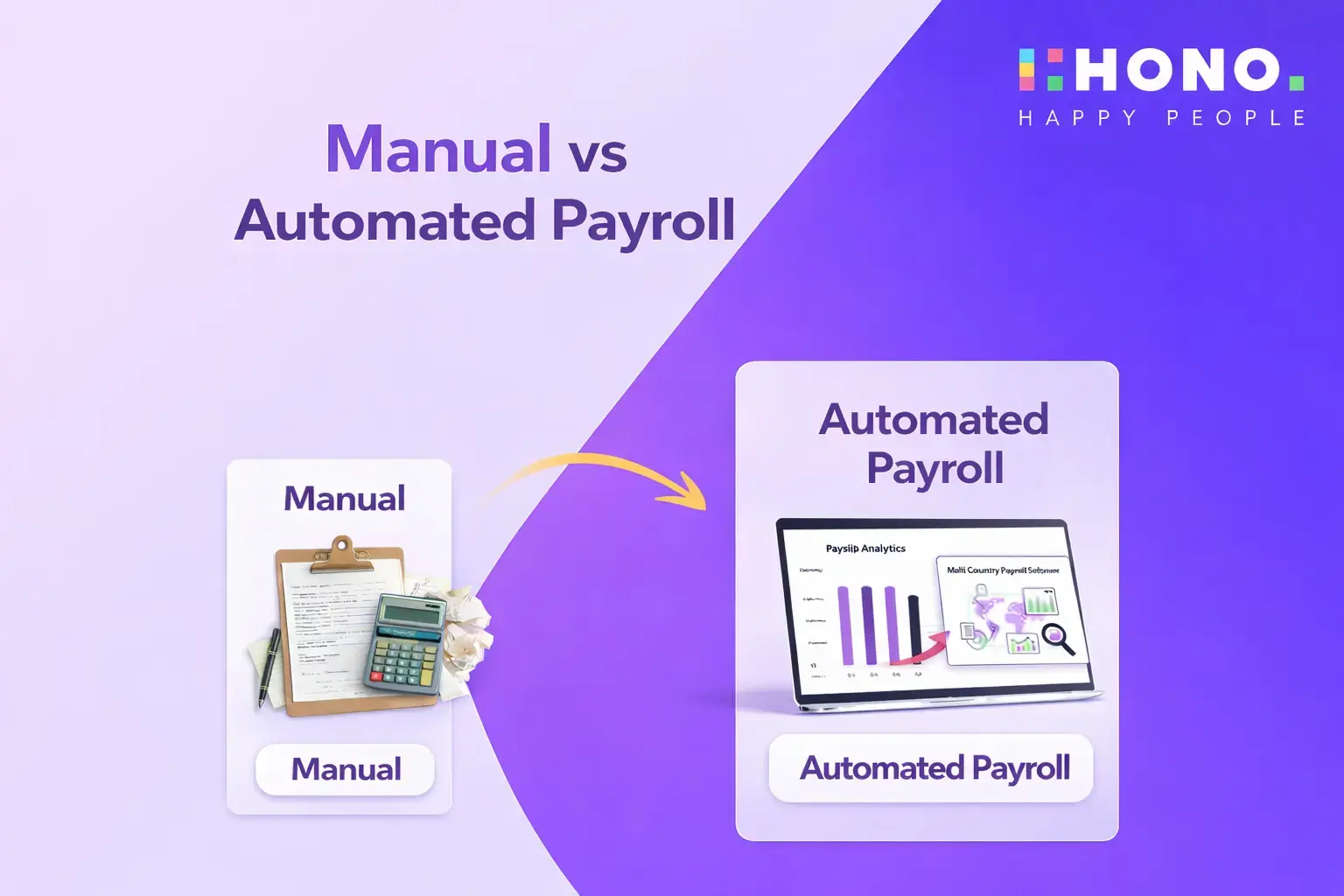
What is Manual Payroll Process?
The manual payroll process is the basic, traditional method of processing employee salaries which has been followed for ages. In this process, payroll activities are handled manually either by the finance team or the HR team. The process components include calculating wages, overtime management, calculating bonuses, deductions, due taxes, provident fund, and rest of the statutory components through traditional methods such as spreadsheets, paper-intensive methods, or basic accounting tools & techniques.
This process typically includes:
-
Salary and overtime calculation
-
Bonus and incentive management
-
Tax deductions
-
Provident Fund (PF), ESI, and other statutory components by traditional method
-
Payslip preparation and salary disbursement
Advantages of Manual Payroll
- Low budget option with no initial costing required as there’s no payroll software or subscriptions.
- Better control over calculations and payroll decisions even for smaller teams.
- Easy to manage in terms of smaller organizations, having limited employees.
- The internet connectivity dependency as there are no physical software systems; traditional methods are followed.
- Flexibility to make speedy and instant decisions or adjustments whenever required.
Disadvantages of Manual Payroll
- Greater risk of calculation errors due to manual data entry and traditional spreadsheets.
- Time consuming process requires multiple teams to work collectively, utilizing every team’s time.
- Difficult to scale as employee count and payroll complexity; both increase altogether.
- Elevated chances of compliance mistakes as tax regimes are constantly changing, and labor laws update with time.
- Limited reporting opportunities with other aspects such as audit trails, and data security in comparison to automated payroll software.
What is Automated Payroll Process
The automated payroll process utilizes payroll software for managing salary calculations, tax & other deductions, and payments with minimum or negligible manual efforts. Imperative employee data such as attendance, salary structure, leaves, and statutory details are easily stored in the system basis predefined rules.
The software automatically calculates:
-
Gross and net pay
-
PF, ESI, TDS, gratuity, and other deductions
-
Generate Payslips and Bank transfers.
This process includes generating pay slips automatically and processing the salary in employee’s bank thereafter. Moreover, automated payroll software manages the after process such as compliance reports, files the statutory returns, and ensures that accuracy, consistency and timely payroll execution is taken care of in every cycle.
Advantages of Automated Payroll
- Significantly reduces payroll errors with the help of automated and rule-based calculations.
- Saves time by eliminating any manual data entry and processing thereafter.
- Ensures that the statutory compliance with updated tax and labor laws.
- Conveniently scales as the workforce and payroll complexity increases and intensifies.
- Provides access to instant reports, pay slips, and all sorts of audit trails.
Disadvantages of Automated Payroll
- It involves initial setup costs and needs an ongoing software subscription fee to be implemented.
- Requires employee training for using the system effectively.
- Heavy dependency on technology and internet connectivity for multiple operations.
- Provides data migration from manual records; it can time consuming in the initial phase.
- Offers limited flexibility if the software does not support customized payroll rules & requirements.
When Should You Switch from Manual Payroll to Payroll Software?
It can often be confusing about which payroll software should be chosen; every organization might have different expectations and requirements.
Listed below are 5 major steps that explain well about the right time to switch from manual payroll to payroll software.
- Growing Employee Count
As the workforce tends to increase with time and changing requirements, managing salaries accurately with taking care of multiple aspects such as attendance, overtime, and deductions manually becomes highly complex, increasing the risk of any delays and errors thereafter.
- Frequent Payroll Errors
When there are repeated calculation errors, incorrect deductions, or delayed salary crediting, it indicates that the manual process is no longer accurate, and it is better to opt for automated payroll software.
- Compliance Challenges
While organizations are willing to track changing tax laws, PF, ESI, gratuity, and labor regulations, doing it accurately becomes highly tough. Here, automated software ensures timely and accurate compliance.
- Elevating HR Workload
HR teams spend most of their time processing payroll instead of keeping their focus on the most required task of talent management and employee engagement. Here, automation becomes critical.
- Better Reporting & Security
When the business requires accurate payroll reports, audit trails, and secure data storage, the payroll software provides structures cand complaint systems that stay accurate and well managed.
Why is an Automated Process Better Than Manual?
| Factor | Manual Payroll | Automated Payroll |
| Time efficiency | Slow and repetitive | Fast & streamlined |
| Accuracy | High risk of human error | Very high Accuracy |
| Compliance | Manual Tracking required | Auto-updated compliance |
| Scalability | Difficult to manage growth | Easily scalable |
| Data security | Limited protection | Encrypted and secure |
| Reporting | Basic and manual | Detailed and Real Time Update |
Consider having an automated payroll process instead of manual ones because it significantly reduces errors, saves huge time, and ensures compliance with the help of rule-based calculations and even real-time updates about the tax and labor laws to be adhered in the process. Unlike any manual payroll process which is followed and relied completely on traditional methods such as spreadsheets or human intervention, automation transforms and speeds the process streamlining salary processing, deductions, pay slip generation, and statutory reporting in a constant and secure manner.
Consider the automated payroll process if your goal is to improve accuracy and efficiency, allowing HR and finance teams to keep their focus on strategic initiatives.
Read Here: Payroll Processing: A Complete Guide with Steps, Types, and Challenges
Final Thoughts
Automated payroll is no longer a regular convenience but a necessity for organizations looking to scale with time and stay compliant altogether. Although, manual payroll process might suit smaller organizations having limited employees, it can become insufficient and even risky for a larger workforce as regulatory complexity increases. Consider utilizing automated software if you’re looking for accuracy, time-efficiency, reduced compliance errors, and a seamless payroll system.
To simplify the process or make a transition from manual payroll process to automated payroll process, get started with HONO, a smart, reliable HCM suite offering HR and payroll solutions curated for automating multiple HR modules such as payroll processing, ensuring compliance, and supporting business growth all at the same time.
Curious to know more about HONO?
<<Schedule a Demo>>
Frequently asked
FAQs
See it live
Ready to see HONO in action?
Book a 20-minute demo tailored to your team's HR stack.
Request a demoAbout the author
Akanksha Shekhar
With over 9 years immersed in the world of content marketing for SaaS, Cloud, HRMS and multiple other industries, Akanksha Shekhar currently leads the content initiatives as Manager of Content Marketing. Her expertise lies in the art of bringing words to life, creating engaging narratives and technically sound pieces that are both catchy and deeply informative.