
On June 1, 2026, the rules of UAE payroll changed overnight. MoHRE scrapped the 15-day grace period that companies had built their entire payroll calendars around. Under Ministerial Resolution No. 340 of 2026, salaries now have to clear through the Wage Protection System by the first of the month, full stop. Miss it, and the clock starts on Day 2: a MoHRE notification, then a permit freeze by Day 5, fines and a downgrade to Third Category by Day 11, a labour dispute filed by Day 16, and asset attachment with a Public Prosecution referral by Day 21.
That is the backdrop against which every payroll decision in this country is now made. Payroll in the UAE has never just been about getting people paid. It is fused, legally, to whether you can renew a trade licence, sponsor a visa, or keep operating at all. A spreadsheet, or a payroll tool built for a different market and bolted onto the UAE as an afterthought, does not just create inefficiency here. It creates exposure: a blocked work permit, a fine that lands per affected worker, a gratuity calculation that gets challenged in a labour dispute because nobody excluded the unpaid leave days correctly.
This list looks at ten platforms that handle UAE payroll as a first-class problem rather than a regional add-on, and what actually separates them.
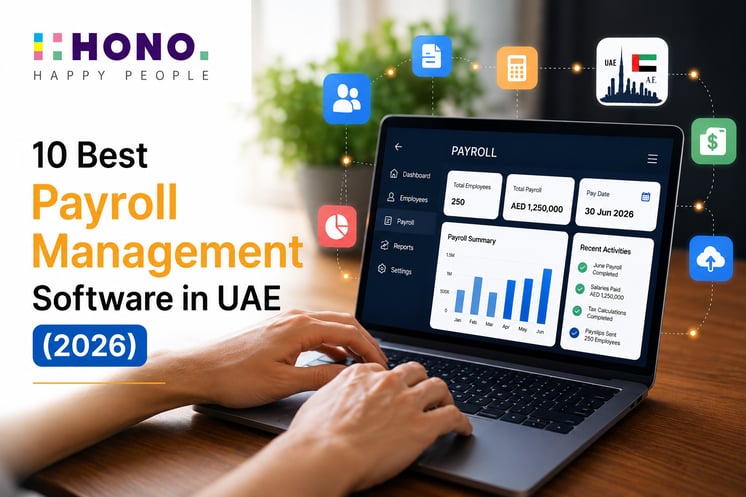
10 Best Payroll Management Software in UAE (2026)
Key Takeaways
- Native WPS and SIF file generation should be a non-negotiable requirement when evaluating UAE payroll software. Manual file preparation introduces unnecessary compliance and operational risks.
- Gratuity automation and free-zone savings scheme support are critical differentiators, often separating truly UAE-focused payroll platforms from global solutions with limited localization.
- There is no one-size-fits-all payroll solution. The right platform depends on factors such as company size, number of legal entities, geographic footprint, and free-zone operations.
- Organizations employing UAE nationals should carefully evaluate GPSSA support, including contribution calculations, reporting, and compliance workflows.
- Companies operating in free zones should verify DEWS and other employee savings scheme capabilities before making a purchase decision.
- Regulatory compliance should be validated directly with vendors, particularly regarding updates related to Ministerial Resolution No. 340 of 2026 and the latest WPS requirements.
- Look beyond payroll processing alone. Features such as payroll automation, anomaly detection, reporting, compliance monitoring, and multi-country payroll capabilities can significantly reduce administrative effort and improve payroll accuracy.
- The best payroll software is the one that aligns with your compliance obligations, workforce structure, and future growth plans, not necessarily the platform with the longest feature list.
What is payroll management software in the UAE?
It is software that calculates and disburses employee wages while handling the specific legal infrastructure the UAE requires around that process: generating the Salary Information File banks need for WPS submission, calculating end-of-service gratuity under Federal Decree-Law No. 33 of 2021, routing Emirati pension contributions to GPSSA or the Abu Dhabi Pension Fund, and applying different rules depending on whether an employee sits on the mainland or inside a free zone like DIFC or ADGM.
Why generic, global payroll tools fail here?
Most international payroll platforms were built around a single core idea: calculate gross-to-net, run deductions, issue a payslip. That works in most countries. It does not work cleanly in the UAE, because the compliance layer here is not optional paperwork sitting beside payroll, it is structurally part of the payroll run itself.
A platform that does not generate a SIF file natively means someone on your team is manually reformatting payroll data into the structure each bank's WPS portal expects, every single cycle, with zero margin for the kind of formatting error that gets a file rejected.
A platform with no gratuity engine that understands the 21-day and 30-day split means someone is doing that math by hand, and getting it wrong is exactly the sort of mistake that surfaces in a labour dispute.
And a platform with no concept of DIFC's DEWS scheme will simply apply mainland gratuity rules to a free-zone employee who is supposed to be on a defined-contribution savings plan instead.
What to look for in UAE compliant payroll software?
WPS and SIF file generation
This is the non-negotiable filter. The Wage Protection System covers the vast majority of UAE private-sector employees, and since June 1, 2026, the deadline for paying them is the first day of the month, with no buffer.
Practically, that means your SIF file needs to be submitted to the bank several working days before the 1st, since most banks need a day or two to process and confirm the transfer.
An establishment is considered compliant only if at least 85% of total wages clear on time; fall under that threshold and MoHRE's escalation sequence begins automatically.
Ask any vendor whether SIF generation is native, meaning the software talks to the bank format directly, or whether it produces an export that a human still has to massage into shape. That distinction is where most compliance failures actually originate.
End-of-service gratuity (EOSB) automation
Gratuity in the UAE follows a specific formula under Federal Decree-Law No. 33 of 2021: 21 days of basic salary for each of the first five years of service, then 30 days of basic salary for every year after that, calculated strictly on basic wage and excluding housing, transport, and other allowances.
Unpaid leave days do not count toward service length, and the total payout is capped at two years' total wage no matter how long someone has worked.
None of this is exotic, but it is exactly detailed enough that manual calculation invites mistakes, and the law applies the same gratuity entitlement whether someone resigns or is terminated, which is a change many older calculation habits haven't caught up with.
Good UAE payroll software runs this calculation automatically off the payroll data it already has, including the pro-rata math for partial final years.
Free zone vs. mainland logic
This is the gap most non-UAE platforms simply don't map. Mainland employees fall under standard MoHRE gratuity rules.
DIFC operates its own savings-based scheme, DEWS, instead of a traditional lump-sum gratuity.
ADGM has offered employees a choice between the two since 2025.
JAFZA and DMCC largely follow MoHRE's WPS framework but sit within their own regulatory authorities for other matters.
A platform that treats every UAE employee as subject to the same rule set will eventually misclassify someone, and the fix after the fact is far more painful than getting the setup right from day one.
GPSSA and pension handling for Emirati employees
If you employ UAE nationals, you're required to register them with the General Pension and Social Security Authority (for Dubai and the northern emirates) or the Abu Dhabi Pension Fund.
Since the 2023 pensions law took effect, the contribution structure has been 26% of the contribution salary in total: 11% from the employee and 15% from the employer, with the government covering 2.5% of the employer's share for Emiratis earning under AED 20,000 a month.
Getting this wrong isn't a minor payroll error, it's a separate compliance failure layered on top of whatever else is happening with WPS.
Payroll software aimed at the UAE market should handle this contribution split automatically rather than treating it as a side calculation finance does in a spreadsheet.
Overtime, allowances, and multi-currency
UAE labour law sets overtime at 25% above the basic hourly rate for daytime overtime and 50% for work performed between 10pm and 4am.
If your workforce includes shift workers, multi-currency contracts, or a mix of allowances on top of basic salary, the software needs to apply these rules correctly without manual intervention every cycle, since this is also where basic-versus-gross confusion tends to bleed into gratuity miscalculations later.
Corporate tax and e-invoicing readiness
The UAE's e-invoicing mandate is arriving in stages: a voluntary pilot from July 2026, mandatory compliance from January 2027 for businesses earning AED 50 million or more in revenue, and a wider rollout to remaining VAT-registered businesses from July 2027.
Payroll itself isn't an invoicing process, but the businesses now under pressure to clean up their financial data pipelines for e-invoicing are the same businesses that benefit from payroll software whose outputs flow cleanly into finance and accounting systems rather than sitting in a separate silo that needs manual reconciliation.
Security and audit trail
Look for role-based access control, a clear audit trail for every payroll change, and alignment with the UAE's PDPL data protection rules given how much sensitive salary and identity data payroll systems hold.
Ask vendors directly how long they retain payroll records and whether that matches your own retention obligations under UAE labour law, since this varies by document type and is worth confirming rather than assuming.
Quick overview: best payroll software in UAE (2026)
| # | Software | Best for | WPS/SIF compliant* | Starting price |
|---|---|---|---|---|
| 1 | HONO | AI-native, ZERO touch payroll, overall HR functions | Yes | Contact sales |
| 2 | Bayzat | SMBs wanting payroll bundled with insurance | Yes | Contact sales |
| 3 | Zoho Payroll | Cheapest native entry point | Yes | Free for small teams |
| 4 | greytHR | WPS-ready SMB payroll | Yes | Contact sales |
| 5 | ZenHR | MENA-localised payroll + attendance | Yes | Contact sales |
| 6 | Darwinbox | Enterprise, multi-country GCC payroll | Yes | Contact sales |
| 7 | Paylite HRMS | GCC in-country built payroll | Yes | Contact sales |
| 8 | HR Chronicle | UAE-first, broad bank SIF coverage | Yes | Contact sales |
| 9 | ZingHR | Enterprise multi-entity | Yes | Contact sales |
| 10 | EasyHR | Lightweight UAE payroll for small teams | Yes | Contact sales |
10 Best Payroll Management Software in UAE
1. HONO
HONO is an AI-native HRMS and payroll platform designed to manage the entire employee lifecycle from hire to retire. Built for global and multi-country organizations, it combines payroll, workforce management, talent management, and analytics within a single platform.
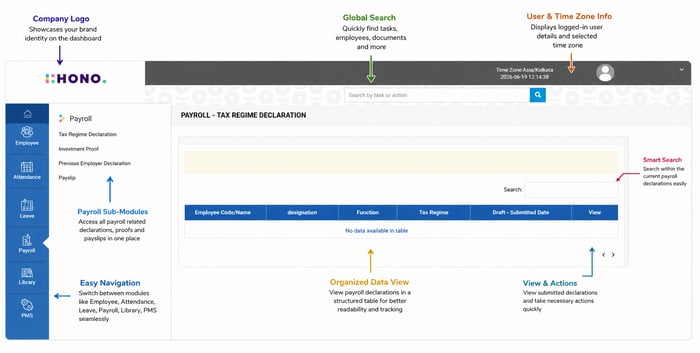
Its differentiator is ERA by HONO, a conversational, Zero-UI experience that enables users to complete HR and payroll tasks through natural language interactions rather than traditional interfaces.
Transform Your Payroll Process Today
See how payroll automation can save time, reduce errors, and ensure compliance across your organization.
Book a DemoThe platform supports UAE payroll requirements, including WPS processing, gratuity calculations, and compliance workflows.
Key Features
- UAE-compliant payroll processing with automated WPS and SIF generation, helping organizations manage salary disbursements while adhering to local payroll regulations.
- AI-powered Zero-Touch Payroll, designed to automate payroll validation, exception management, and routine payroll administration, reducing manual effort and processing time.
- Formula Builder for complex payroll configurations, allowing payroll teams to create, customize, and manage earning, deduction, taxation, and allowance rules without relying heavily on technical support.
- Report Wizard and Payroll Intelligence Dashboard, enabling HR and finance teams to generate payroll reports, analyze payroll costs, and access workforce insights without manual data compilation.
- Anomaly Engine and Troubleshooting Dashboard, which proactively identify payroll discrepancies, attendance mismatches, unusual payouts, and calculation errors before payroll is finalized, helping improve payroll accuracy and compliance.
Pros
- Goes beyond payroll processing to support end-to-end workforce operations, making it suitable for organizations looking to consolidate multiple HR systems.
- Strong automation capabilities that help reduce payroll processing time and minimize dependency on manual checks and reconciliations.
- Designed for organizations operating across multiple geographies and compliance frameworks.
- Advanced workforce analytics provide visibility into payroll costs, headcount trends, and workforce productivity metrics.
- Innovative conversational interface reduces reliance on traditional HRMS navigation and improves accessibility for HR teams and employees alike.
Cons
- The breadth of functionality may be more than what a small business seeking a basic payroll solution requires.
- Organizations may need structured onboarding and implementation support to fully leverage advanced automation and AI capabilities.
2. Bayzat
Bayzat is a UAE-based HR and payroll platform built primarily for small and medium-sized businesses. The platform combines payroll, HR administration, attendance tracking, and employee benefits management into a unified solution.
Its strongest differentiator is the seamless integration between payroll and health insurance administration, helping businesses manage employee benefits alongside compensation.
Key Features
- UAE-compliant payroll processing
- WPS file generation and salary transfers
- Payroll integration with employee insurance benefits
- Automated payroll calculations and deductions
- Payroll reporting and payslip generation
Pros
- Designed specifically for UAE businesses
- Strong benefits and insurance integration
- User-friendly interface
- Good fit for SMBs
- Local customer support
Cons
- Limited scalability for large enterprises
- Fewer advanced analytics capabilities
- Less suitable for multi-country payroll operations
3. Zoho Payroll
Zoho Payroll is a cloud-based payroll solution designed for small and growing businesses. As part of the broader Zoho ecosystem, it integrates easily with other Zoho business applications while offering UAE payroll functionality, including WPS compliance and SIF generation.
Its affordability makes it particularly attractive for organizations transitioning from manual payroll processes.
Key Features
- Native UAE SIF file generation
- Automated salary calculations
- Payroll tax and deduction management
- Employee self-service payslip access
- Payroll integration with Zoho applications
Pros
- Affordable pricing
- Easy implementation
- Seamless integration with Zoho applications
- Suitable for small businesses
- Simple and intuitive interface
Cons
- Limited enterprise-grade capabilities
- Basic reporting compared to larger HRMS platforms
- Less suitable for complex payroll structures
4. greytHR
greytHR is a payroll and HR software platform widely used by SMBs and mid-sized businesses. The solution focuses on simplifying payroll, attendance, leave management, and employee recordkeeping while maintaining compliance requirements.
It offers UAE payroll functionality and is often chosen by organizations looking for a straightforward payroll system without extensive HR complexity.
Key Features
- WPS-ready payroll processing
- Automated salary and deduction calculations
- Leave and attendance-linked payroll
- Payroll compliance management
- Payslip generation and payroll reporting
Pros
- Easy to use
- Cost-effective for SMBs
- Reliable payroll processing
- Quick deployment
- Good customer support
Cons
- Limited advanced HR functionality
- Fewer customization options
- Reporting capabilities can be basic for larger organizations
5. ZenHR
ZenHR is an HR and payroll platform built specifically for organizations operating across the UAE and wider MENA region. The platform places a strong emphasis on workforce management, attendance tracking, and payroll integration, making it particularly useful for businesses with shift-based workforces and complex overtime requirements.
Key Features
- UAE and MENA payroll processing
- Attendance-linked payroll calculations
- Overtime and shift differential calculations
- Automated payroll workflows
- Payroll compliance management
Pros
- Strong regional localization
- Excellent attendance-payroll integration
- Suitable for shift-based industries
- Modern interface
- Good mobile experience
Cons
- Limited global payroll capabilities
- Smaller ecosystem compared to larger vendors
- Enterprise analytics may be less advanced
6. Darwinbox
Darwinbox is an enterprise HRMS platform that serves large organizations across Asia, the Middle East, and other global markets. The platform combines payroll, workforce management, talent management, and employee experience tools in a unified ecosystem.
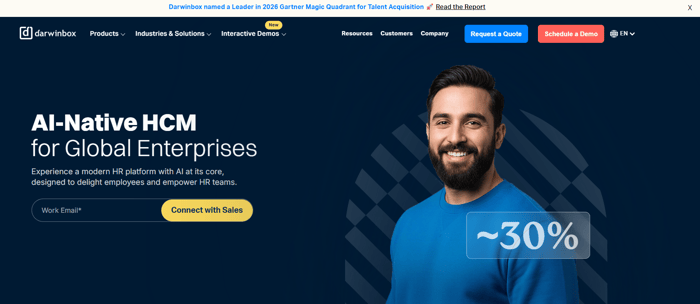
It is particularly suited for organizations managing payroll across multiple GCC countries and entities.
Key Features
- Multi-country GCC payroll processing
- Centralized payroll management across entities
- Automated payroll compliance workflows
- Gratuity and end-of-service calculations
- Payroll analytics and reporting dashboards
Pros
- Highly scalable for enterprises
- Strong regional payroll capabilities
- Comprehensive HR functionality
- Modern user experience
- Extensive automation features
Cons
- May be complex for small businesses
- Higher implementation effort
- Premium pricing compared to SMB-focused solutions
7. Paylite HRMS
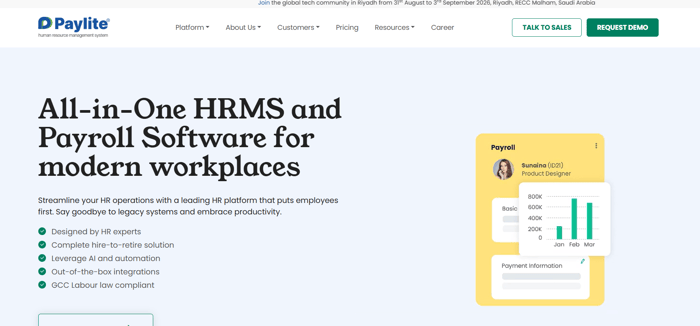
Paylite HRMS is a GCC-focused payroll and HR solution developed specifically for organizations operating in the region. The platform emphasizes local payroll compliance, workforce management, and HR administration while addressing the practical payroll requirements of businesses operating across GCC countries.
Key Features
- GCC payroll processing
- WPS-compliant salary processing
- End-of-service benefit calculations
- Payroll reporting and reconciliation
- Attendance-linked payroll calculations
Pros
- Built specifically for GCC businesses
- Strong regional payroll expertise
- Good compliance support
- Practical payroll-focused design
- Suitable for mid-sized organizations
Cons
- Less global functionality than international vendors
- Limited advanced AI capabilities
- User interface may feel less modern than newer platforms
8. HR Chronicle
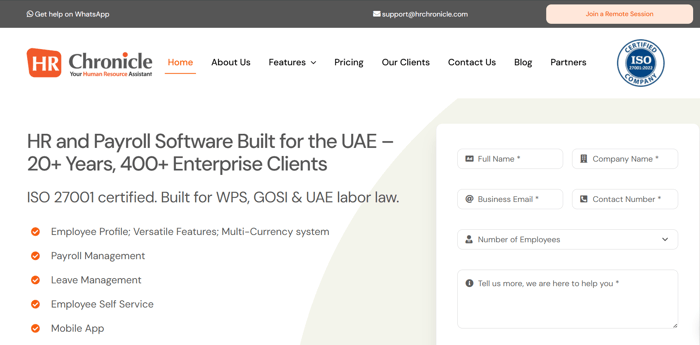
HR Chronicle is a UAE-focused HRMS and payroll platform designed to support payroll processing, employee management, and compliance requirements. The platform is particularly notable for its broad banking support for SIF file generation and its focus on helping businesses streamline payroll operations while remaining compliant with UAE regulations.
Key Features
- UAE payroll processing
- SIF generation compatible with multiple UAE banks
- Payroll calculations and deductions management
- WPS-compliant payroll workflows
- Payroll reporting and employee payslips
Pros
- Strong UAE payroll focus
- Extensive bank compatibility
- Easy payroll setup
- Suitable for small and medium businesses
- Trial option available
Cons
- Limited enterprise functionality
- Less comprehensive HR suite
- Fewer advanced analytics capabilities
9. ZingHR
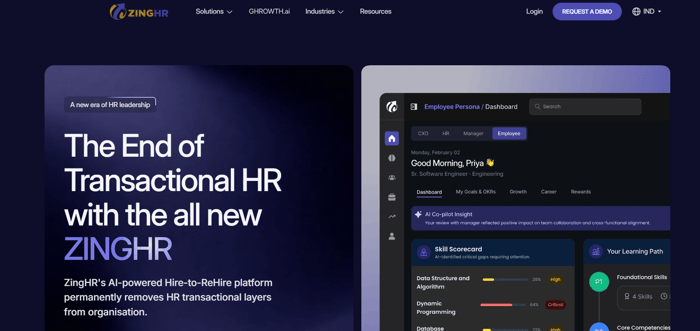
ZingHR is a cloud-based HR and payroll platform designed for mid-sized and enterprise organizations. The platform focuses heavily on automation and digital HR processes, including its "Zero Touch Payroll" approach aimed at reducing manual intervention across payroll cycles.
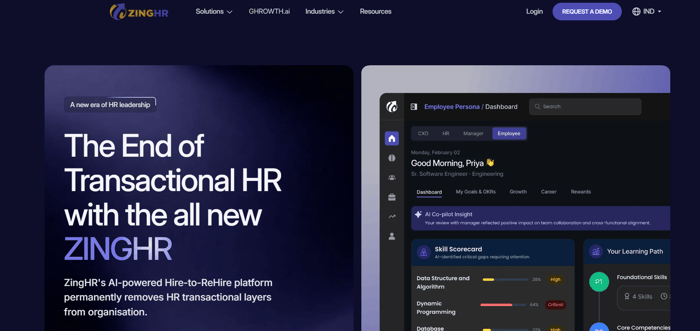
It supports organizations operating across multiple GCC markets and business entities.
Key Features
- Zero Touch Payroll automation
- Multi-country payroll processing
- Automated payroll validation workflows
- Payroll compliance monitoring
- Payroll reporting and analytics
Pros
- Strong payroll automation capabilities
- Suitable for complex organizations
- Broad HRMS functionality
- Multi-entity support
- Good workflow automation
Cons
- Can be complex for smaller businesses
- Implementation may require additional configuration
- User interface can have a learning curve
10. EasyHR
EasyHR is a lightweight HR and payroll software solution designed for small businesses operating in the UAE. The platform focuses on delivering core payroll processing, employee management, attendance tracking, and WPS compliance without the complexity often associated with enterprise HR systems.
Key Features
- UAE payroll processing
- WPS compliance support
- Salary and deduction calculations
- Payroll reporting and payslip generation
- Employee payroll self-service access
Pros
- Simple and easy to use
- Affordable for small businesses
- Quick implementation
- Covers core payroll requirements
- Minimal training required
Cons
- Limited scalability for larger organizations
- Basic reporting and analytics
- Fewer advanced HR management features compared to enterprise platforms
How to choose the right payroll software for your UAE business?
The deciding factor isn't brand recognition, it's your entity structure and headcount. A ten-person mainland startup and a forty-branch multi-entity group have almost nothing in common in terms of what their payroll software actually needs to do.
SME or startup with one mainland entity
Prioritise affordability and native WPS generation over depth of features. Zoho Payroll, greytHR, and Bayzat all fit this band well.
Mid-market or multi-branch operations
The priority shifts toward deeper gratuity automation and tighter leave-and-attendance integration, since payroll errors compound faster once you're running multiple branches or shift patterns.
ZenHR and Paylite are worth a closer look here.
Enterprise or multi-entity GCC operations
You need configurable, multi-country payroll logic and real analytics, not just a compliant payslip generator.
Darwinbox and ZingHR are built for that scale, and HONO is worth evaluating if an AI-native, conversational layer on top of payroll and HR is something your team would actually use day to day.
.png?width=70&height=70&name=Team%20HONO%20logo-01%20(1).png)