
1. What Counts as Overtime in the UAE?
Standard Working Hours
Article 17 of Federal Decree-Law No. 33 of 2021 sets the standard for private-sector employees at 8 hours per day or 48 hours per week. For specific sectors such as trade, hotels, cafeterias, and security, daily hours may extend to 9 hours while remaining compliant.
During Ramadan, working hours are reduced by 2 hours per day for all employees, regardless of religion, meaning the standard drops to 6 hours per day.
When Does Overtime Begin?
Any work performed beyond the standard daily or weekly hours is classified as overtime and must be compensated at the enhanced statutory rates. Employers may request overtime from employees, but it requires the employee's agreement, it is not unilaterally imposable except in emergency situations.
The 2-Hour Daily Cap
Article 19 of Decree-Law No. 33 of 2021 limits overtime to a maximum of 2 hours per day. Beyond this, overtime may only be worked to prevent serious accidents or eliminate their consequences. Across any rolling three-week period, total working hours (including overtime) must not exceed 144 hours.
2. UAE Overtime Rates
The rates below are mandated minimums under Federal Decree-Law No. 33 of 2021 and Cabinet Resolution No. 1 of 2022. Employers may pay more, but never less.
| Scenario | When It Applies | Rate | Multiplier |
|---|---|---|---|
| Regular overtime | Extra hours on a standard weekday | Basic + 25% | 1.25 |
| Night overtime | Work performed between 10 PM and 4 AM | Basic + 50% | 1.50 |
| Weekly rest day | Employee works on their designated day off | Compensatory day off or basic + 50% | 1.50 |
| Public holiday | Work on an official UAE public holiday | Compensatory day off + bonus or basic + 50% | 1.50 |
Important: Only the basic salary component is used in these calculations. Housing allowances, transport allowances, and all other benefits are excluded. For example, if an employee earns AED 6,000 total (AED 4,000 basic + AED 2,000 allowances), overtime is calculated on AED 4,000 only.
3. The UAE Overtime Calculation Formula (Step by Step)

The formula is consistent across all overtime types, only the multiplier changes.
Step 1: Calculate the Daily Wage
Daily Wage = Basic Monthly Salary ÷ 30
UAE law treats every calendar month as 30 days for payroll purposes, regardless of actual days in the month.
Step 2: Calculate the Hourly Rate
Hourly Rate = Daily Wage ÷ 8
This divides the daily wage across the standard 8-hour working day.
Step 3: Calculate Overtime Pay
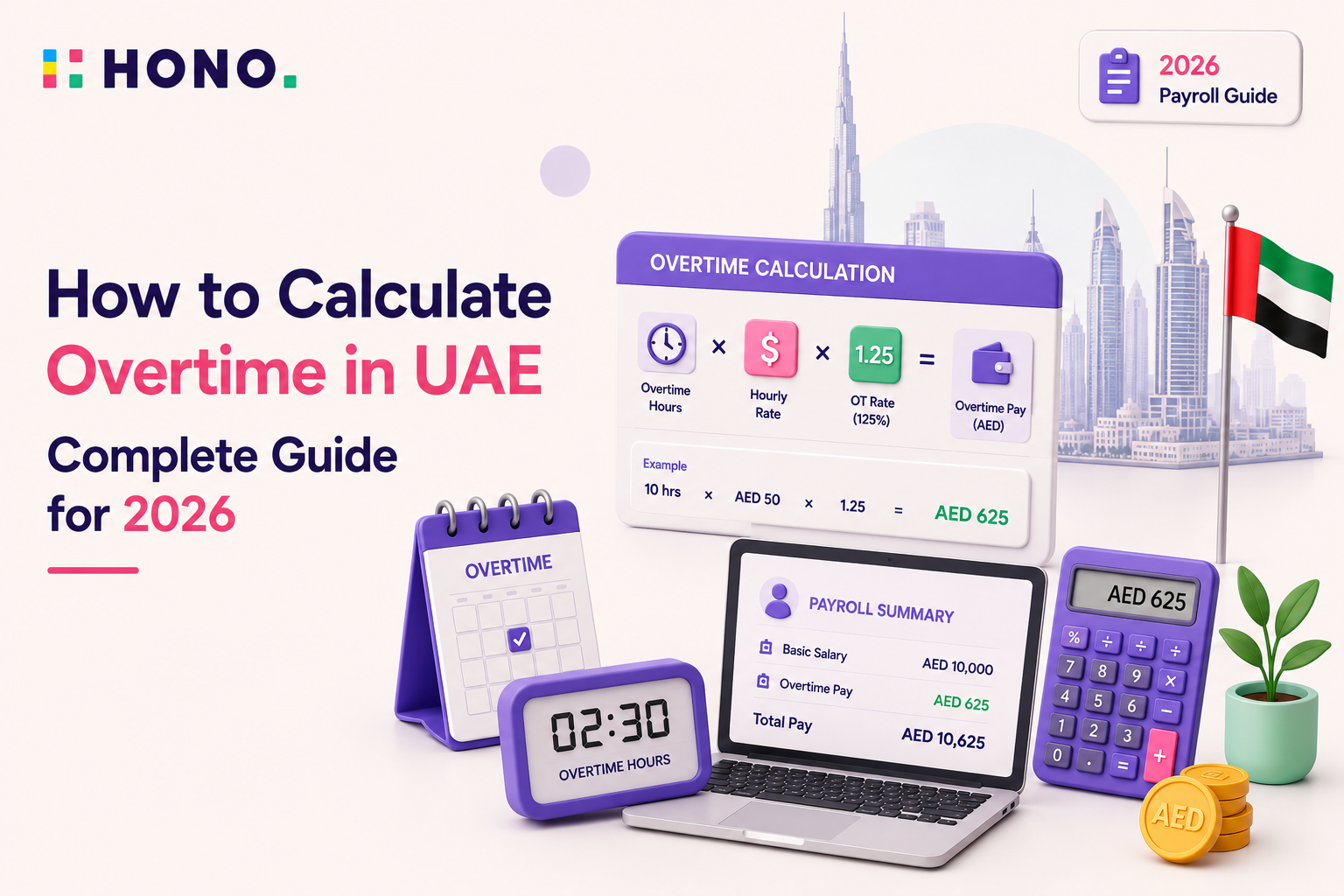
Overtime Pay = Hourly Rate × Multiplier × Number of Overtime Hours
Apply multiplier 1.25 for regular overtime and 1.50 for night, rest-day, or public holiday overtime.
4. Examples of UAE Overtime Calculation
The following examples use a basic salary of AED 5,000/month unless otherwise noted, and apply the formula verified against Article 19 of Decree-Law No. 33 of 2021.
Example A: Regular Weekday Overtime
Scenario: Ahmed has a basic salary of AED 5,000. He works 2 extra hours on a Tuesday afternoon.
- Daily wage = AED 5,000 ÷ 30 = AED 166.67
- Hourly rate = AED 166.67 ÷ 8 = AED 20.83
- Overtime pay = AED 20.83 × 1.25 × 2 = AED 52.08
Ahmed earns AED 26.04 per overtime hour during regular weekday hours.
Example B: Night Overtime (10 PM–4 AM)
Scenario: Priya has a basic salary of AED 7,500. She works 2 extra hours between 11 PM and 1 AM.
- Daily wage = AED 7,500 ÷ 30 = AED 250.00
- Hourly rate = AED 250.00 ÷ 8 = AED 31.25
- Overtime pay = AED 31.25 × 1.50 × 2 = AED 93.75
Night overtime earns Priya AED 46.88 per hour, 50% more than her standard rate.
Example C: Weekly Rest-Day Work
Scenario: Carlos (basic AED 5,000) is asked to work on Friday, his weekly rest day. The employer opts to pay the 150% rate instead of granting a substitute day off.
- Daily wage = AED 5,000 ÷ 30 = AED 166.67
- Full-day rest-day pay = AED 166.67 × 2.50 = AED 416.68.00
Alternatively, under Article 19 of Decree-Law No. 33 of 2021, the employer may grant Carlos a substitute rest day in lieu of the 150% payment. The employee cannot be forced to accept cash instead of a day off if they prefer the compensatory leave.
Example D: Public Holiday Work
Scenario: Sara (basic AED 9,000) works 8 hours on UAE National Day (2 December), an official public holiday.
- Daily wage = AED 9,000 ÷ 30 = AED 300.00
- Public holiday pay = AED 300.00 × 1.50 = AED 450.00
Sara is entitled to either this AED 450 payment or a compensatory day off plus a premium, as stipulated by her employer's policy within the bounds of Article 28.
5. Common Overtime Mistakes to Avoid
Getting overtime wrong exposes employers to MOHRE disputes, WPS flags, and financial penalties. These are the most frequent errors:
1. Using Total Salary Instead of Basic Salary
This is the single most common error. Including housing, transport, or other allowances inflates the overtime figure and creates non-compliant payroll records. Only the basic component of the salary is used.
2. Paying at 100% Instead of the Statutory Premium
Some payroll setups simply pay the normal hourly rate for overtime. The law requires a minimum 25% supplement on top of regular pay for weekday overtime, not a flat normal-rate payment.
3. Missing the Night / Rest-Day Uplift
Failing to apply the 1.50 multiplier for work between 10 PM and 4 AM, on rest days, or on public holidays is a common omission, particularly for shift-based roles. The 1.25 rate does not apply to these scenarios.
4. Not Recording Overtime in WPS
All overtime payments must be reflected accurately in the Salary Information File (SIF) submitted through the Wage Protection System. Submitting incorrect wage data can trigger fines of AED 1,000 per employee and, for larger companies, public prosecution referrals.
6. Who Is Eligible and Who Is Exempt?
The vast majority of private-sector employees working under Federal Decree-Law No. 33 of 2021 are entitled to overtime pay. This includes both UAE nationals and expatriates on standard employment contracts.
1. Managerial and Supervisory Exemptions
Employees in roles classified by MOHRE as having genuine managerial authority may be exempt from overtime entitlements. The practical test is whether the employee has meaningful power to hire, terminate, or make significant business decisions. Leading a small team while performing regular operational work does not, by itself, disqualify someone from overtime.
Supervisors and team leaders typically remain eligible unless their level of authority meets the MOHRE threshold.
2. Part-Time Employees
Part-time workers are generally not entitled to overtime pay unless their employment contract explicitly includes overtime terms. Any additional hours worked beyond their contracted hours are typically compensated at standard rates, unless the contract specifies otherwise. Employers must define overtime entitlements clearly in all part-time agreements.
3. Free Zone Employees
Employees in most mainland-mirror free zones follow the same overtime rules. However, employees in the Dubai International Financial Centre (DIFC) and Abu Dhabi Global Market (ADGM) operate under separate employment frameworks with different overtime provisions typically governed by company policy or written agreement rather than statutory multipliers.
4. Agreed Overtime
Overtime must be agreed between employer and employee. Except in genuine emergencies (such as preventing significant damage or loss), an employer cannot unilaterally compel overtime work.
7. Overtime, WPS, and Compliance for Overtime Calculation

Wage Protection System Requirements
The Wage Protection System (WPS) developed by the UAE Central Bank and administered by MOHRE is a mandatory electronic salary transfer platform for all private-sector employers registered with MOHRE. Salaries, including all overtime payments, must be processed through WPS and must match the amounts recorded in the employee's registered employment contract.
Employers are considered in default if wages have not been transferred within 15 days of the due date. The WPS timeline for non-compliance is swift:
- Day 15: Wages officially classified as late
- Day 17: MOHRE automatically suspends new work permit approvals for the company
- Day 30: For companies with 50+ employees, the matter is referred to the Public Prosecution
MOHRE Disputes and Penalties
Employees who believe their overtime has been miscalculated or underpaid can raise a formal dispute directly with MOHRE or escalate to the Labour Courts.
Submitting false wage data through WPS including understated overtime carries administrative fines of AED 1,000 per affected employee under Cabinet Resolution No. 21 of 2020.
Repeated violations can result in:
- Suspension of work permit approvals
- Downgrading of the employer's MOHRE classification
- Business licence suspension
- Blacklisting by MOHRE
MOHRE has significantly increased its volume of inspection visits in recent years, reflecting the UAE's commitment to labour market transparency and worker protection.
8. How Payroll Software Automates UAE Overtime?
Manual overtime calculation - especially across a multi-national workforce with shift workers, part-timers, and employees on different allowance structures - is error-prone and time-consuming. Payroll software built for UAE compliance addresses each of the common failure points:
Automatic Rate Application
The system applies the correct multiplier (1.25 or 1.50) based on when overtime was worked - weekday, night, rest day, or public holiday - without manual intervention.
Basic-Salary-Only Calculation
The software ring-fences the basic salary component and excludes all allowances from the overtime base, maintaining compliance with Decree-Law No. 33 of 2021.
WPS-Ready Outputs
SIF files are generated automatically with overtime figures already incorporated, eliminating the manual reconciliation step that causes most compliance delays.
Audit Trail
Every overtime event - who approved it, when it was worked, and how it was calculated - is recorded and retrievable for MOHRE inspections or internal audits.
HONO's UAE payroll module handles all of the above natively, including Ramadan hour reductions, sector-specific hour caps, and free zone flag exceptions. This removes compliance risk at the calculation layer and lets HR teams focus on strategy rather than spreadsheets.
👉 Book a HONO demo to see UAE overtime automation in action.
9. Conclusion
Calculating overtime in the UAE correctly comes down to four principles: use basic salary only, apply the right multiplier (1.25 for regular hours, 1.50 for nights, rest days, and public holidays), respect the 2-hour daily cap, and reflect every payment accurately in WPS.
Getting any one of these wrong creates legal exposure and erodes employee trust. With Federal Decree-Law No. 33 of 2021 firmly in effect and MOHRE enforcement intensifying, there is no longer a tolerance window for payroll errors.
If your current system requires manual calculation or separate spreadsheet reconciliation for overtime, it is costing you more than you realise - in time, risk, and potential penalties.
👉 See how HONO automates UAE payroll compliance →
This article is based on Federal Decree-Law No. 33 of 2021 on the Regulation of Labour Relations in the Private Sector and Cabinet Resolution No. 1 of 2022. It is intended as general guidance only and does not constitute legal advice. Consult a UAE-qualified employment lawyer or MOHRE directly for advice specific to your situation.
Frequently asked
FAQs
See it live
Ready to see HONO in action?
Book a 20-minute demo tailored to your team's HR stack.
Request a demo
About the author
Mazna Majeed
Mazna is a strategic HR leader with over 10 years of experience driving talent success and organizational growth. As Head of Talent Acquisition and Operations at HONO, she leads HR initiatives across India and South-East Asia, including manpower planning, employee lifecycle management, talent development, engagement, and retention. Mazna is known for aligning people strategy with business goals, building inclusive high-performing teams, and strengthening culture to enable sustainable growth.