Key takeaways
-
Qatar's WPS requires a bank ready SIF file, not just a payslip PDF, so payroll and HR data must connect natively.
-
Employers must transfer wages within seven days of the due date under Ministry of Labour rules.
-
Basic salary alone drives EOSB math: 21 days of basic pay per year of service, per Article 54.
-
Ramadan cuts private sector hours to 36 a week with no pay reduction, and payroll must apply this automatically.
-
GRSIA pension contributions for Qatari staff sit at 21 percent of contributory wage, split 14 percent employer and 7 percent employee.
Why Qatar payroll is not just HR software with a new logo
A lot of HR platforms get sold into Qatar with the same pitch used in London or Bangalore: leave tracking, an org chart, a payslip generator. That misses what actually makes payroll in Qatar different. Salaries here are not just paid, they are reported. Every wage transfer runs through the Wage Protection System, using a Salary Information File that has to match the bank's format, the Ministry of Labour's visa quota records, and the employee's registered basic salary, or the transfer gets rejected and the company faces fines, visa restrictions, or worse.
Layer on top of that the fact that end of service gratuity is calculated off basic salary and years of service under Article 54 of Labour Law No. 14 of 2004, that Qatari national employees need GRSIA pension contributions handled separately from expatriate payroll, and that Ramadan legally shortens the working day to six hours without touching pay. None of these are HR nice to haves. They are payroll mechanics, and if the software cannot do the math and generate the file correctly, the company is exposed.
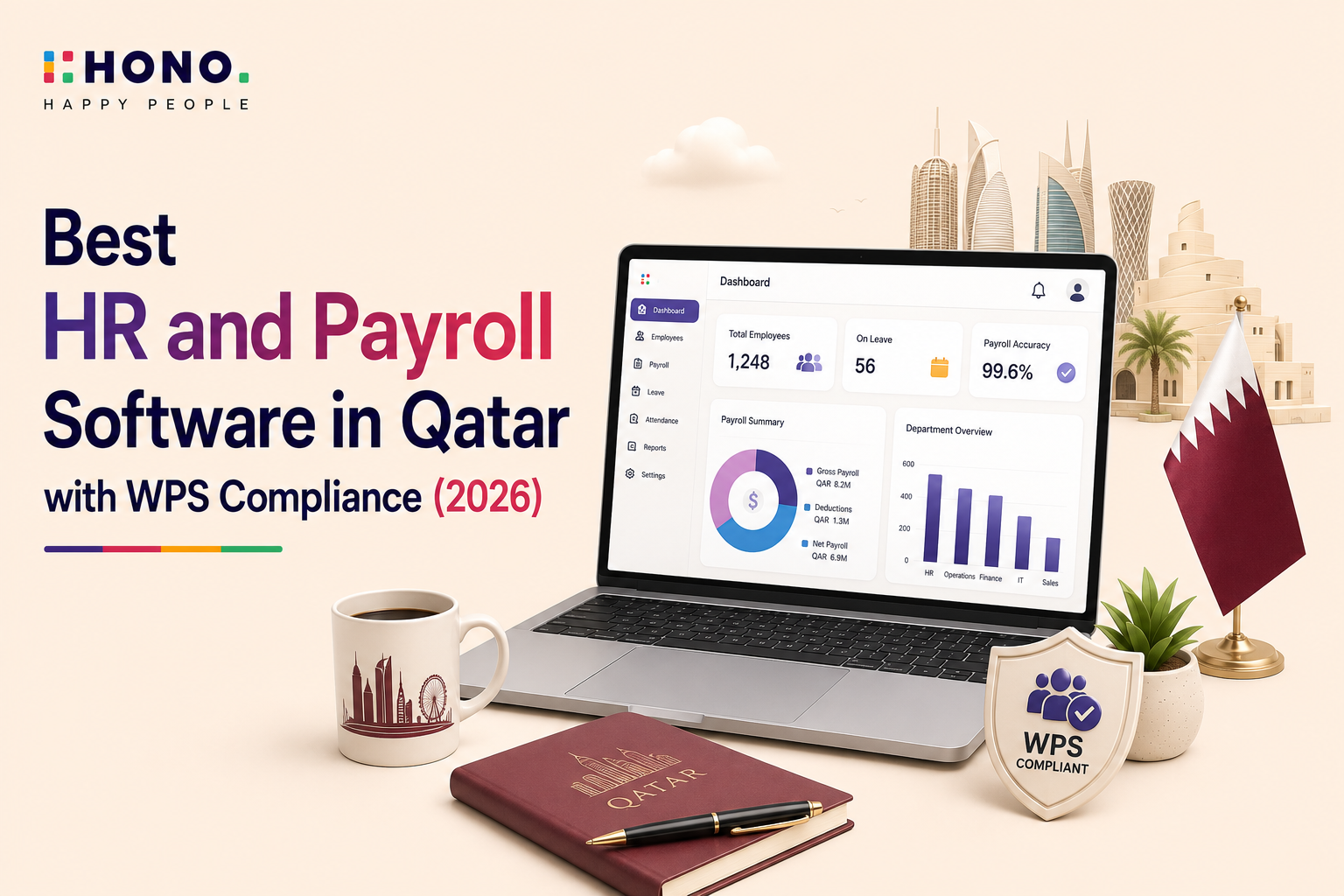
The purpose of this blog is to identify eight platforms that are actually being used or marketed for Qatar payroll today, scored on how they handle WPS SIF generation, EOSB, attendance linked payroll, and multi entity support, plus a quick comparison table and a compliance breakdown for anyone building a shortlist.
Quick comparison: HR and payroll software for Qatar
| Vendor | Core + Payroll | Attendance sync | Leave management | Self service | Multi entity | Best for | Starting price |
|---|---|---|---|---|---|---|---|
| HONO | Yes | Yes | Yes | Chat based | Yes | AI native enterprises wanting conversational HR | Custom quote, verify with vendor |
| Yomly | Yes | Yes | Yes | Mobile app | Yes | GCC enterprises needing bilingual, mobile first HR | Custom quote |
| PeoplesHR (Ensaan Tech) | Yes | Yes, with anomaly alerts | Yes | Portal and mobile | Yes | Qatar localized payroll with fraud detection | Custom quote |
| ZenHR | Yes | Yes | Yes | Portal and mobile | Yes | MENA SMEs on a budget | Custom quote |
| Bayzat | Yes | Yes | Yes | Portal and mobile | Yes | Companies wanting HR, payroll and insurance together | Custom quote |
| greytHR | Yes | Yes | Yes | Portal and mobile | Yes | SMEs expanding from India into the GCC | From roughly 50 USD per month for GCC plans, verify with vendor |
| DOTS HR | Yes | Yes, biometric and facial recognition | Yes | Portal | Limited | Field and multi site workforces | Custom quote |
| ADP Workforce Now | Yes | Yes | Yes | Portal and mobile | Yes | Large multinational entities with global payroll needs | Custom quote |
Pricing for every platform on this list is set through a custom quote in Qatar, so treat the notes above as a starting point and confirm directly with the vendor before budgeting.
8 best HR and payroll software in Qatar for WPS compliance (2026)
1. HONO

HONO is an AI native HR and payroll platform, and one of its core offerings is a headless Zero UI HRMS, meaning HR and payroll actions run through natural language inside Teams, Slack, mobile, or the web, rather than through a traditional dashboard. The platform uses agentic AI to execute tasks directly instead of just surfacing information. HONO overall serves more than 300 enterprise clients and over a million employees, with legal entities in seven countries and clients spanning more than 30 countries including parts of the Middle East, but the headless Zero UI product itself is a newer addition to that portfolio and has not yet been deployed at that same scale.
Here is the honest caveat. HONO's public material talks about GCC expansion and broad compliance auditability claims, but there is no confirmed, published detail on Qatar specific WPS SIF formatting, GRSIA style national pension handling, or Ramadan hour automation for the Qatar market specifically. If your business is Qatar based and this level of local depth is non-negotiable, ask HONO directly for a Qatar compliance walkthrough before signing, rather than assuming the AI native pitch covers it out of the box.
Best for: fast growing companies that want a single AI native platform for HR, payroll, and workforce analytics, provided Qatar specific compliance is verified first.
2. Yomly
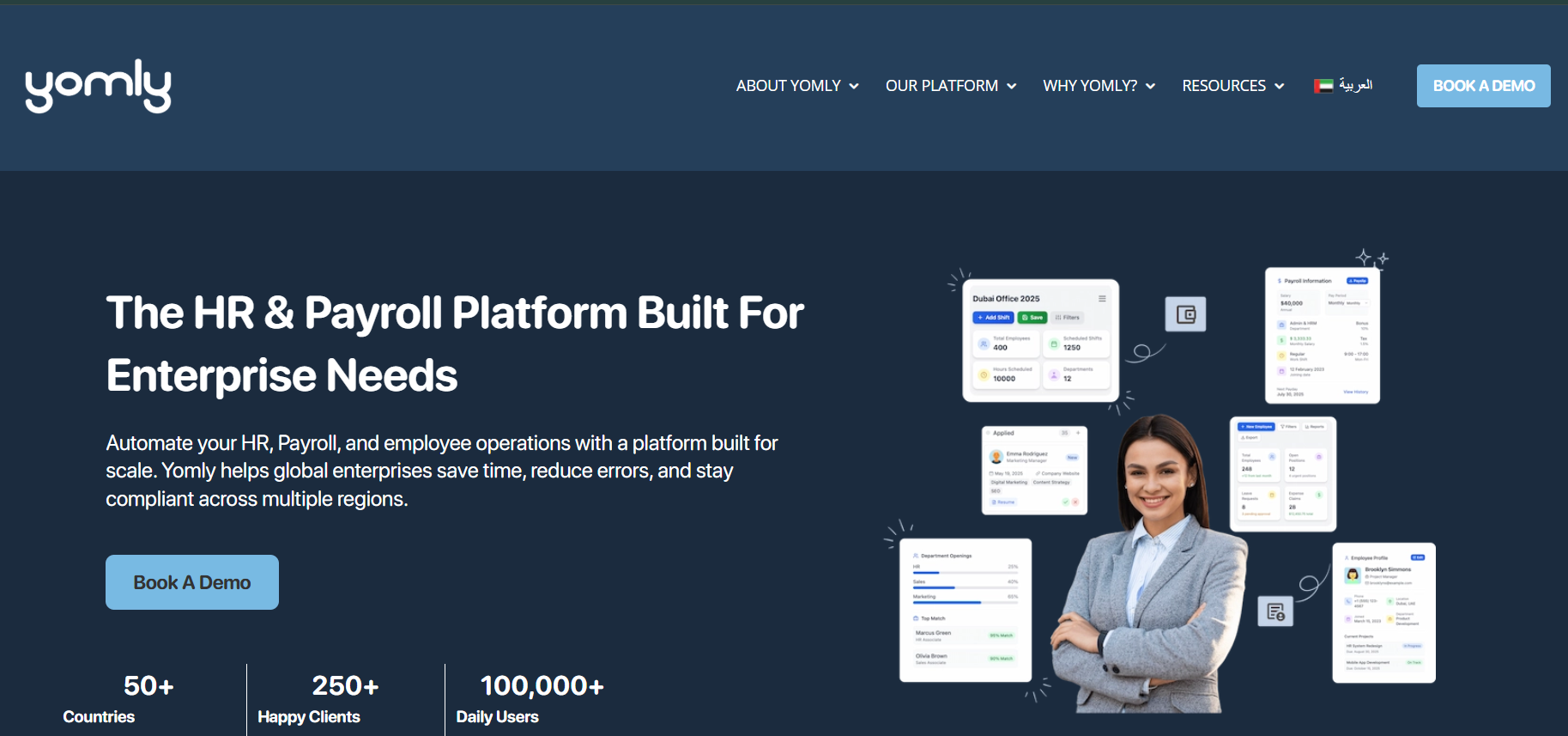
Yomly, originally launched in Dubai in 2018 as EmiratesHR, has built out a dedicated Qatar offering that generates WPS compliant salary files in the format Qatari banks and regulators accept, alongside gratuity calculations and multi-currency payroll. The platform is bilingual in Arabic and English and mobile first, which matters in a market where a large share of the workforce checks payslips and leave balances from a phone rather than a desktop. Yomly says it supports more than 60,000 users across over 50 countries, with GCC enterprise clients including firms in aviation, manufacturing, and education.
Best for: GCC enterprises, typically 100 or more employees, that want Arabic English bilingual HR and payroll in one mobile first system.
3. PeoplesHR (Ensaan Tech)
PeoplesHR, delivered in Qatar through Ensaan Technologies, is built specifically around GCC payroll mechanics rather than adapted from a global template. It handles WPS and SIF generation, GOSI style social insurance calculations, and EOSB, with cloud hosting inside the GCC. What sets it apart on this list is the anomaly detection layer, robotic process automation flags unusual payroll patterns, unauthorized changes, and suspicious activity before a payroll run goes out, which is a genuine safeguard against both error and fraud in high volume payroll cycles.
Best for: Qatar businesses that want payroll built around local compliance from day one, with built in fraud and error detection.
4. ZenHR
ZenHR is a MENA native HRMS that has extended its localization work across Saudi Arabia, the UAE, Egypt, Jordan, Kuwait, and Qatar, with native alignment to systems like WPS and GOSI in the markets where those apply. It automates Ramadan adjusted shifts, geolocation-based attendance, and overtime rules that vary by country, and its attendance module syncs directly into payroll, so exceptions do not need to be manually reconciled before a pay run. It is generally positioned, and priced, toward small and mid-sized businesses rather than large multinational entities.
Best for: MENA based SMEs that want compliance automation without paying enterprise level fees.
5. Bayzat
Bayzat started in 2013 as a health insurance comparison platform in the UAE before growing into a full HR, payroll, and benefits suite, and it now serves more than 4,000 companies and roughly 250,000 employees across the UAE, Saudi Arabia, and Qatar. Its payroll module is built to sync with attendance and leave data automatically and includes WPS compliant processing, and its differentiator is that group health insurance, a legal requirement for work permits in Qatar since late 2025, sits inside the same platform rather than requiring a separate broker relationship.
Best for: companies that want HR, payroll, and employee health insurance managed inside a single vendor relationship.
6. greytHR
greytHR launched in India in 2011 as one of the country's first fully integrated cloud HR and payroll platforms, and it has since expanded into the GCC, where it now supports over 1,000 businesses across industries including manufacturing, healthcare, retail, and IT services. In Qatar specifically, the vendor highlights native handling of WPS, GOSI style contributions, and DEWS style end of service schemes, and a recent regional survey it ran found that some GCC clients running around 1,000 employees could complete a full payroll cycle in about 30 seconds using the platform, with reported full accuracy. That kind of speed claim always deserves a live demo before trusting it fully, but the underlying architecture, payroll tightly wired into attendance and leave from a single Indian originated engine now serving 30,000 plus organizations globally, is a real strength for SMEs scaling out of South Asia into Qatar.
Best for: SMEs and mid-sized companies expanding from India or South Asia into Qatar and the wider GCC.
7. DOTS HR
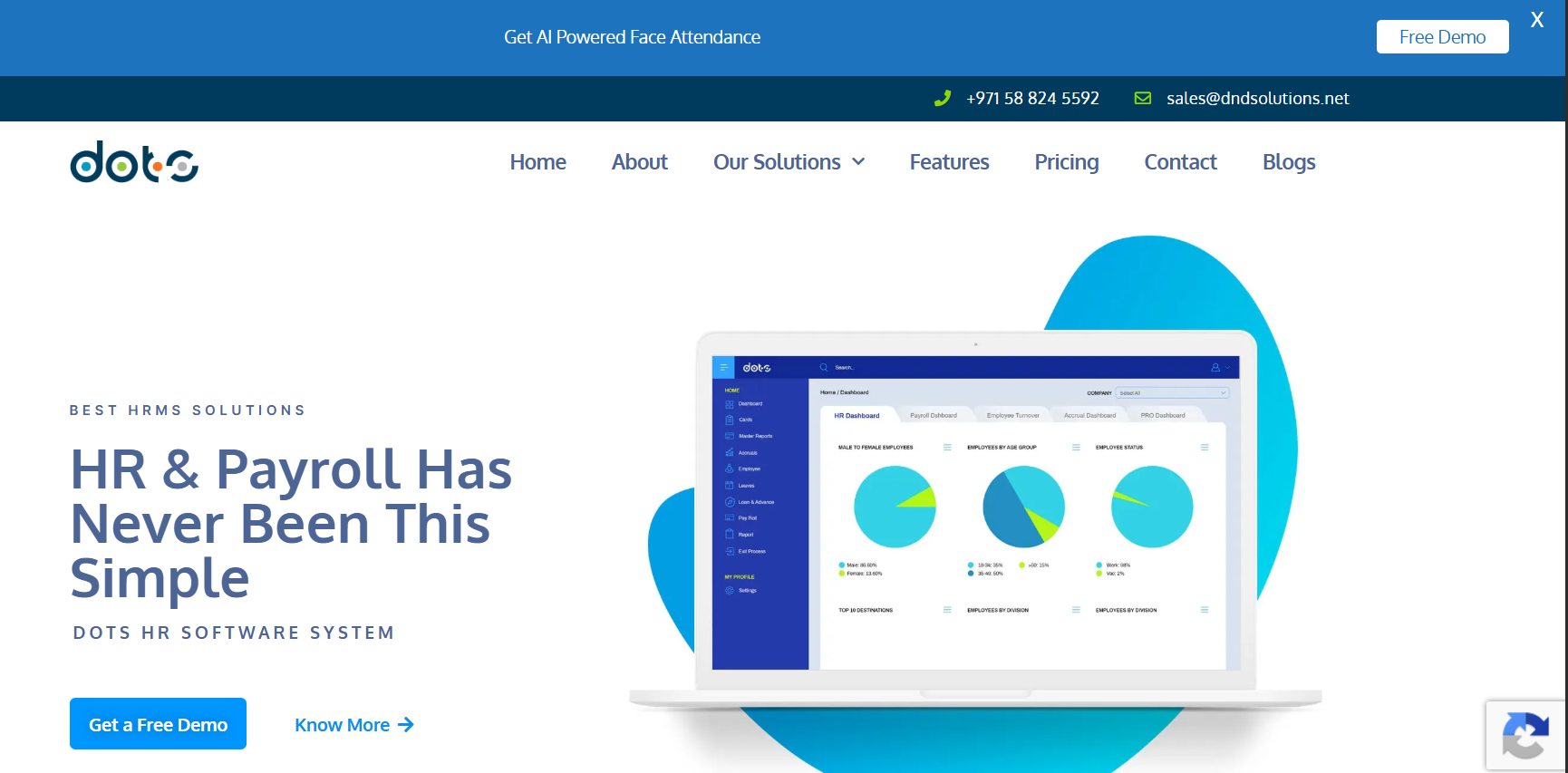
DOTS HR has been operating in the MENA region since 2008 and has completed over 1,000 implementations, with a particular strength in attendance capture for field and multi-site workforces. Its biometric integration, and its newer facial recognition tool called DOTS Faces, ties attendance directly into payroll so overtime, absences, and shift patterns feed the pay run without manual entry. This matters in Qatar's construction, logistics, and hospitality sectors, where attendance disputes are one of the most common sources of payroll error and WPS mismatches. Multi entity support is present but generally less deep than the enterprise focused platforms on this list, so larger groups running several legal entities should scope this carefully.
Best for: field based or multi-site workforces where accurate, tamper resistant attendance capture is the priority.
8. ADP Workforce Now
ADP operates payroll and HCM services in more than 140 countries, and its enterprise tier, sold through ADP Workforce Now alongside its multinational GlobalView and Streamline products, is built to manage payroll across multiple jurisdictions, currencies, and compliance regimes from one system. AI powered anomaly detection flags payroll issues before disbursement, and the platform is positioned for large, established organizations, typically 1,000 or more employees, that need a single global vendor rather than a regional specialist. For a multinational entity operating a Qatar office alongside operations elsewhere, this consolidation can be worth the tradeoff against the deeper local nuance that GCC native platforms offer.
Best for: large multinational entities that need one global payroll vendor spanning Qatar and other markets simultaneously.
How to choose HR and payroll software for your Qatar business?
The deciding factor is your entity structure and workforce mix, not simply how many people you employ.
-
Fast growing company wanting one AI native platform for HR, payroll, and analytics. HONO fits this profile on architecture, but confirm Qatar specific WPS, GOSI equivalent, and Ramadan hour handling directly with the vendor before committing.
-
Mainland SME with mostly expatriate staff. PeoplesHR through Ensaan Tech, ZenHR, or greytHR are built around exactly this profile, with WPS, EOSB, and attendance sync as core rather than bolted on features.
-
QFC free zone or multinational entity. Bayzat, ADP Workforce Now, or HONO for GCC wide analytics suit organizations juggling QFC rules alongside mainland Labour Law, or running payroll across several countries from one head office.
-
Field or multi site workforce needing biometric attendance. DOTS HR is purpose built for this, with attendance capture designed to withstand audits and reduce buddy punching on construction sites, warehouses, and hospitality venues.
What does WPS compliant HR and payroll software mean in Qatar?
In short, it means software that generates a Salary Information File in the exact format Qatar Central Bank and its approved banks require, so wages transfer on time and in full under the Wage Protection System, with payroll data pulled directly from attendance and leave records to avoid manual reconciliation.
The SIF itself is a structured file, usually CSV, that includes the employer's establishment and computer card details, each employee's Qatar ID or labor card number, IBAN, and salary breakdown. Banks validate this file against Ministry of Labour records before releasing funds, and mismatches, wrong visa numbers, incorrect character formatting, a net salary that does not equal basic pay plus allowances minus deductions, trigger rejections. Employers are required to transfer wages within seven days of the due date, and software that cannot generate a clean SIF on the first attempt turns a routine payroll cycle into a repeated back and forth with the bank.
Why generic global payroll tools often fail this test?
Most international payroll platforms are built around a generic payslip and a bank transfer instruction, not a government validated file format tied to a national labor database. They typically lack a native SIF export, do not track the difference between mainland Labour Law and QFC free zone employment rules, and are not built to automatically shrink working hours during Ramadan without touching pay, a rule that applies to the entire workforce regardless of religion. Bolting these gaps on with manual spreadsheets defeats the purpose of buying software in the first place, and it is usually where WPS rejections and EOSB miscalculations start.
What to look for in HR and payroll software for Qatar?
At minimum, look for native WPS SIF generation, correct handling of mainland versus QFC rules, attendance linked payroll, multi entity support, and self service access to WPS linked salary documents.
-
WPS SIF file generation and QCB bank submission. The system should export a file your bank accepts without manual reformatting, and ideally integrate directly with the bank portal.
-
Mainland versus QFC free zone payroll rules. QFC licensed entities are generally excluded from standard WPS obligations unless specifically brought in by the Ministry of Labour, so the software needs to recognize which regime each entity sits under.
-
Attendance and leave sync into payroll. Overtime, deductions, and the mandatory Ramadan hour reduction to 36 hours a week need to flow from attendance data automatically, without a manual recalculation each month.
-
Multi entity and multi currency support. Employers running operations across the GCC need one system that can separate payroll rules, currencies, and reporting by country and legal entity.
-
Employee self service for payslips and WPS linked salary certificates. Reduces HR ticket volume and gives employees a way to confirm their own salary transfer independently of a manual request.
Frequently asked
FAQs
See it live
Ready to see HONO in action?
Book a 20-minute demo tailored to your team's HR stack.
Request a demo
About the author
Milind Trivedi
Milind Trivedi is the Country Director - GCC at HONO, leading enterprise business across the Middle East. He specializes in AI-powered HR technology, payroll transformation, workforce digitization, and strategic business growth, helping organizations streamline HR operations while ensuring compliance and delivering exceptional employee experiences.