Quick answer
Human resource management (HRM) is how a business manages its employees, from hiring and onboarding to payroll, performance, development and retention.
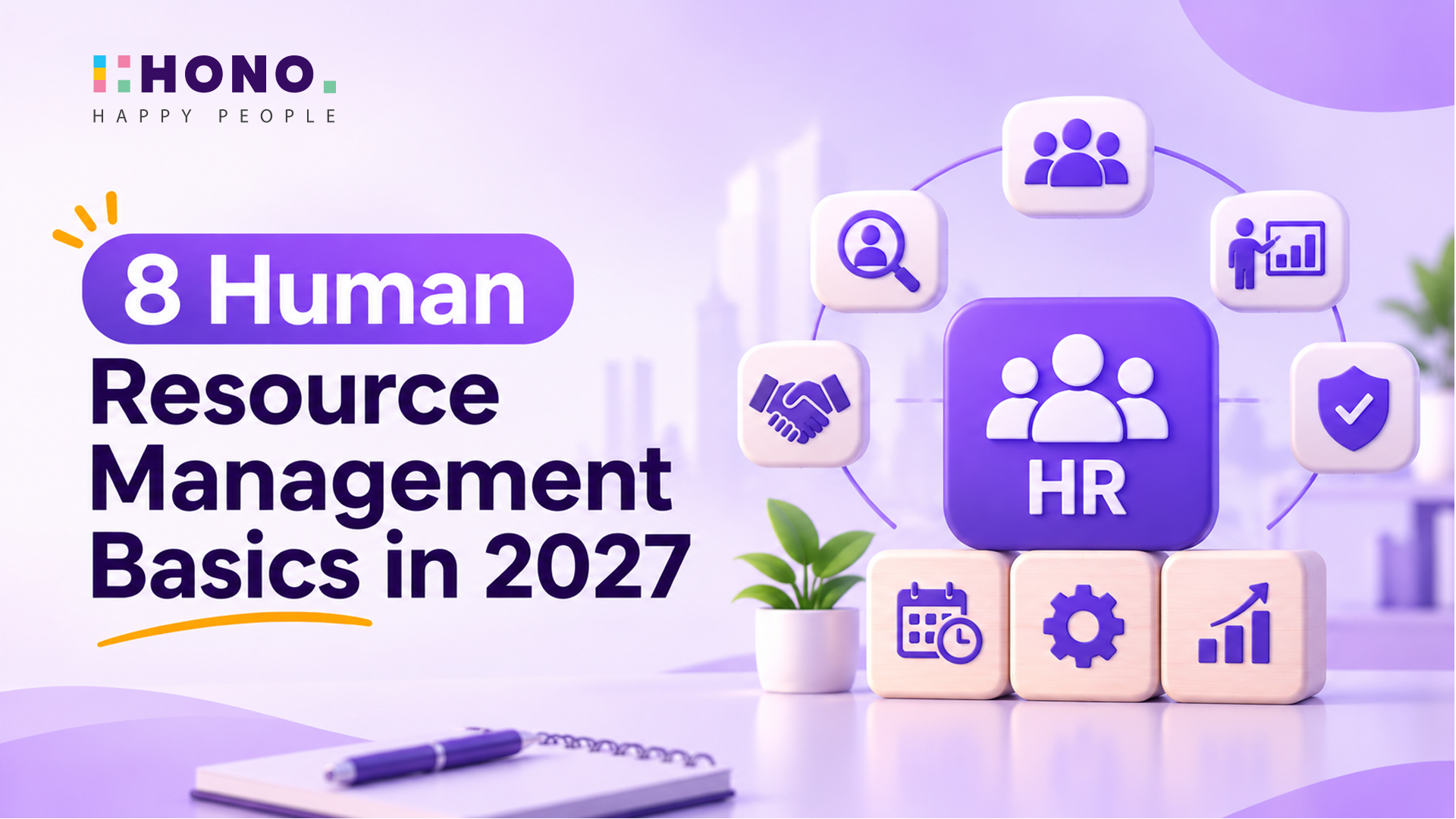
The eight basic HR functions are:
HR planning and workforce management
Recruitment and selection
Employee onboarding
Compensation and payroll
Performance management
Learning and career development
Employee relations and welfare
HR compliance and employee records
In India, HR teams must also manage statutory requirements such as PF, ESI, gratuity and applicable Labour Codes. Accurate employee records help keep these processes on track. HR software connects employee data, attendance, payroll and performance, while AI assistants can help employees access services such as payslips and leave through simple conversations.
What Is Human Resource Management?
Human resource management (HRM) is how a business hires, pays, develops and retains employees. It covers the entire employee lifecycle, from recruitment and onboarding to performance, payroll and exit management.
HRM also helps businesses plan workforce costs, manage employee records and meet labour requirements. It is not just an administrative function; it connects people management with business performance.
What Is the Importance of Human Resource Management?
HRM helps businesses manage workforce costs, improve productivity and keep employee operations compliant. Its importance is growing as India's workforce and employment models change.
Plan the workforce: Identify hiring needs, skill gaps and staffing costs before they affect business operations.
Hire and retain talent: Use structured recruitment, fair compensation and career development to reduce avoidable attrition.
Improve productivity: Set measurable goals, review performance and link skill gaps to relevant training.
Manage payroll and compliance: Maintain accurate employee records and handle PF, ESI, gratuity and other applicable requirements.
Manage a changing workforce: India's gig workforce grew by 55% between FY21 and FY25, making worker classification, payments and compliance important HR considerations.
Control workforce costs: Track headcount, overtime, payroll and attrition by department, location and legal entity.
Support employee experience: Make payslips, leave requests, policies and HR support accessible to office and frontline employees.

What Are the Fundamentals & Basics of Human Resource Management?
The basics of human resource management cover eight core functions: workforce planning, recruitment, onboarding, compensation and payroll, performance management, learning and development, employee relations, and HR compliance.
Together, these functions manage the employee lifecycle, from identifying a hiring need to processing an employee's final settlement. They also help businesses control workforce costs, maintain productivity, reduce employee turnover and meet labour law requirements.
Here are the eight fundamentals of HRM, what each involves and how businesses can manage them effectively.
1. HR Planning and Workforce Management
HR planning determines how many employees a business needs, which skills they require and when those skills will be needed. Workforce management turns that plan into daily operations through shift scheduling, attendance, overtime and leave management.
The main activities include:
Headcount planning: Compare existing employees with approved positions and future hiring requirements.
Skills forecasting: Identify skill shortages before they affect business operations.
Shift and attendance management: Track working hours, late arrivals, overtime and absences across locations.
Workforce cost planning: Estimate salary, overtime and hiring costs against departmental budgets.
For example, a manufacturing company can compare upcoming production requirements with employee availability. If a shift is likely to have a shortage, predictive workforce tools can flag the gap early and help managers arrange replacements.
Why it matters
Better workforce planning reduces unnecessary hiring, overtime expenses and last-minute shift changes. It also helps businesses put the right people in the right roles.
How to measure it
Planned versus actual headcount, absenteeism rate, overtime cost and workforce utilisation.
2. Recruitment and Selection
Recruitment and selection is the process of attracting candidates, assessing their suitability and hiring people who meet a business's skill and role requirements. It covers everything from creating a job description to issuing an offer letter.
The process generally involves:
Job requisition: Get approval for a new position and define its requirements.
Candidate sourcing: Publish vacancies, search talent pools and collect applications.
Screening and assessment: Evaluate resumes, skills and experience against the role.
Interview and selection: Coordinate interviews, collect feedback and select candidates.
Offer management: Generate offer letters and track candidate acceptance.
AI-assisted recruitment can reduce repetitive work by drafting job descriptions, matching resumes against job requirements, ranking suitable candidates and coordinating interview schedules.
For example, when a company receives 500 applications for a finance position, resume screening tools can shortlist candidates based on relevant experience, qualifications and required skills. Recruiters can then spend more time evaluating the strongest applicants.
Why it matters
A structured recruitment process reduces hiring delays, improves candidate selection and helps businesses avoid the cost of unsuitable hires.
How to measure it
Time to hire, cost per hire, offer acceptance rate and quality of hire.
3. Employee Onboarding
Employee onboarding is the process of preparing new employees to perform their roles, understand company policies and become part of the organisation. It starts after offer acceptance and continues beyond the employee's first working day.
A complete onboarding process includes:
Collecting identity, address, bank and employment documents.
Completing background verification and joining formalities.
Creating employee records and providing system access.
Sharing company policies, role expectations and workplace guidelines.
Assigning reporting managers and onboarding buddies.
Tracking training and first-month activities.
Digital onboarding workflows can automatically assign tasks to HR, IT, finance and reporting managers. New employees can also receive policy guidance, document instructions and onboarding support through conversational AI agents.
For example, a new employee can ask about the company's leave policy or required joining documents through a messaging platform instead of waiting for an HR response.
Why it matters
A consistent onboarding experience reduces administrative delays, helps employees become productive sooner and lowers the risk of early employee exits.
How to measure it
Onboarding completion rate, time to productivity and 90-day employee retention.
4. Compensation and Payroll
Compensation and payroll covers how employees are paid, what benefits they receive and whether their salary is calculated and disbursed correctly. It includes fixed pay, variable pay, bonuses, incentives, allowances, deductions and statutory contributions.
The main responsibilities include:
Maintaining salary structures and employee compensation records.
Calculating monthly salaries, overtime, incentives and bonuses.
Processing deductions, reimbursements and employee benefits.
Managing statutory contributions and tax deductions.
Generating payslips and payroll reports.
Processing full and final settlements when employees leave.
Payroll requirements vary by country. In India, payroll teams must account for Provident Fund (PF), Employees' State Insurance (ESI), gratuity, Professional Tax and Tax Deducted at Source (TDS), as applicable.
Modern payroll systems can validate salary calculations before disbursement. They flag exceptions such as duplicate payments, missing deductions, negative net pay and unusual salary changes. Configurable payroll rules also help businesses accommodate different salary structures, locations and statutory requirements.
For example, if an employee's attendance, overtime and incentive data do not match the payroll inputs, the system can flag the discrepancy before salary processing is completed.
Why it matters
Accurate payroll builds employee trust, reduces payment disputes and helps businesses avoid statutory penalties and costly corrections.
How to measure it
Payroll accuracy, on-time salary disbursement, payroll processing time and number of payroll corrections.
Checkout Best Payroll Outsourcing companies in India
5. Performance Management
Performance management is the ongoing process of setting employee goals, reviewing progress, providing feedback and evaluating performance against agreed expectations. It connects individual contributions with departmental and business objectives.
A structured performance management cycle includes:
Setting measurable goals and key performance indicators (KPIs).
Aligning individual targets with team and company objectives.
Conducting regular feedback and performance discussions.
Recording achievements, challenges and improvement areas.
Reviewing performance for appraisals, promotions and rewards.
Digital performance management tools help managers track goals throughout the year rather than relying only on annual reviews. AI-assisted review tools can bring together goal progress, feedback and past performance records to give managers a more complete view of employee contributions.
For example, a sales manager can review an employee's quarterly targets, actual revenue, customer acquisition and feedback before conducting a performance discussion.
Why it matters
Regular performance reviews identify problems earlier, improve accountability and help managers make better decisions about promotions, rewards and employee development.
How to measure it
Goal completion rate, review completion rate, employee productivity and performance improvement.
6. Learning and Career Development
Learning and career development helps employees build the skills required for their current jobs and prepare for future responsibilities. It includes training, mentoring, career planning, leadership development and succession planning.
Key activities include:
Identifying skill gaps through performance reviews and assessments.
Creating individual learning and development plans.
Providing technical, functional and behavioural training.
Tracking course completion and training effectiveness.
Identifying employees for leadership and critical roles.
Preparing internal successors for important positions.
Skills-based learning tools can compare an employee's existing capabilities with the requirements of their role. They can then recommend relevant courses, certifications or development activities.
For example, if a team leader needs stronger data analysis skills to move into a managerial position, the system can identify the gap and recommend suitable training.
Why it matters
Developing existing employees reduces dependence on external hiring, improves internal mobility and helps businesses retain experienced talent.
How to measure it
Skill gaps closed, training completion, internal promotion rate and successor readiness for critical roles.
7. Employee Relations and Welfare
Employee relations and welfare focuses on maintaining a healthy working relationship between employees and the organisation. It covers employee concerns, workplace policies, engagement, recognition, health and safety.
Important activities include:
Managing employee grievances and workplace complaints.
Responding to questions about HR policies and benefits.
Conducting employee engagement and satisfaction surveys.
Recognising employee contributions and achievements.
Supporting workplace safety and employee welfare initiatives.
Tracking employee concerns until they are resolved.
A centralised employee helpdesk can manage HR requests across departments and locations. Conversational AI can also answer routine questions using approved company policies, while directing sensitive or complex cases to the appropriate HR team.
For example, an employee can ask about leave eligibility, salary deductions or reimbursement status through WhatsApp or another workplace messaging channel without navigating multiple HR screens.
Employee pulse surveys can also help managers identify dissatisfaction within a department before it contributes to higher attrition.
Why it matters
Accessible HR support improves employee experience, builds trust and helps organisations identify workplace issues before they become larger problems.
How to measure it
Employee engagement score, grievance resolution time, employee satisfaction and voluntary attrition rate.
8. HR Compliance and Employee Records
HR compliance and employee records ensure that an organisation follows applicable employment laws and maintains accurate, secure employee information. This includes employment contracts, statutory records, salary documents, attendance records and regulatory filings.
The main responsibilities include:
Maintaining employee master data and employment documents.
Tracking statutory deductions and employer contributions.
Preparing regulatory returns and statutory reports.
Managing employment contracts, appointment letters and policy acknowledgements.
Monitoring changes in labour laws and compliance requirements.
Maintaining access controls and audit trails for employee information.
In India, HR compliance includes applicable requirements under EPF, ESI, gratuity, Professional Tax, TDS and labour legislation, including the Labour Codes as and when brought into force through applicable notifications and rules.
For organisations operating across multiple states or countries, compliance becomes more complex. Rules, contribution limits, tax structures and statutory reporting requirements can differ by location.
Modern HRMS platforms can maintain country-specific statutory configurations, generate compliance documents and apply role-based access controls. Audit trails also help HR teams identify who accessed or changed employee records and when.
Why it matters
Effective compliance management reduces legal exposure, improves audit readiness and ensures that employee records remain accurate and accessible.
How to measure it
On-time statutory filing rate, compliance exceptions, audit findings and employee record accuracy.

How Do These Eight HRM Basics Work Together?
The eight fundamentals of HRM are connected. A recruitment decision affects workforce planning. Onboarding creates the employee record used by payroll. Attendance data influences salary calculations, while performance reviews help determine learning requirements, promotions and compensation decisions.
Managing these functions separately can create duplicate records, manual work and reporting gaps. An integrated Human Resource Management System (HRMS) connects them through a shared employee database.
Two additional capabilities make this integration more useful:
HR automation and conversational AI
Employees and managers can request payslips, check leave balances, raise HR queries or review team information through messaging platforms. AI agents can also handle tasks across payroll, attendance, recruitment, performance and onboarding, reducing dependence on manual navigation and repetitive HR requests.
HR analytics and workforce intelligence
HR teams can analyse headcount, payroll costs, absenteeism, attrition, overtime and employee performance in one place. Predictive insights can help identify workforce shortages, rising employee turnover and potential cost overruns before they affect business operations.
The result is a shift from HR teams spending most of their time on administrative work to focusing more on workforce planning, employee experience, productivity and business decisions.
How Do You Manage Human Resources?
Managing human resources means organising the people, processes and policies that help a business hire, pay, develop and retain employees. The approach depends on the size of the organisation, but the objective remains the same: ensure employees are productive, HR operations run smoothly and the business meets its employment obligations.
Follow these six steps to manage HR effectively:
Plan workforce requirements: Identify the number of employees, skills and roles needed to meet business targets. Set headcount budgets before approving new positions.
Standardise hiring and onboarding: Define job requirements, use a consistent selection process and give every new employee a clear joining plan.
Connect attendance and payroll: Maintain accurate working-hour, leave and overtime records so salary calculations and statutory deductions are correct.
Set performance and development goals: Agree on measurable targets, review progress regularly and provide training where employees have skill gaps.
Make employee support accessible: Establish a clear process for HR queries, grievances, leave requests and policy-related questions.
Maintain records and compliance: Keep employee documents, salary records, contracts and statutory filings accurate and updated as requirements change.

How Should HR Management Change as a Company Grows?
HR priorities change with headcount. A small business needs reliable employment records and payroll first. A growing organisation needs standardised processes, while a large enterprise needs better coordination across departments, locations and legal entities.
Company size | HR priorities | Recommended approach |
|---|---|---|
10–50 employees | Employment contracts, payroll, leave policies and employee records | A founder or HR generalist can manage operations using standardised processes and basic HR software. |
50–250 employees | Recruitment workflows, onboarding, performance reviews, employee queries and compliance | Assign dedicated HR responsibilities and introduce an integrated HRMS to reduce manual administration. |
250–1,000 employees | Workforce planning, multi-location payroll, structured performance management and HR analytics | Build specialist HR functions and automate repetitive workflows across departments. |
1,000+ employees | Multi-entity HR operations, succession planning, country-specific compliance, workforce analytics and cost control | Use an enterprise HRMS with configurable workflows, integrated payroll, role-based access and centralised reporting. |
The important difference is not just the number of employees. As an organisation grows, the number of locations, employment types, approval layers and statutory requirements also increases. HR processes must scale without creating more manual work.
How Can HR Software Make Human Resource Management Easier?
Modern HRMS platforms are moving beyond dashboards, forms and traditional employee self-service. HONO’s headless, Zero UI approach by ERA takes this further by allowing employees and managers to complete HR tasks through conversations instead of navigating multiple screens. AI agents can handle requests across payroll, leave, attendance, recruitment, performance and onboarding through WhatsApp, Microsoft Teams, Slack, email and other channels.
For example, an employee can request a payslip, compare salary details across months or check leave balances through a simple message. A manager can ask for team absenteeism trends, pending leave approvals or overtime comparisons without generating reports manually. These agents can understand requests and execute workflows, not just provide chatbot-style answers. Support across 100+ languages also makes HR services more accessible to a geographically distributed workforce.
This shifts HR management from navigating software and coordinating repetitive tasks to getting work done through conversations, while giving HR teams more time to focus on workforce productivity, employee experience and business outcomes.
Choose the Top 10 HR software in India
Frequently asked
FAQs
See it live
Ready to see HONO in action?
Book a 20-minute demo tailored to your team's HR stack.
Request a demoAbout the author