Key Takeaways
-
Every Philippine pay run has to reconcile four separate agencies: SSS, PhilHealth, Pag-IBIG, and BIR, each on its own schedule.
-
SSS sits at 15 percent of Monthly Salary Credit in 2026, the final step mandated under RA 11199.
-
PhilHealth holds at 5 percent for 2026, split evenly between employer and employee, per the Universal Health Care Act.
-
The right tool depends on headcount and filing complexity, not how big or well known the vendor is.
-
Always confirm the current year's contribution tables with each agency before your first live payroll run.
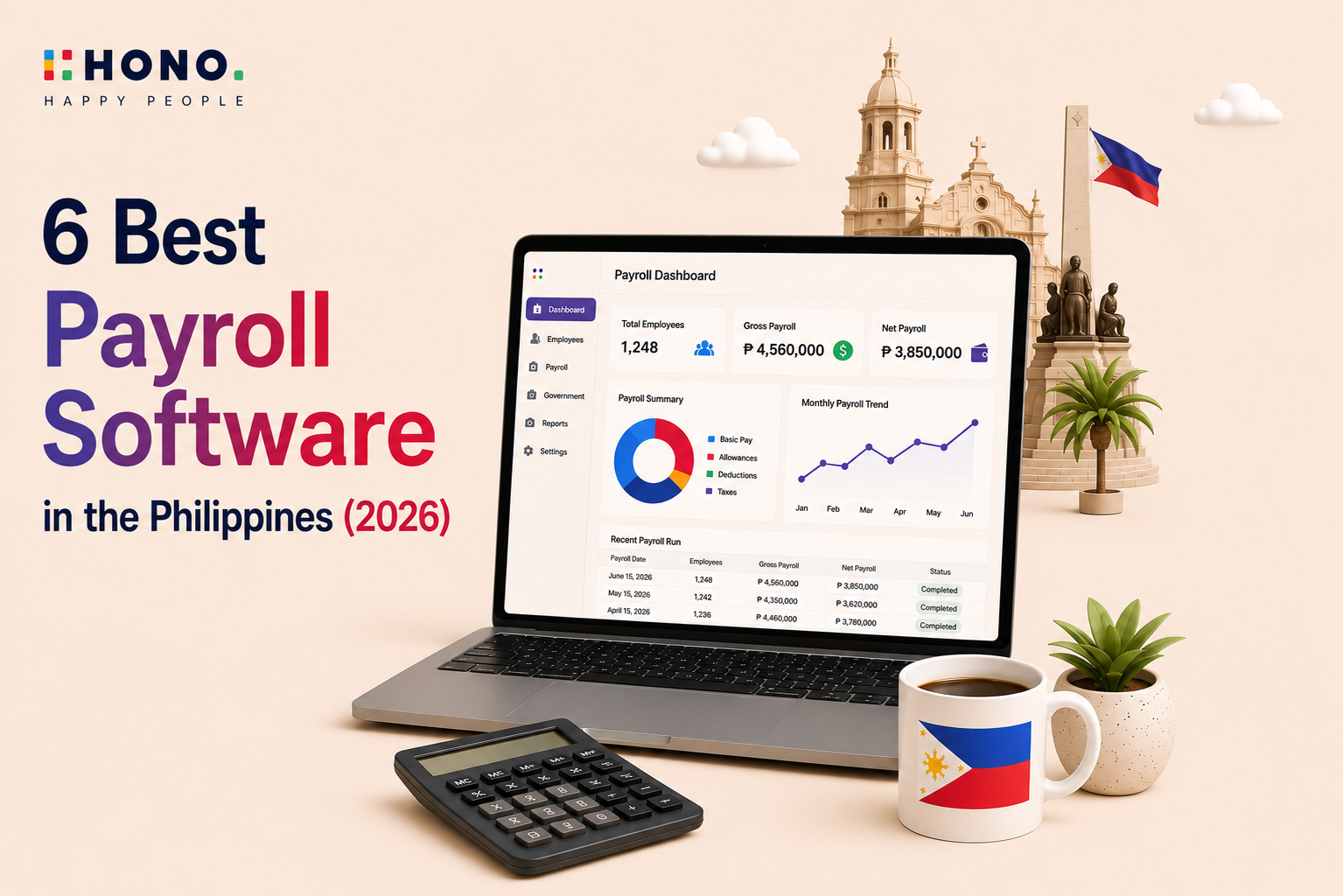
Running payroll in the Philippines is not something you can bolt onto a generic system and expect it to work. Four separate government bodies, SSS, PhilHealth, Pag-IBIG, and the Bureau of Internal Revenue, each maintain their own contribution tables that update on different schedules. Layer on DOLE rules for 13th month pay, night differential, and overtime, and it's clear why so many finance teams outgrow their first payroll spreadsheet within a year.
This guide compares six payroll software options built for or heavily localized to the Philippines. Each handles the statutory math differently, so the best payroll software philippines businesses can rely on is really a question of fit: headcount, industry, and how many employees clock in from a desk versus a delivery route.
6 Best Payroll Software in the Philippines (2026)
| Tool | Statutory Compliance | BIR Form Automation | Timekeeping Integration | Bank / E-Wallet Disbursement | Best For | Starting Price |
|---|---|---|---|---|---|---|
| HONO | Multi-country compliance engine; confirm PH-specific depth in a demo | Varies by region, confirm for PH | Yes, native attendance module | Yes | Enterprises running across multiple Asian markets | Custom quote |
| Sprout Solutions | Native SSS, PhilHealth, Pag-IBIG, BIR | Yes, including 2316 and alphalists | Yes, biometric and mobile clock-in | Yes, bank file generation | SMEs and BPOs that want deep local compliance | Around ₱7,900 to ₱10,000/month for 10 employees (Starter), custom quote above that |
| PayrollHero | Native SSS, PhilHealth, Pag-IBIG, BIR | Yes | Yes, facial recognition and GPS geofencing | Yes | Shift-based, multi-branch, or field teams | From about $4/user/month |
| Darwinbox | Native PH payroll module (launched 2025), SSS, PhilHealth, Pag-IBIG | Yes | Yes, part of unified HCM | Yes | Large enterprises and multi-country employers | Custom quote, third-party estimates suggest around $5/employee/month plus implementation |
| Zoho Payroll | No native Philippine payroll edition; strong for accounting sync | Not applicable for PH statutory filings | Via Zoho People | Via Zoho Books integration | SMEs already on Zoho Books wanting clean journal entries | Custom quote |
| Talenox | Native for Singapore, Malaysia, Hong Kong; PH runs on a flexible global plan | Not automated for PH forms | Basic | Yes, depending on plan | Regional employers running SG, MY, or HK payroll alongside a smaller PH team | From about $10 base plus $2/employee/month (global plan) |
The 6 Tools, Compared in Detail
1. HONO
HONO is an AI-native enterprise HRMS platform headquartered in India, with a footprint spanning India, the Middle East, and Southeast Asia. It covers the full hire-to-retire employee lifecycle, including multi-country zero touch payroll, core HR, and workforce analytics, wrapped in a conversational "chat first" interface where employees handle requests through WhatsApp, Slack, or Microsoft Teams instead of a traditional dashboard.
The platform's strength is consolidation. If your organization already runs HONO for HR or payroll in other Asian markets, adding a Philippine entity means one login and one data model rather than a separate local tool. That said, HONO's Philippine-specific depth on SSS, PhilHealth, Pag-IBIG, and BIR filing has not been independently documented in the same detail as the more locally focused vendors below, so confirm this directly in a sales demo before committing, particularly if BIR e-filing automation is a hard requirement.
2. Sprout Solutions
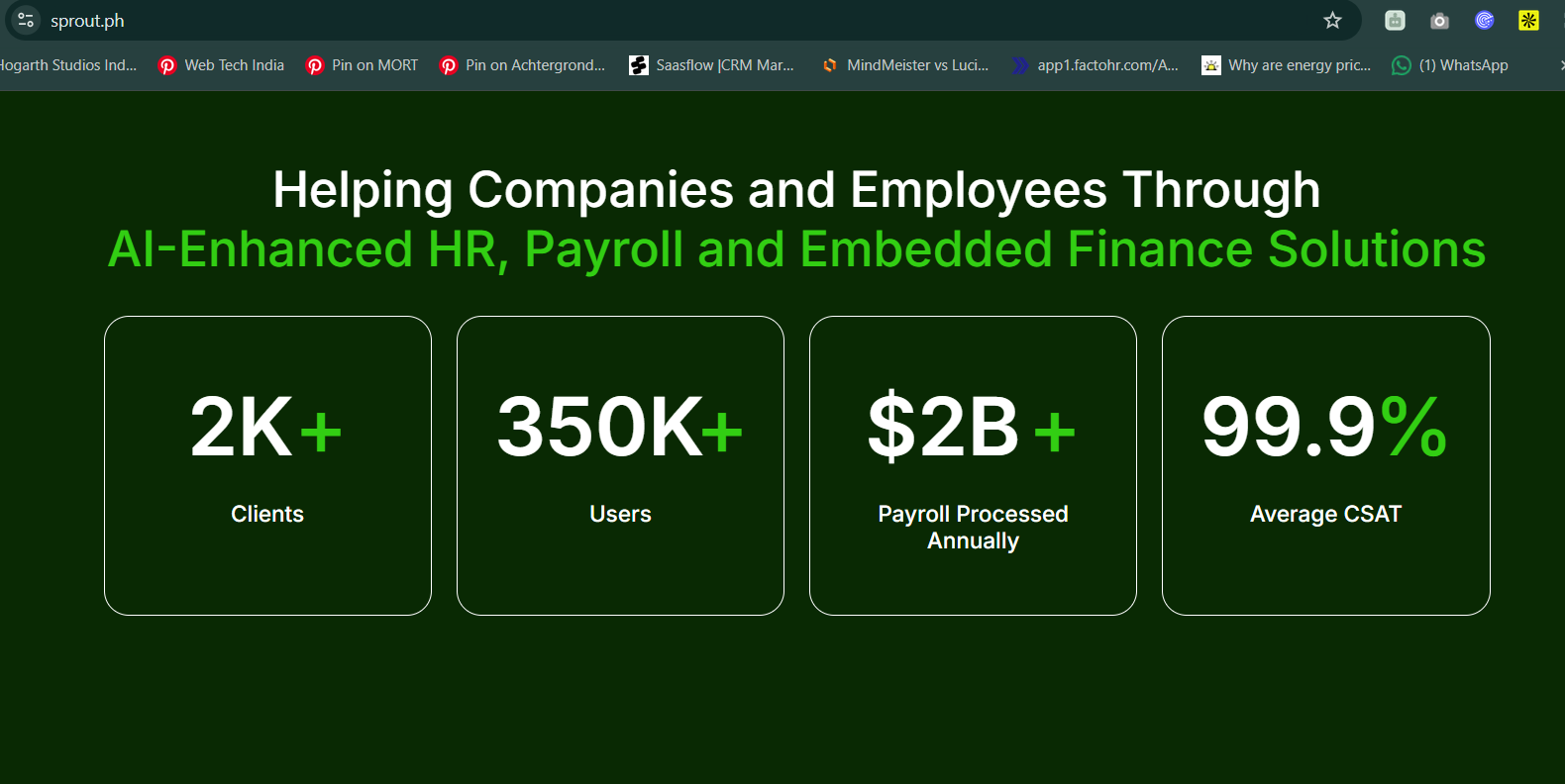
Sprout Solutions is the most recognized homegrown payroll and HR platform in the Philippines. Founded in 2015, it serves more than 2,000 business teams and over 350,000 platform users, and reports having processed more than $2 billion in payroll built on local expertise in Philippine labor law.
The platform automates SSS, PhilHealth, Pag-IBIG, and BIR calculations and filings, syncs biometric and mobile clock-in data directly into payroll, and generates monthly SSS R-3 and R-5 reports along with BIR forms. Its Starter package runs from roughly ₱7,900 to ₱10,000 a month for 10 employees, while standard Sprout Payroll uses a quote-based, per-employee model for larger teams. Sprout also serves Thailand, but its core strength remains the Philippine market, and it's the default choice for many BPOs and SMEs needing compliance handled with minimal manual intervention.
3. PayrollHero

PayrollHero has built a specific niche around businesses where time tracking matters just as much as the payroll calculation itself. It's a strong fit for retail chains, BPOs, hospitality groups, or any operation running multiple locations with shift-based staff.
The platform uses facial recognition as its primary biometric, paired with GPS geofencing, to cut down on buddy punching and inflated time records. It supports SSS, PhilHealth, Pag-IBIG, and BIR compliance natively, along with employee self-service and multi-branch scheduling. Pricing starts at roughly $4 per user per month, and it works well for companies that need attendance and payroll to function as one continuous data flow rather than two systems requiring manual reconciliation.
4. Darwinbox
Darwinbox is an Asia-founded enterprise HCM platform, it launched a native payroll product for the Philippines in January 2025 as the first step in a broader Southeast Asia expansion, built on its proprietary RIVeR processing framework and covering SSS, PhilHealth, and Pag-IBIG within a unified HCM suite.
Darwinbox does not publish pricing publicly; third-party estimates put it around $5 per employee per month for smaller headcounts, plus implementation fees ranging from $5,000 to $50,000. It suits enterprises with 500 or more employees, or any organization wanting payroll living inside the same system as recruitment, performance, and workforce planning.
5. Zoho Payroll
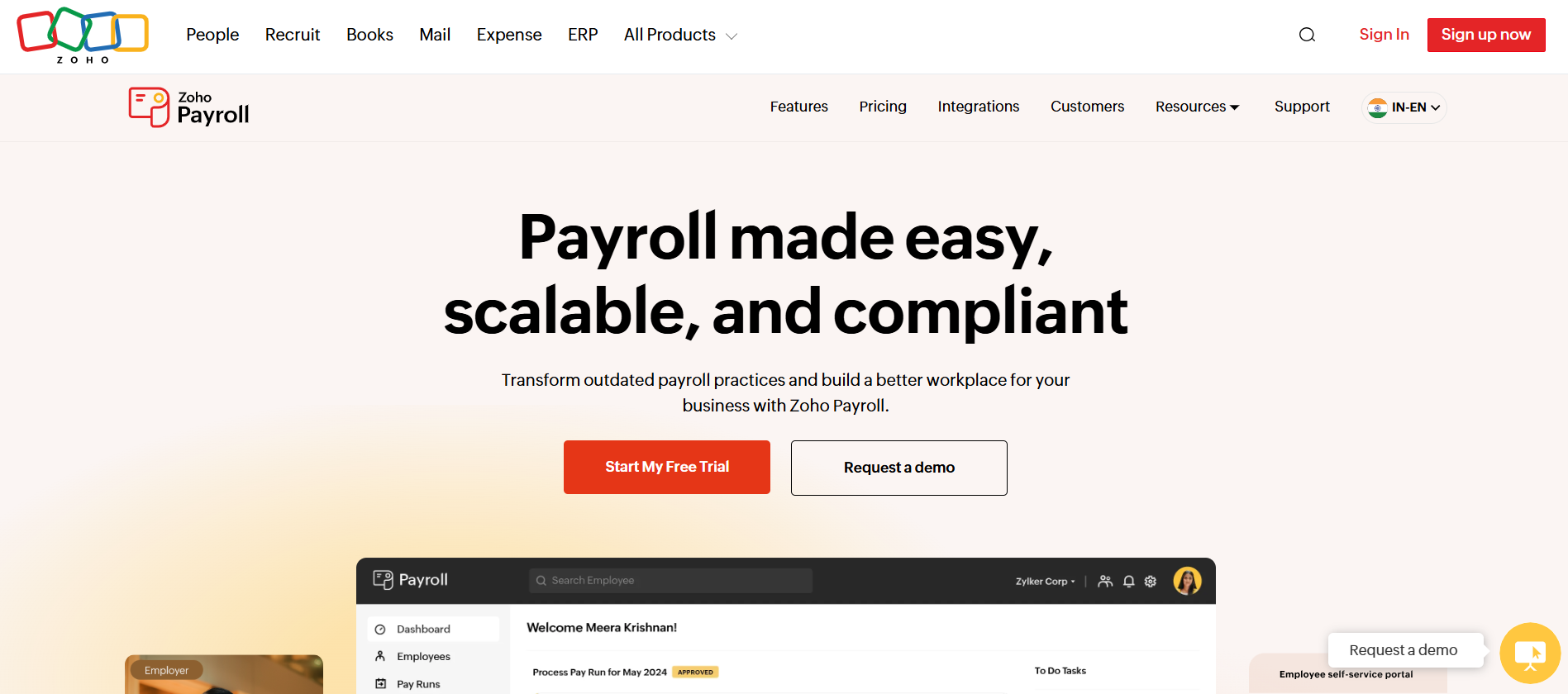
Zoho Payroll is worth including because so many Philippine SMEs already run their books on Zoho Books and their HR on Zoho People. The integration between the three products is genuinely useful: payroll transactions post automatically as journal entries, keeping your profit and loss statement accurate without manual entry.
Where it falls short for this list is native Philippine statutory coverage. Zoho Payroll's officially supported editions cover the United States, India, the United Arab Emirates, Saudi Arabia, and the wider GCC region; the Philippines is not one of the countries with a native, localized payroll edition. In practice, Philippine businesses on Zoho typically use Zoho Books and Zoho People for accounting and HR records, then run SSS, PhilHealth, Pag-IBIG, and BIR computations through a separate local provider or module, syncing results back as journal entries. If your priority is clean books and you're fine handling PH statutory compliance through a separate tool, this setup works. If you need one system that computes and files everything natively, look elsewhere on this list.
6. Talenox
Talenox is a Singapore-founded cloud HR and payroll platform, established in 2014, with native statutory calculations for Singapore (CPF), Malaysia (EPF, SOCSO, EIS), and Hong Kong (MPF). For markets outside those three, including the Philippines, Talenox offers a flexible global payroll plan rather than a fully localized statutory engine.
That makes it a strong pick for a regional employer whose core operations sit in Singapore, Malaysia, or Hong Kong and who also has a smaller Philippine team to manage under the same login. The global plan starts at around $10 as a base fee plus $2 per employee per month, and it integrates with Xero and QuickBooks Online for accounting sync. Just be clear-eyed that the deep, automatic SSS, PhilHealth, Pag-IBIG, and BIR handling you get in Singapore or Malaysia isn't the same experience you'll get for a Philippine entity here.
Online Payroll Software vs On-Premise Systems
Most Philippine businesses today choose online payroll software over on-premise systems, and the reasons are practical rather than trendy. Online payroll software runs in the cloud, so contribution tables and BIR withholding brackets can be pushed out the moment an agency changes them, without anyone installing a patch. It also means employees can access payslips and file leave requests from a phone, which matters when a large share of the workforce is in the field rather than at a desk.
On-premise systems put the update burden on your own IT team. When SSS raises a ceiling or PhilHealth issues a new advisory, someone internally has to apply that change manually, and if they miss it, every payroll run afterward is wrong until caught. On-premise setups can offer more control over where data physically sits, which occasionally matters for regulated industries, but for most SMEs and mid-market companies the operational risk of falling behind outweighs that benefit. Nearly every vendor on this list, HONO, Sprout, PayrollHero, Darwinbox, Zoho, and Talenox, is cloud-based for exactly this reason.
Payroll Time and Attendance Software: Why the Two Must Be Linked
Payroll time and attendance software pairs timekeeping data (clock-ins, shift schedules, overtime, leave) with the payroll engine that turns those hours into pay. When the two systems are separate, someone has to manually export attendance data and re-enter it into payroll, and that manual step is where most Philippine payroll errors originate, whether it's a missed overtime premium, a wrong night differential, or a late employee marked absent for the whole shift.
This is why PayrollHero built its reputation around biometric and GPS-based attendance feeding straight into payroll, and why Sprout markets its timekeeping-to-payroll sync as cutting processing time and disputes significantly. For any Philippine business with shift workers, field staff, or multiple branches, treating time and attendance as a bolt-on rather than a native part of the payroll platform is an expensive mistake to make.
How to Choose the Right Payroll Software for Your Business
The deciding factor is headcount plus filing complexity, not company size alone. A 40-person business with one location and straightforward salaries has very different needs from a 40-person business running three shifts across two provinces.
-
SME with straightforward payroll: Prioritize local compliance depth. Sprout Solutions handles SSS, PhilHealth, Pag-IBIG, and BIR natively. If you're already in the Zoho ecosystem, Zoho Payroll keeps books clean but pair it with a local provider for the actual statutory math.
-
Shift-based or field workforce: Look for biometric and GPS attendance tied directly to payroll. PayrollHero is built specifically for this.
-
Enterprise or multi-entity: You need a unified HCM with a configurable payroll engine. Darwinbox and HONO both fit, though Darwinbox has more thoroughly documented native Philippine depth since its 2025 launch.
-
Regional employer expanding across Southeast Asia: Talenox supports Singapore, Malaysia, and Hong Kong well, with the Philippines handled under its more flexible global plan.
See it live
Ready to see HONO in action?
Book a 20-minute demo tailored to your team's HR stack.
Request a demo
About the author
Harshita Bhalla
Harshita Bhalla is an Assistant Manager - HR at HONO and a Certified HR Payroll Specialist with around 4 years of experience in HR operations, payroll, and employee lifecycle management. She has worked across domestic and international payroll functions and brings a detail-oriented, people-first approach to everything she does. Harshita is passionate about building efficient HR systems that support both people and business growth.