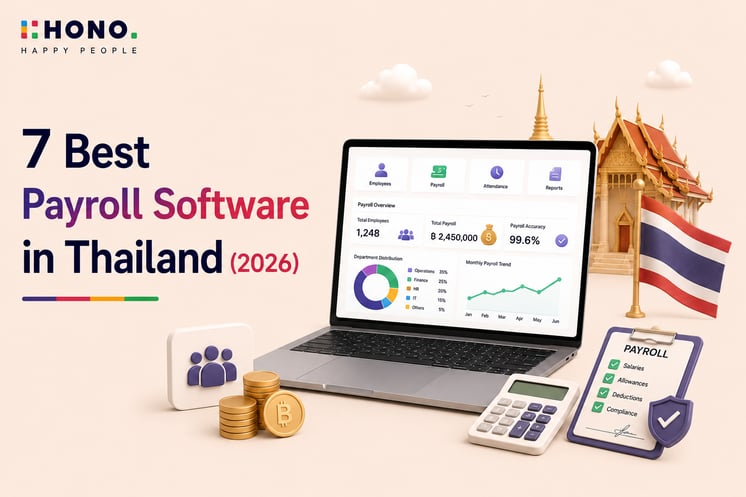
Running payroll in Thailand isn't just a matter of hitting "send" on bank transfers at the end of the month. Thai employers juggle an intricate web of statutory obligations: withholding personal income tax under PND 1, managing the Workmen’s Compensation Fund, tracking provident funds, and generating payslips in the Thai language.
Staying compliant became even more demanding on January 1, 2026. The Social Security Office implemented a major regulatory shift, raising the maximum monthly wage ceiling used to calculate Social Security Fund (SSF) contributions from 15,000 baht to 17,500 baht. This marks the first adjustment to the cap in nearly three decades.
If your current payroll tool or spreadsheet setup still rounds off contributions at the old 15,000 baht cap, it is quietly generating non-compliant numbers. Over time, those back-taxes and penalties add up.
This guide reviews seven payroll platforms used by companies in Thailand today. We evaluate each one on its compliance capabilities, Thai language support, system localization, and organizational fit, ranging from local tools for growing startups to regional Human Capital Management (HCM) systems for multinational enterprises.
Key Takeaways
Why dedicated Payroll software matters: Manual spreadsheets cannot reliably track the phased SSF ceiling increase, PND 1 deadlines, or Workmen's Compensation risk classifications, and errors in these areas can result in significant financial penalties.
The 7 platforms at a glance: HONO, Humanica, DataOn (SunFish), Empeo, Tigersoft, BetterHR, and Darwinbox each cater to different business needs, from Thai SMEs to large enterprises with multi-country payroll operations.
Methodology: Platforms were evaluated based on statutory compliance capabilities, Thai language support, pricing transparency, ease of implementation, and their proven track record in the Thailand market.
Detailed comparison: Each solution is reviewed for its core strengths, standout features, and ideal business size—from a 20-person retail business to a 5,000-employee manufacturing enterprise.
How to choose: The best payroll software depends on your company size, need for multi-country payroll, budget per employee, and whether you prefer managing payroll internally or outsourcing it.
Why Dedicated Payroll Software is Essential in Thailand
Managing Thai payroll using manual spreadsheets introduces significant compliance risks. Thailand's payroll regulations require accurate calculations, timely tax submissions, and proper statutory reporting. A dedicated payroll system helps businesses automate these processes, reduce errors, and remain compliant with local labor and tax laws.
The 2026 SSF Ceiling Update: Payroll software should automatically apply the 17,500 baht Social Security Fund (SSF) salary cap, ensuring both employee and employer contributions of 5% are calculated correctly for salaries above the previous threshold.
PND 1 and PND 1 Kor Withholding: The system should generate accurate withholding tax forms and support timely submissions. Physical filings are due by the 7th of the following month, while electronic filings must be completed by the 15th.
Workmen’s Compensation Fund (WCF): WCF premiums typically range from 0.2% to 1.0%, depending on the employer's industry risk classification. Since these calculations are based on gross wages without a salary cap, payroll software must accurately track employee earnings.
Provident Funds (PVD): A robust payroll platform should support voluntary employee contributions and employer matching schemes ranging from 2% to 15% of employee salaries.
Localization and Language Support: Payroll software should generate compliant Thai-language or bilingual payslips, 50 Tawi tax certificates, and statutory reports that meet the requirements of Thailand's Revenue Department and Social Security Office.
The 7 Best Thai Payroll Platforms at a Glance
Software | Best For | Pricing Model | Key Advantage |
|---|---|---|---|
HONO | Large enterprises wanting regional payroll and AI analytics | Custom enterprise quotes | Conversational HR via teams, slack on mobile. |
Humanica | Mid-to-large firms seeking software + full BPO outsourcing | Custom quote based on service scope | Market leader listed on the Stock Exchange of Thailand |
DataOn (SunFish) | Mid-market businesses scaling across 5+ ASEAN nations | Modular enterprise quotes | Highly configurable rules for complex shifts |
Empeo | Thai SMEs and mid-market teams wanting modern cloud HR | 590 to 3,990 baht/month tiers | Built natively for local banks and Thai tax rules |
Tigersoft | Established Thai companies wanting hybrid hardware + software | Subscription or license quotes | Direct integration with physical biometric timeclocks |
BetterHR | Startups and budget-conscious regional operators | 80 baht per employee/month | Flat, transparent pricing with a simple UI |
Darwinbox | Enterprises (500+ employees) needing unified APAC HCM | Custom quote (approximately $5/user/month estimate) | Fast enterprise deployment via the RIVeR framework |
The 7 Best Payroll Systems for Thailand
1. HONO
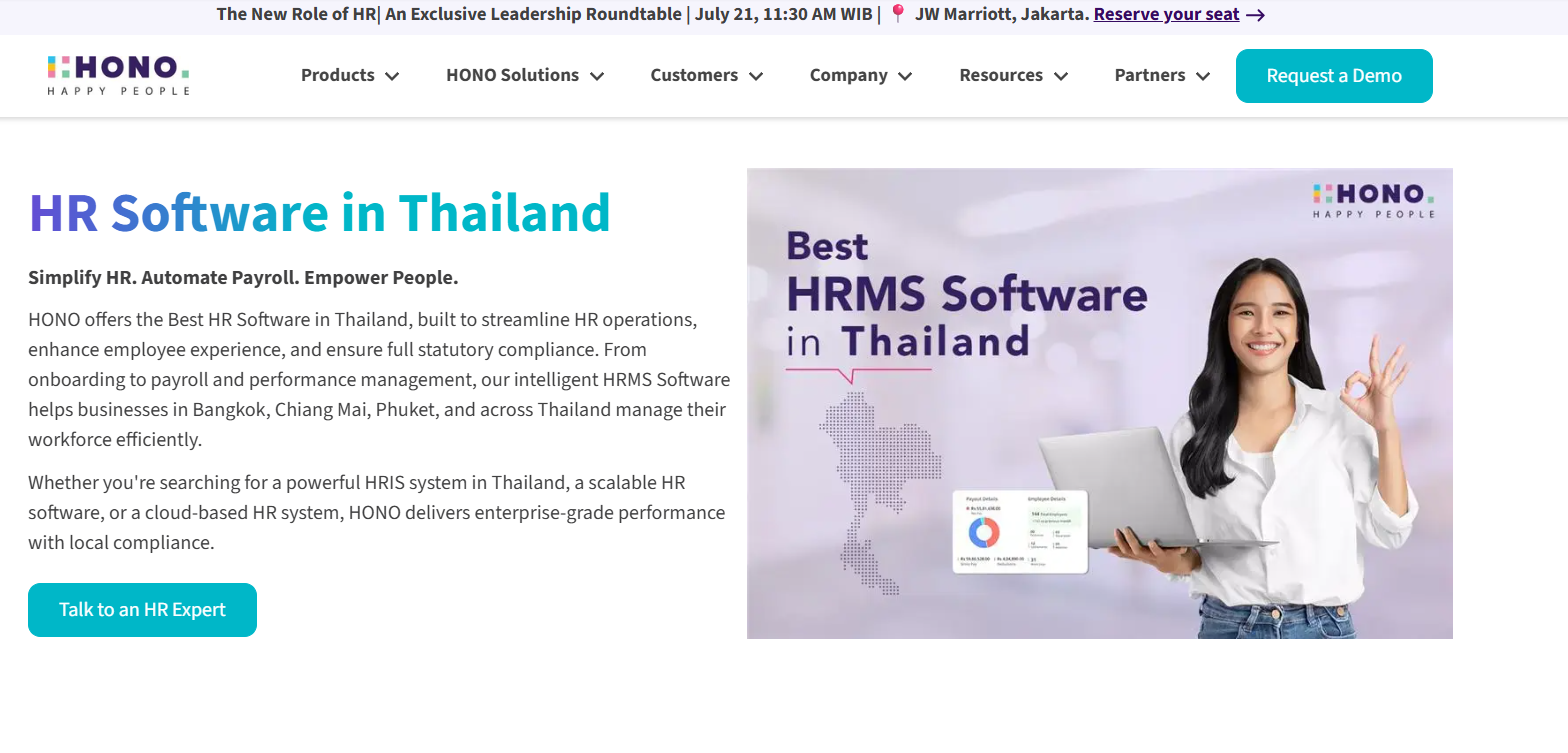
HONO is a comprehensive, AI-powered Human Capital Management (HCM) suite built for large enterprises managing distributed workforces across Asia. With operations spanning more than 25 countries, the platform supports organizations that require localized payroll engines while maintaining a unified regional HR system.
One of HONO's standout features is its chat-first approach to employee engagement. Rather than relying solely on traditional HR portals, employees can access payroll and HR services through familiar messaging platforms such as Line, WhatsApp, and Microsoft Teams. They can retrieve payslips, submit attendance requests, check leave balances, and complete routine HR tasks directly within these applications. Behind the scenes, the payroll engine calculates Thai statutory deductions while AI-powered analytics help identify workforce trends, retention risks, and productivity patterns.
Key Strengths
Comprehensive 14-module hire-to-retire HCM suite.
Localized payroll engines for Thailand and other regional markets.
AI-powered workforce insights and predictive analytics.
Chat-based employee self-service through Line, WhatsApp, and Microsoft Teams.
Enterprise-grade security with ISO 27001 and SOC 2 Type 2 certifications.
Best For
Large enterprises operating in Thailand that need regional payroll capabilities, AI-driven workforce management, and a modern chat-based employee experience.
2. Humanica (Workplaze)
Humanica is one of Thailand's most established HR and payroll providers. Founded in 2003 and listed on the Stock Exchange of Thailand, the company has built a strong reputation for its expertise in Thai payroll compliance and labor regulations. Its proprietary HR platform, Workplaze, is now used by organizations across Thailand and Southeast Asia.
A key differentiator of Humanica is its flexible delivery model. Businesses can either deploy the Workplaze platform to manage payroll internally or outsource the entire payroll process to Humanica's Business Process Outsourcing (BPO) team. The company's payroll specialists can process payroll changes, prepare tax filings, and help organizations meet ongoing statutory compliance requirements.
Key Strengths
Extensive expertise in Thai labor laws and payroll compliance.
Strong local support backed by decades of industry experience.
Flexible deployment with both software and payroll outsourcing (BPO) services.
Listed on the Stock Exchange of Thailand, providing an established market presence.
Best For
Mid-sized and enterprise organizations that want a trusted local payroll provider or prefer outsourcing payroll processing to an experienced team.
3. DataOn (SunFish Worklife)
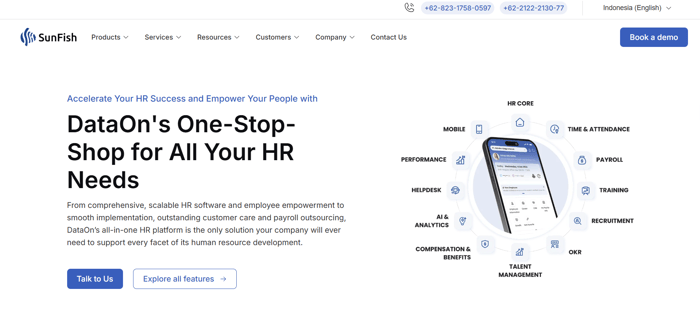
DataOn's SunFish Worklife is a comprehensive HRIS and ERP platform designed for businesses operating across Southeast Asia. Since its launch in 2005, the platform has supported approximately 2,000 organizations in countries including Thailand, Indonesia, Malaysia, Vietnam, and the Philippines with localized HR and payroll management.
SunFish Worklife is known for its highly configurable architecture, making it well suited for organizations with complex workforce requirements. Businesses can configure detailed shift schedules, multi-level overtime policies, department-specific compensation rules, and industry-specific payroll workflows without extensive custom development. In addition to its cloud-based software, DataOn also provides managed payroll services, allowing organizations to transition between in-house payroll management and outsourced processing as their operational needs evolve.
Key Strengths
Highly configurable payroll and HR rules engine for complex workforce policies.
More than 25 modular HR extensions to support business growth.
Localized payroll engines across five major ASEAN countries.
Flexible deployment with both cloud software and managed payroll services.
Best For
Manufacturing, retail, logistics, and industrial organizations that require advanced shift management, complex payroll configurations, and multi-country HR operations across Southeast Asia.
4. Empeo
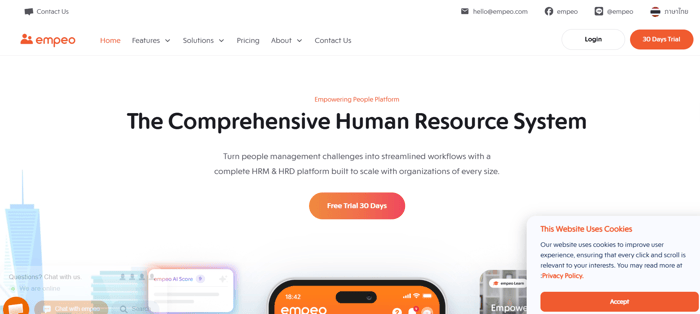
Empeo is a cloud-based HR and payroll platform developed specifically for businesses in Thailand. Recognized at the Thailand ICT Awards, the platform emphasizes an intuitive user experience, transparent subscription pricing, and automation of Thai payroll and statutory compliance processes.
The platform streamlines core payroll operations by calculating Thai income tax, supporting the 2026 Social Security Fund (SSF) contribution rules, and generating payment files compatible with major Thai banking portals for salary transfers. Its employee self-service portal also enables staff to submit personal tax deduction information, such as mortgage interest and insurance allowances, helping HR teams reduce manual data entry and improve payroll accuracy.
Key Strengths
Affordable subscription plans starting from 590 baht per month.
User-friendly cloud interface with minimal implementation effort.
Support for managing multiple business entities within one account.
Built-in AI-powered productivity features and employee self-service tools.
Automated payroll calculations and Thai statutory compliance.
Best For
Small and medium-sized businesses in Thailand that want an easy-to-implement, cloud-based HR and payroll solution with strong local compliance capabilities.
5. Tigersoft
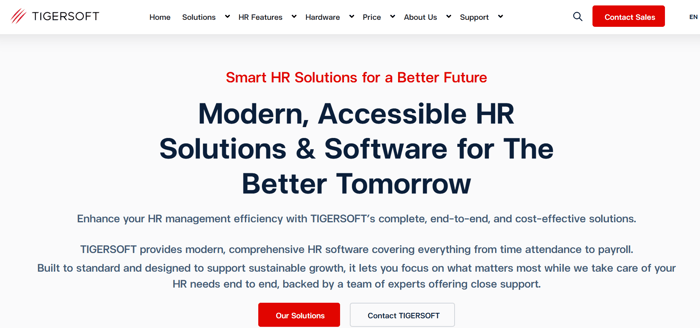
Tigersoft is one of Thailand's longest-established HR and payroll software providers, serving local businesses since 1998. The company is well known for delivering reliable payroll processing, comprehensive statutory reporting, and flexible deployment options for organizations with varying IT requirements.
Through its Tiger OpenSpace solution, Tigersoft offers seamless integration between payroll software and physical attendance hardware. Businesses can connect biometric devices, fingerprint scanners, facial recognition terminals, and access control systems directly to the payroll platform. Attendance data flows automatically into payroll calculations, helping organizations accurately process overtime, late arrivals, absences, and working hours while reducing manual data entry.
Key Strengths
Flexible deployment with both on-premise and cloud-based options.
Comprehensive government-compliant payroll and statutory reporting.
Direct integration with biometric attendance devices and time-clocking systems.
Bundled hardware and software solutions for workforce management.
Reliable payroll processing backed by decades of local market experience.
Best For
Established businesses in Thailand, including manufacturing, hospitality, and other industries that require integrated biometric attendance systems alongside a dependable payroll compliance solution.
6. BetterHR
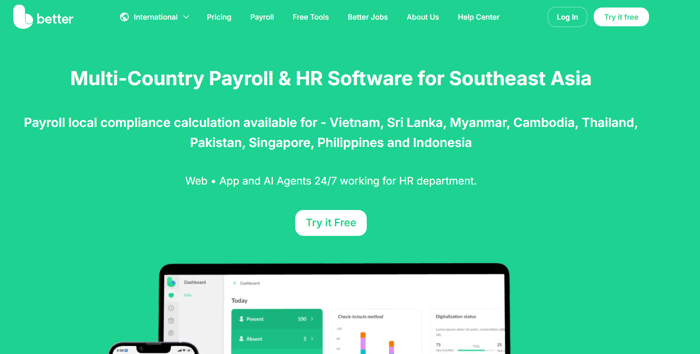
BetterHR is a cloud-based HR and payroll platform designed for startups, small businesses, and fast-growing companies across Southeast Asia. The platform focuses on simplicity, affordability, and ease of use, making it an attractive option for organizations that want to digitize payroll without investing in a complex enterprise solution.
One of BetterHR's biggest advantages is its transparent pricing model. Businesses pay a flat fee of 80 baht per employee per month under an annual subscription, with no hidden implementation charges or mandatory module upgrades. Despite its cost-effective pricing, the platform supports essential Thai payroll requirements, including progressive income tax calculations, the 2026 Social Security Fund (SSF) contribution rules, and the generation of PND 1 and Social Security Office (SSO) reports.
Key Strengths
Transparent pricing at 80 baht per employee per month.
Simple, intuitive interface with fast account setup.
Supports Thai payroll compliance, including tax and SSF calculations.
Generates PND 1 and SSO statutory reports.
Native support for multiple Southeast Asian markets.
Best For
Startups, small businesses, and regional teams seeking an affordable, self-service payroll solution that is quick to implement and easy to manage.
7. Darwinbox
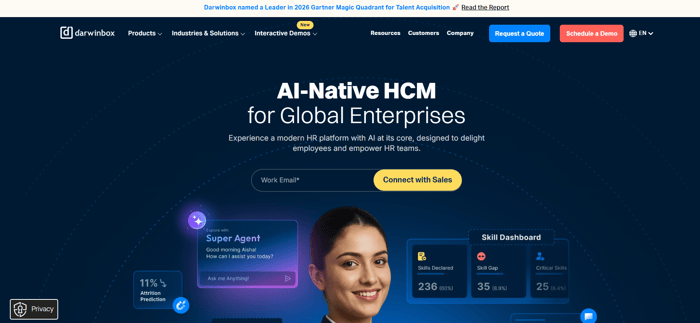
Darwinbox is a leading enterprise Human Capital Management (HCM) platform serving organizations across the Asia-Pacific region. Designed for large enterprises, the platform combines comprehensive HR capabilities with localized payroll processing, enabling businesses to manage regional workforces from a single unified system.
The platform leverages its RIVeR framework (Review, Verification, and Reporting) to streamline payroll approvals and strengthen governance. This workflow ensures that Thai payroll undergoes the necessary review and compliance checks before final processing. Instead of relying on third-party payroll integrations, Darwinbox offers a native Thai payroll engine alongside modules for recruitment, performance management, employee engagement, and strategic workforce planning.
Key Strengths
Native payroll compliance across 11+ APAC and GCC markets.
RIVeR framework for structured payroll review, verification, and reporting.
Unified HCM platform covering payroll, recruitment, performance, and workforce planning.
Mobile-first user experience for employees and managers.
Enterprise implementation timelines typically ranging from four to six months.
Best For
Enterprises and high-growth organizations with more than 500 employees that require a single HCM platform to manage regional talent operations and localized payroll compliance across multiple countries.
How to Choose the Right Payroll Platform
Selecting the right payroll platform depends on your organization's size, operational complexity, compliance requirements, and long-term growth plans. Evaluating these factors carefully will help you choose a solution that supports both your current needs and future expansion.
1. Assess Your Scale and Operational Footprint
Your company size and geographic presence are among the most important considerations when selecting payroll software.
SMEs and Startups (1–150 employees): Businesses operating a single entity in Thailand with a lean HR team should prioritize ease of implementation, intuitive workflows, and fast deployment. Solutions such as Empeo, BetterHR, and Tigersoft provide essential payroll and compliance capabilities without the complexity of enterprise-grade systems.
Mid-Market and Enterprises (150+ employees or Multi-Country Operations): Organizations managing larger workforces or operating across multiple countries should focus on platforms that provide centralized reporting, multi-entity payroll management, and seamless integration with broader HR processes. Solutions like HONO, Darwinbox, and DataOn are designed to support regional operations from a unified platform.
2. Verify Regulatory Compliance
Before selecting a payroll provider, request a live demonstration of how the platform handles Thailand's statutory payroll requirements.
Confirm that the system correctly applies the January 2026 Social Security Fund (SSF) salary ceiling.
Verify that salaries exceeding 17,500 baht generate the maximum SSF contribution of 875 baht for both employers and employees.
Ensure the platform supports Thai tax calculations, statutory reporting, and required government filing formats.
3. Determine Your In-House Payroll Capabilities
Decide whether your organization intends to manage payroll internally or outsource payroll processing and compliance responsibilities.
For in-house payroll teams: Cloud-based SaaS platforms such as Empeo and BetterHR provide the tools needed to manage payroll efficiently while maintaining direct control over payroll operations.
For outsourced payroll management: Vendors such as Humanica and DataOn offer managed payroll services alongside their software platforms, enabling organizations to transfer payroll processing and compliance responsibilities to experienced local specialists.
Frequently asked
FAQs
See it live
Ready to see HONO in action?
Book a 20-minute demo tailored to your team's HR stack.
Request a demo
About the author
Harshita Bhalla
Harshita Bhalla is an Assistant Manager - HR at HONO and a Certified HR Payroll Specialist with around 4 years of experience in HR operations, payroll, and employee lifecycle management. She has worked across domestic and international payroll functions and brings a detail-oriented, people-first approach to everything she does. Harshita is passionate about building efficient HR systems that support both people and business growth.