The Copilot Problem
A July 2025 Gartner survey of HR leaders revealed a sobering finding: 88% of organisations have not realised significant business value from their AI tools. Not marginal returns — no significant value at all. For a function that has poured budget and change management effort into AI adoption, that number demands a serious explanation.
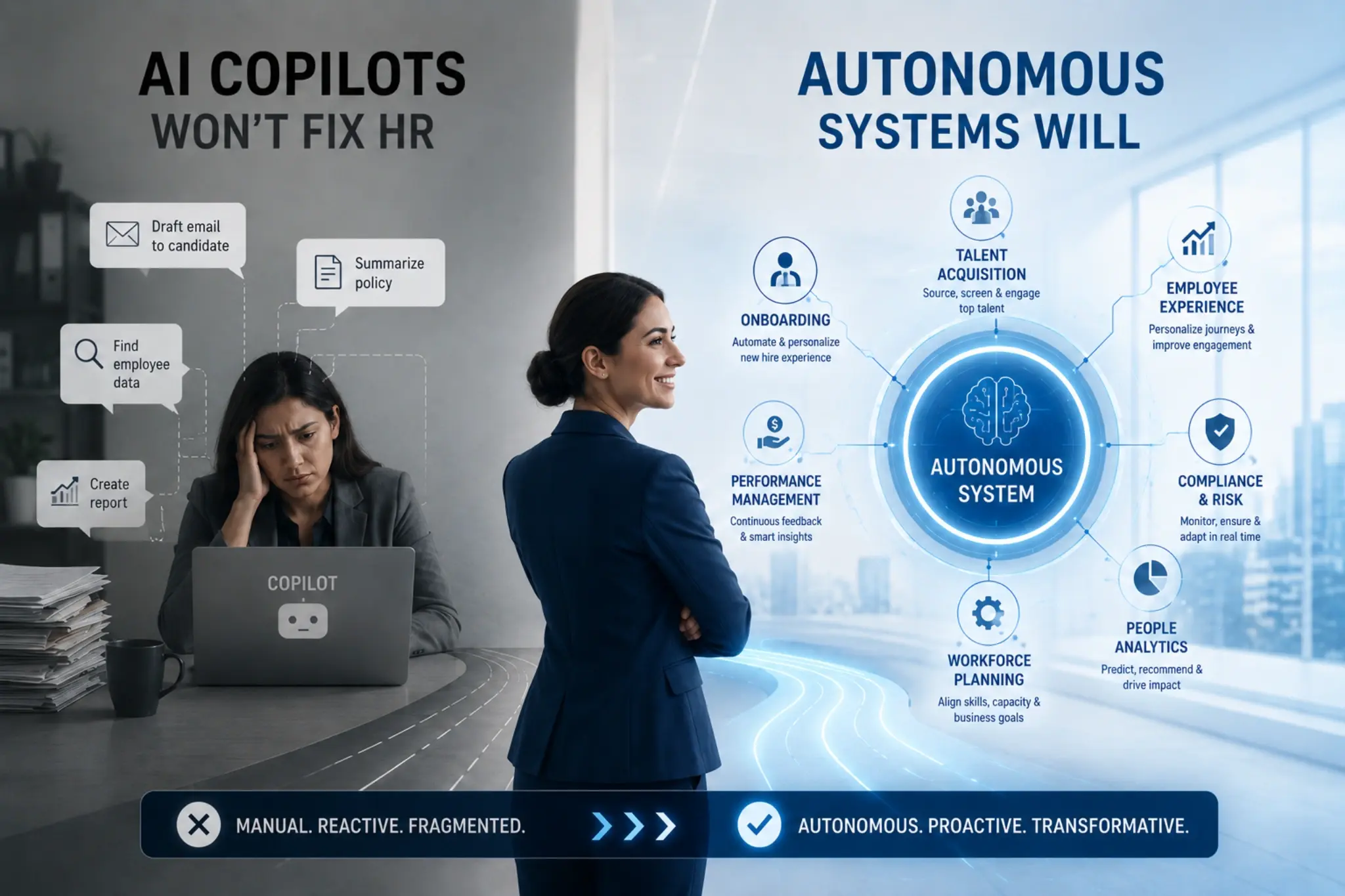
The explanation is not that AI is weak. It is that copilots are architecturally limited. A copilot assists. It waits to be prompted, offers a suggestion, and then hands control back to the human. In an HR context — where the same transactional requests repeat thousands of times a month across leave approvals, payslip queries, onboarding checklists, and benefits enrolments — a system that still requires a human to prompt, review, and confirm every step is not fixing the workload. It is redistributing it.
HR professionals already spend as much as 57% of their time on administrative tasks, according to Deloitte research. A copilot that helps them do those tasks a little faster is not a transformation. It is a speed bump on the way to one.
What Autonomous Systems Actually Change
The meaningful shift comes when AI stops assisting and starts acting. Agentic AI systems — those capable of planning, executing, and adapting across multi-step workflows without waiting for human confirmation at each stage — represent a categorically different proposition. A frontline employee requests shift cover; the system finds a match, confirms availability, updates the schedule, and notifies both parties. No portal. No queue. No human intermediary required for a routine task.
Gartner's forecast reflects this trajectory: by 2030, 50% of current HR activities will be AI-automated or performed by AI agents, fundamentally transforming HR workflows and roles. More immediately, 82% of HR leaders plan to deploy some form of agentic AI within the next 12 months, according to a May 2025 Gartner survey — a sign that the industry is actively moving beyond the copilot model, even if the language hasn't caught up yet.
The distinction matters because it changes what HR professionals can focus on. When routine work is genuinely handled end-to-end by autonomous systems, HR's human capacity shifts to the work that actually requires judgment: complex employee relations, organisational design, culture, and strategy.
The Interoperability Wall
There is, however, a significant structural obstacle between where most organisations are today and the autonomous HR future they are investing toward — and Gartner has named it directly.
Eser Rizaoglu, Senior Analyst in Gartner's HR Practice, flagged interoperability as a central challenge for HR leaders evaluating agentic AI. "Protocols in the market are still not set," he warned, noting that agents from different platforms may not be able to work together. The lack of industry standardisation means that even well-funded AI deployments can stall at the seams — unable to share data cleanly across payroll, performance management, time tracking, and benefits systems that were never designed to talk to each other autonomously.
This is not a minor technical footnote. It is the primary reason AI copilots have remained bolt-ons rather than transformative infrastructure. When each HR module is a walled garden with its own interface and data model, the AI layer on top can only do so much. The system cannot act autonomously if it cannot move freely across systems.
Architecture Is the Strategy
Solving the interoperability problem requires thinking about HR infrastructure differently. The organisations that will unlock genuine autonomous HR are not the ones that buy the most AI features — they are the ones that build or adopt a composable, API-first foundation where HR data and logic are decoupled from any single vendor's interface.
This is the principle behind headless HR architecture. When the system's capabilities are exposed via clean APIs rather than locked inside a proprietary UI, any AI agent — whether embedded in Slack, triggered by a workflow engine, or surfaced through a voice interface — can read, write, and act on HR data in real time. Platforms like Hono Headless are built precisely on this model, giving organisations the interoperable foundation that agentic AI actually requires to function at its potential.
The Gap Between Excitement and Execution
Gartner's Hype Cycle for AI in HR, 2025 makes the current moment clear: GenAI in HR is moving toward the Trough of Disillusionment, while agentic AI remains in early infancy. The organisations that will emerge well are not those that chased every new AI feature, but those that made deliberate architectural decisions early — decisions that ensure their systems can actually support autonomous action when the technology matures to deliver it.
AI copilots were a reasonable first step. They demonstrated that AI could add value to HR workflows and shifted expectations about what was possible. But the destination was never a smarter assistant. It was a system that does not need to be asked.
That system is coming. The question is whether your infrastructure is ready to run it.
Frequently asked
FAQs
See it live
Ready to see HONO in action?
Book a 20-minute demo tailored to your team's HR stack.
Request a demo
About the author
Mazna Majeed
Mazna is a strategic HR leader with over 10 years of experience driving talent success and organizational growth. As Head of Talent Acquisition and Operations at HONO, she leads HR initiatives across India and South-East Asia, including manpower planning, employee lifecycle management, talent development, engagement, and retention. Mazna is known for aligning people strategy with business goals, building inclusive high-performing teams, and strengthening culture to enable sustainable growth.