The Quiet Collapse of the Dashboard Era
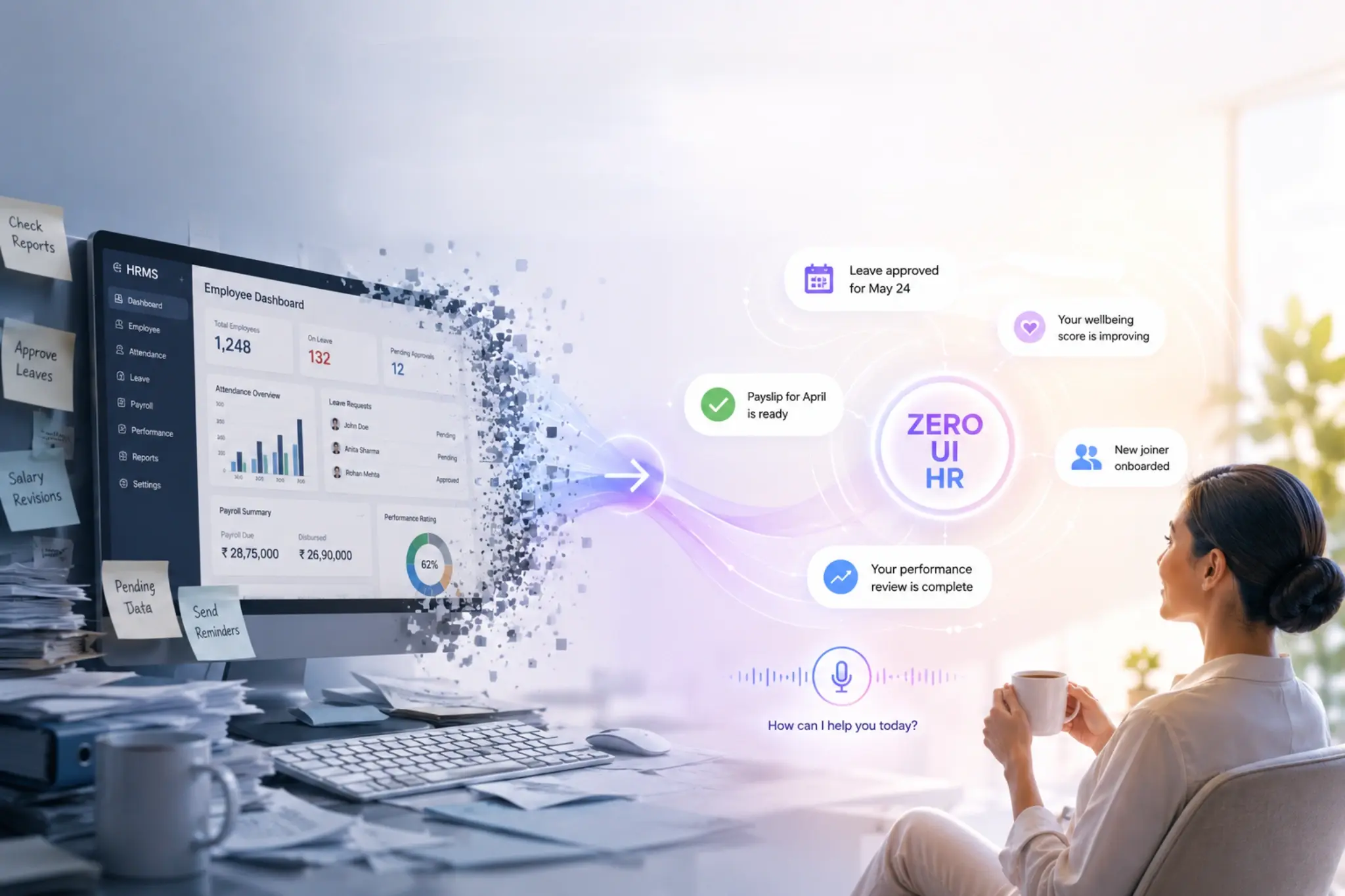
HRMS platforms were designed around a simple assumption: HR professionals sit at desks, open a browser, and navigate screens. That assumption no longer holds. Workforces are distributed, mobile, and time poor. Employees are not going to log into a self-service portal to check their payslip — they want to ask and receive an answer instantly.
The numbers reflect this strain. According to a 2024–2025 survey by Sapient Insights Group, 28% of enterprise organisations now expect to replace their HRMS — up sharply from just 10% the prior year. Separately, research cited by Gartner found that 56% of HR leaders say their existing technology does not match current or future business needs. These are not small cracks. They are structural faults.
Meanwhile, employee expectations are shifting decisively. HR.com's 2025 State of HR Technology report found that enhancing employee experience now ranks as the second-highest HR technology priority, cited by 55% of respondents. The traditional dashboard, designed primarily for HR administrators rather than employees, is poorly equipped to deliver that experience.
What Zero UI Actually Means
Zero UI does not mean no interface. It means the interface becomes invisible. Instead of navigating to software, employees and HR teams speak to it — through natural language, voice, or messaging apps they already use. The system understands intent, takes action, and confirms completion. The screen disappears; the outcome remains.
Gartner's 2024 Hype Cycle for HR Technology identified HR Virtual Assistants as a key trending innovation, noting that HR solutions without AI will increasingly lag in the market. The shift is not merely about adding a chatbot to an existing portal. It is about rebuilding the interaction model from the ground up — making the conversation the product, not the screen.
This matters because the data shows employees are ready. A July 2025 Gartner survey of nearly 3,000 workers found that 65% are genuinely excited about using AI at work. The barrier to adoption is not enthusiasm; it is poor deployment. When HR software meets employees in the tools and workflows they already inhabit, adoption follows naturally.
Agentic AI: The Engine Behind Zero UI HR
The conversation is moving faster than most HR leaders realise. By May 2026, 82% of HR leaders plan to implement some form of agentic AI, according to Gartner — systems that do not merely respond to queries but plan, execute, and adapt on behalf of the user. A frontline employee can say, “Find someone to cover my Saturday shift” and receive not a list of links, but a completed action.
Gartner's longer-term forecast is even more striking: by 2030, 50% of current HR activities will be AI-automated or performed by AI agents, fundamentally transforming HR roles and workflows. Routine requests — updating benefits, checking pay, requesting time off, retrieving policy documents — will be resolved in seconds through conversational interfaces, without a single screen navigation required.
This is precisely the architecture that headless HR platforms are built for. When the HR system's logic is decoupled from its presentation layer — exposed as an API rather than locked inside a proprietary UI — organisations can surface HR capabilities anywhere: inside Slack, through a voice assistant, embedded in a mobile workflow, or delivered through an intelligent agent.
Why This Shift Is Irreversible
First, the workforce has changed. Millennials and Gen Z now constitute the majority of most organisations' employees. They do not consult manuals. They ask questions and expect answers. An HRMS that forces them into a 2012-era portal experience creates disengagement before the interaction even begins.
Second, AI has matured enough to be trusted. The global market for AI in HR was valued at $3.25 billion in 2023 and is forecast to grow at a CAGR of 24.8% through 2030. The tooling — large language models, agentic frameworks, intent recognition — is no longer experimental. It is production-ready.
Third, the cost of screen-based HR is becoming visible. Deloitte research has found that HR staff spend as much as 57% of their time on administrative tasks — time spent navigating the very interfaces that were meant to make work easier. Zero UI redirects that time toward strategy, relationships, and decisions that actually require human judgment.
The Interface Is Not the Point
The best HR technology should not be memorable. Employees should not think about the system; they should think about the outcome — the approved request, the answered question, the resolved issue. When software demands attention to its own structure, it has already failed part of its brief.
The dashboards are not dying because they were built badly. They are dying because the world they were built for no longer exists. The organisations that recognise this shift now — and invest accordingly — will not just have better HR software. They will have a meaningfully better employee experience.
Frequently asked
FAQs
See it live
Ready to see HONO in action?
Book a 20-minute demo tailored to your team's HR stack.
Request a demo