The Problem Nobody Wants to Say Out Loud
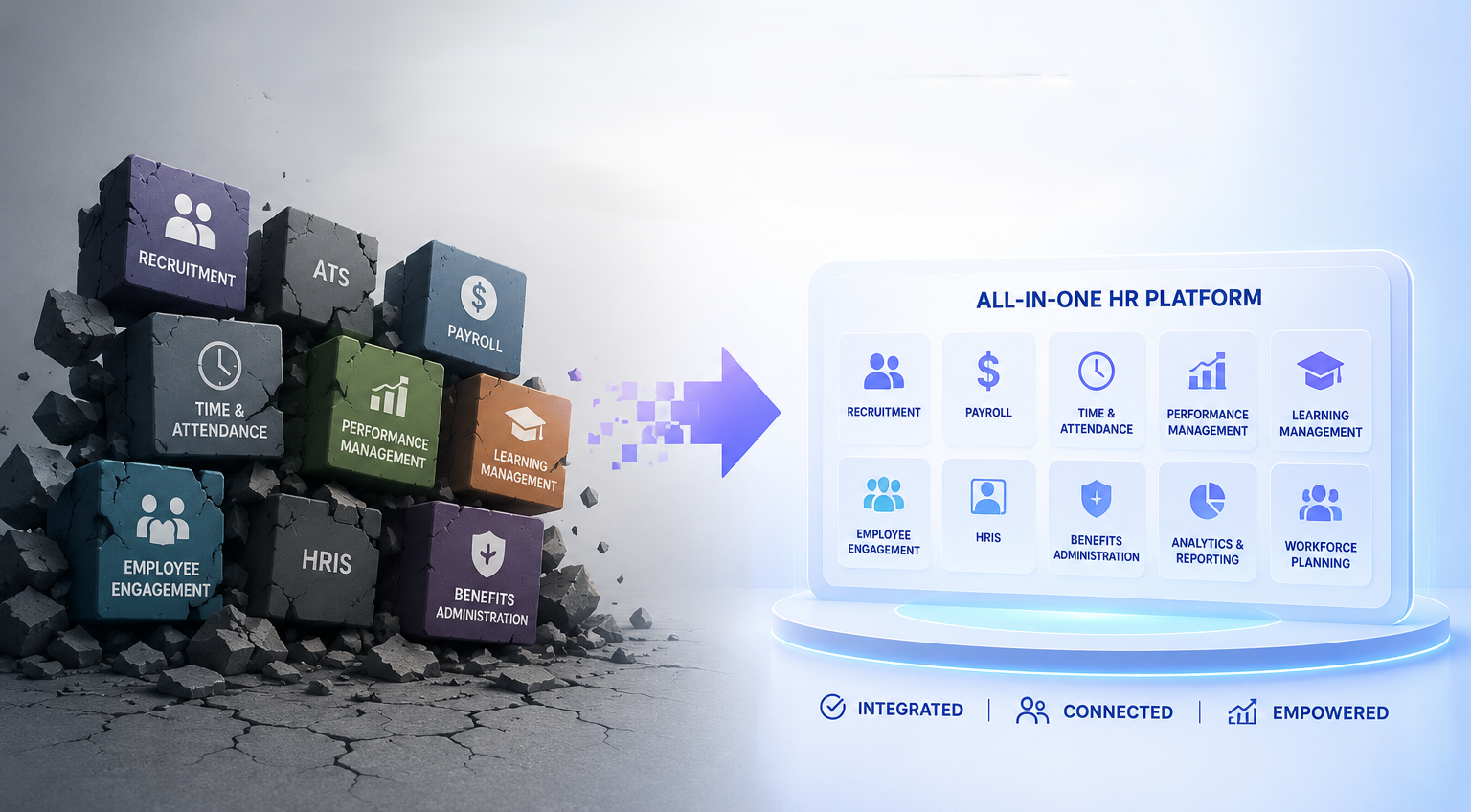
Most companies didn't plan to end up with a mess of disconnected HR tools. It happened gradually. A payroll system here, a performance management platform there, a standalone ATS added when headcount grew. Before long, HR was running on six or seven platforms that were never designed to work together.
According to the Josh Bersin Company’s 2026 HR Technology Market Report, a large enterprise typically runs at least nine separate HR systems, spending an average of $310 per employee per year on HR technology alone. That's nine sources of truth, each telling a slightly different story about your workforce. Sapient Insights Group found that over half of HR buyers were ready to replace their core HR applications within 12 to 24 months, citing dissatisfaction as the primary reason.
The cost goes beyond wasted hours. Poor data integration directly affects decision-making quality. When compensation data lives in one system and performance data in another, making a fair, informed promotion decision becomes genuinely difficult.
Why Integration Has Been So Hard
For years, the answer to fragmentation was supposed to be the all-in-one HRIS. Vendors promised platforms that could do everything. The reality was very different. These systems were rigid, slow to update, and expensive to customise. Companies simply traded one set of problems for another.
API-first thinking changed the conversation. As SaaS matured, connecting tools became more feasible. But even with better APIs, most HR teams still relied on IT to build and maintain integrations, creating a bottleneck that left HR dependent on engineering bandwidth.
A McKinsey piece on reimagining HR notes that many CHROs remain focused on ERP-style platforms when they should be thinking instead about solutions, data, and employee experience. The infrastructure mindset has lagged behind operational reality.
What’s Actually Changing Now
The shift happening now isn’t just technological. It’s architectural.
Forward-thinking organisations are moving away from the idea of a single HR platform and toward a composable stack — one built around a core layer that unifies data, workflows, and employee experience without forcing every tool into the same vendor ecosystem.
Gartner has highlighted the emergence of a Composable HR Application Framework (CHAF), enabling rapid deployment of new employee experiences through packaged business capabilities. Composable modularity is increasingly seen as the foundation for continuous, adaptive business change across all technology layers.
This is where headless HR infrastructure becomes relevant. Platforms like Hono separate the logic layer from the experience layer, allowing HR teams to connect best‑of‑breed tools without rebuilding their entire stack. Instead of replacing everything, organisations create a unified operating layer on top of existing systems. The result is less vendor lock‑in, faster implementation, and HR data that actually talks to itself.
Gartner’s 2025 HR Software Trends Survey found that 70% of HR leaders expect software costs to rise, with integration and AI capabilities driving most new investment. The real question is no longer whether to invest, but whether existing architecture can absorb that investment without increasing fragmentation.
The Human Cost of Getting This Wrong
It’s tempting to frame HR tech fragmentation as an IT problem. It isn’t.
When onboarding workflows span three unconnected systems, new hires feel it immediately. When managers can’t see a complete picture of their team without chasing data across platforms, decision quality suffers.
McKinsey’s 2025 HR Monitor found that roughly 36% of employees across Europe and the United States are not satisfied with their employer. HR leaders consistently pointed to gaps between business expectations, employee needs, and HR delivery — gaps that fragmented tooling reinforces.
What Comes Next
The fragmented HR tech stack isn’t disappearing because a single vendor finally built the perfect product. It’s disappearing because HR leaders are becoming smarter about architecture.
The question is shifting from “What tool should we buy?” to “How do we make our tools work as one?”
That quiet shift may prove to be one of the most consequential changes in HR operations this decade.
Frequently asked
FAQs
See it live
Ready to see HONO in action?
Book a 20-minute demo tailored to your team's HR stack.
Request a demo
About the author
Mazna Majeed
Mazna is a strategic HR leader with over 10 years of experience driving talent success and organizational growth. As Head of Talent Acquisition and Operations at HONO, she leads HR initiatives across India and South-East Asia, including manpower planning, employee lifecycle management, talent development, engagement, and retention. Mazna is known for aligning people strategy with business goals, building inclusive high-performing teams, and strengthening culture to enable sustainable growth.