Gartner put a number on where this is heading
In its Predicts 2024 research, Gartner identified composable modularity as a foundational architecture for continuous business adaptation, noting that composable enterprises are built on principles of modularity, autonomy, orchestration, and discovery. Separately, Gartner projected that by 2024, 70% of large and medium-sized enterprises would have composability as a key criterion in new application planning. That is not a niche technology preference. That is a mainstream shift in how organisations think about building their technology stack, including HR.
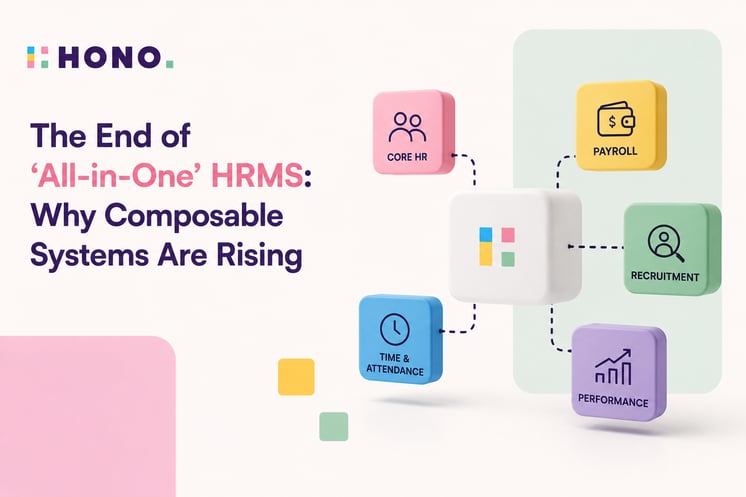
The composable approach is straightforward in principle: instead of a single vendor handling everything, organisations assemble best-of-breed modules that do specific jobs exceptionally well and connect them through APIs and integration layers. Swap out a component that is not working without tearing down everything around it. Add a new capability without a three-year implementation cycle.
The dissatisfaction with suites is real and measurable
Forrester's Q4 2025 Human Capital Management Wave noted a clear trend: HCM is no longer just about HR, benefits, and payroll functioning together. The expectation now is for platforms to act as connective tissue across enterprise systems, integrating with spend management, identity management, and workforce intelligence in ways traditional suites were never designed to support. When a suite cannot do that, organisations bolt on point solutions anyway, which is exactly the fragmentation they were trying to avoid in the first place.
The implementation data makes for uncomfortable reading. McKinsey research on large IT projects found they deliver, on average, 56% less value than predicted. Large-scale HRMS rollouts are not exempt from this. When a failed implementation costs an organisation millions and consumes years of internal capacity, the idea that a single vendor is the safe choice starts to look like a bias rather than a strategy.
Deloitte's research reinforces the pressure from the inside. HR staff spend as much as 57% of their time on administrative tasks, a figure Deloitte has cited in its work on HR modernisation. If the technology that was supposed to free HR professionals for strategic work is instead creating its own administrative overhead through workarounds, configuration backlogs, and data reconciliation, the suite is not solving the problem. It is part of it.
The composable model is not just about flexibility. It is about accountability
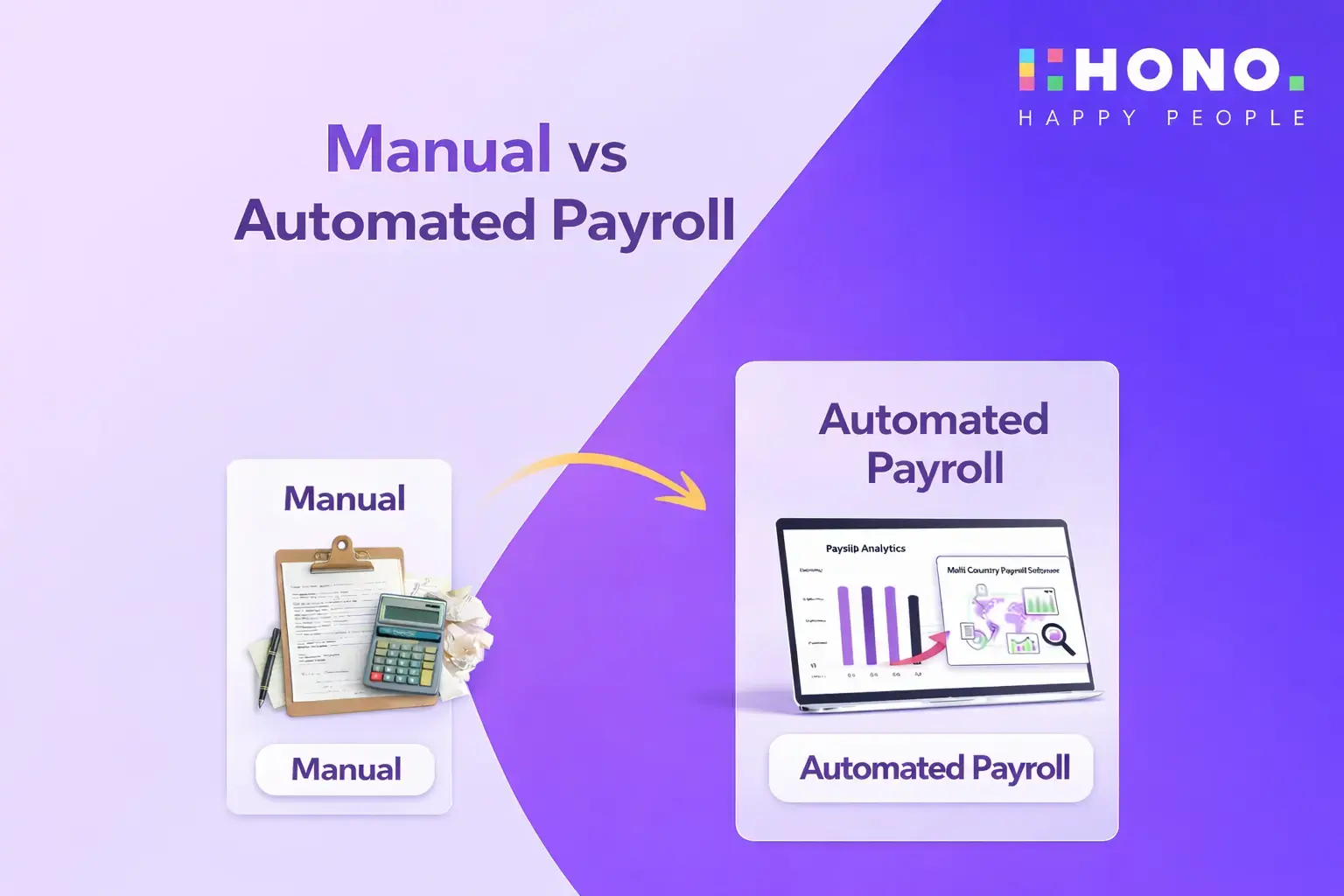
When every function lives in one system, poor performance in one area is insulated by the switching cost of the whole platform. With composable architecture, each module has to justify its place. A payroll component that generates errors gets replaced. A talent acquisition tool that does not integrate with workforce planning gets swapped. Vendors are held to a higher standard because the cost of replacing one piece is not the cost of replacing everything.
This is where platforms built with composability in mind have a real advantage. HONO, for instance, approaches HR technology as a modular system where workforce management, compliance, and people analytics can be deployed and integrated selectively across complex, multi-geography organisations, rather than forcing a single standardised experience on every function and every market.
The AI layer is making this even more urgent
Gartner's 2024 HR Technology Hype Cycle highlighted that adapting the operating model to AI has the highest predicted impact on AI productivity gains, at 29%, outpacing AI knowledge sharing or even AI skills. The organisations best positioned to capture that value are the ones whose HR tech architecture can absorb new AI capabilities as they mature, plug them into existing workflows, and replace them if something better comes along. A rigid all-in-one suite, with its own proprietary AI layer and closed ecosystem, cannot offer that.
The monolithic HRMS made sense in an era when integration was hard, cloud infrastructure was expensive, and the alternative was managing dozens of disconnected systems with no common data layer. That era is over. APIs are mature. Integration platforms are robust. The switching cost of modularity has fallen significantly, while the opportunity cost of staying locked into an underperforming suite has only grown.
The organisations that will get the most from their HR technology investments in the next five years are not the ones with the biggest, most comprehensive platform. They are the ones that built something they can actually change.


.png?width=70&height=70&name=Team%20HONO%20logo-01%20(1).png)










.jpg)