The Gap Between Effort and Outcome
The challenge has never been that HR teams do not care about employee experience. It is that they have been trying to solve a deeply personal problem with inherently generic tools.
A standard onboarding programme. A company-wide engagement survey every six months. A learning path built for a job title rather than an individual.
Everything gets designed for the average employee, because that is all a human team, however talented, can realistically manage at scale.
But Deloitte’s 2026 Global Human Capital Trends research puts it plainly: seven in ten business leaders now say that the experience of work itself needs to be fundamentally redesigned.
And McKinsey’s research shows that while nearly 80% of organisations have deployed AI in at least one business function, only one in five have actually rebuilt their work processes around it. The technology exists. The will to truly integrate it is what is lagging.
What AI Actually Changes
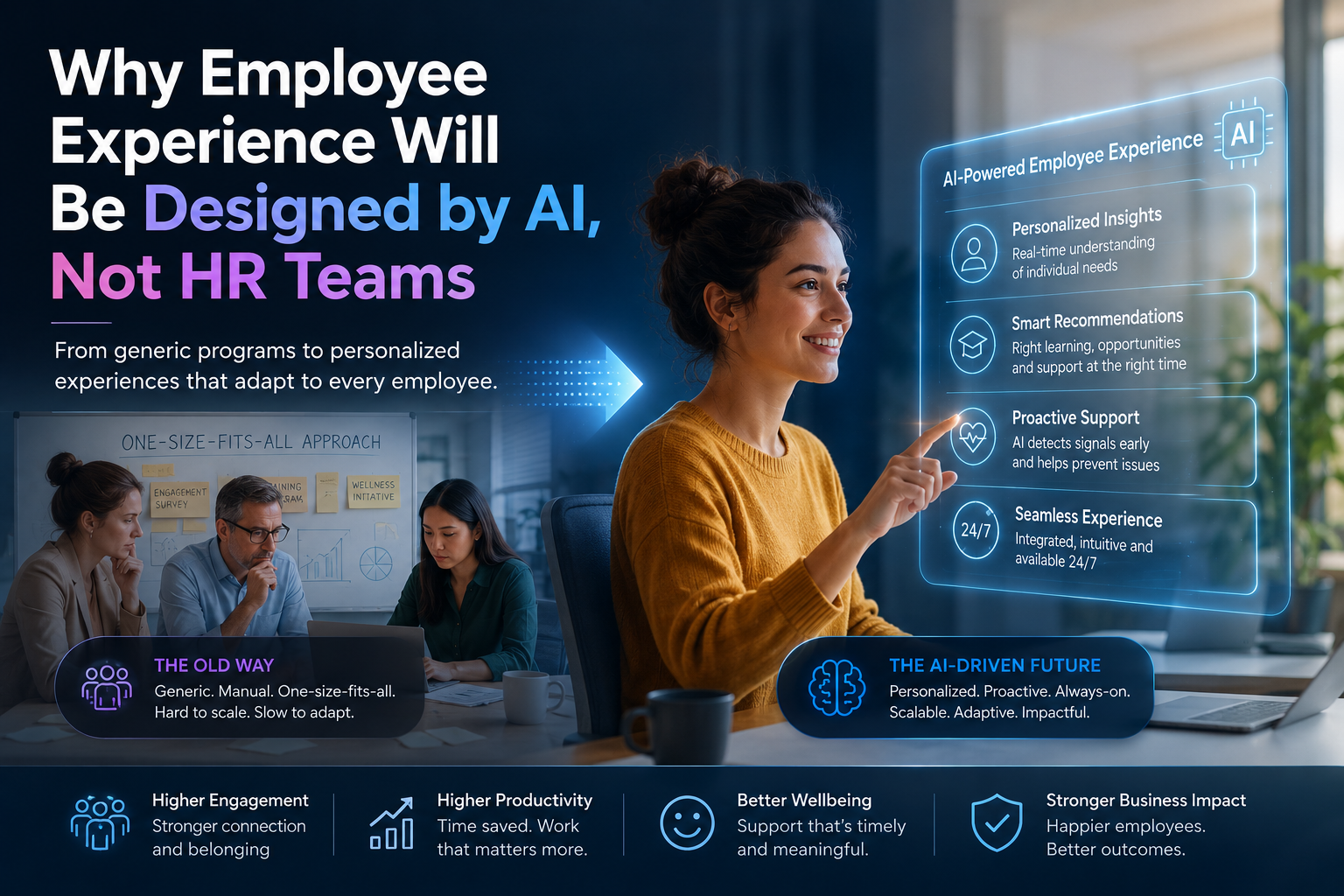
When AI is genuinely embedded into how an organisation operates, employee experience stops being a programme that HR runs once a quarter.
It becomes a continuous, adaptive environment that responds to people in real time.
Consider what that looks like in practice. Gartner research from July 2025 found that employees who use AI in roles where it is relevant save an average of 1.5 hours per day.
That is not just a productivity figure. That is an hour and a half returned to people every single day, freed from administrative friction and routine queries.
Time that can go toward work that is actually meaningful to them.
AI can also detect patterns that human managers simply cannot see at the right moment. Deloitte’s 2025 Workforce Intelligence Report found that mental fatigue and cognitive strain are now the leading indicators of burnout, surpassing workload volume for the first time.
Meanwhile, studies from McKinsey and the University of Oxford suggest that employees spend more than 60% of their working time navigating fragmented systems and unclear workflows.
AI can flag these signals early — before a manager notices, and before the person themselves has named what they are experiencing.
Beyond wellbeing, AI changes the economics of personalisation. Gartner has found that organisations implementing AI-driven engagement strategies have seen a 25% increase in overall workforce satisfaction.
That kind of result has historically required either an enormous HR team or a very small company. AI makes it achievable at any scale.
Platforms built with AI at their core are beginning to demonstrate this in practice. HONO, for instance, has been embedding AI into core HR workflows in ways that go beyond automation.
Helping organisations treat employee experience as something that adapts to people rather than processes.
The Readiness Problem Nobody Is Talking About
There is a harder truth here. Gartner’s October 2025 survey of 114 HR leaders found that 88% of organisations say they have not realised significant business value from their AI tools yet.
And only 7% of organisations provide any guidance to employees on how to use time saved by AI.
That is the real gap. It is not that AI does not work. It is that most organisations are treating AI as a feature to bolt on rather than a foundation to build from.
They are automating individual tasks without rethinking the underlying experience design.
The organisations pulling ahead are the ones asking a different question:
“Not how do we add AI to HR?”
But “if we started from scratch, knowing what AI can do, how would we design the experience of working here?”
What This Means for HR Professionals
None of this makes HR irrelevant. If anything, it makes human judgment in HR more important than it has ever been.
When AI handles the operational layer — personalised nudges, real-time feedback, policy queries, leave management, and learning recommendations — HR professionals are freed to do the work that genuinely requires human wisdom.
Building culture.
Navigating complex situations.
Setting ethical boundaries.
Thinking strategically about the organisation they want to build.
The design of employee experience will shift from HR teams building programmes to HR teams setting intentions that AI delivers personally, at scale, and continuously.
The Expectation Gap Is Closing Fast
Employees today are not comparing their experience at work to what it was five years ago.
They are comparing it to their experience as consumers — personalised, instant, and frictionless. That bar is only going to rise.
SHRM finds that 92% of CHROs are already accelerating AI integration into HR functions.
The organisations moving fastest are not doing it because it is interesting. They are doing it because the alternative is becoming a competitive liability.
Engagement scores will not improve through better survey design. They will improve when the experience of work itself is built to respond to the people living it.
AI is not going to redesign employee experience because HR asked it to.
It is going to do it because employees are going to demand nothing less.
The question is not whether AI will shape how people experience work. It already is. The question is whether your organisation is building with that reality in mind.
Frequently asked
FAQs
See it live
Ready to see HONO in action?
Book a 20-minute demo tailored to your team's HR stack.
Request a demo