
Key Takeaways
- Performance objectives are specific, measurable outcomes agreed between an employee and their manager for a defined period.
- A sound objective contains five components: action verb, task, metric, deadline, and conditions.
- The recommended number of objectives per cycle is 3 to 6, not more.
- Outcome, behavioural, developmental, and project-based are the four main types.
- Vague objectives like "improve reporting" are not objectives; they are wishes.
What Are Performance Objectives?
Performance objectives are specific, measurable outcomes that an employee is expected to achieve within a defined time period, agreed collaboratively between the employee and their manager, and used to guide day-to-day work and evaluate performance at review time. They sit at the centre of the performance management cycle and give both parties a shared, documented reference point.
Unlike a job description, which lists responsibilities, a performance objective defines the standard to which those responsibilities must be performed and by when. This distinction matters because it shifts the conversation from activity to accountability.
Performance objectives are set at the start of a review cycle, monitored through regular check-ins, and formally assessed at the end-of-cycle appraisal. Without them, managers have no consistent basis for evaluation, and employees have no clear target to work toward.
Where they sit in the performance management cycle
Performance objectives anchor the entire performance management process. Once set, they inform coaching conversations, feed into mid-cycle reviews, and determine the basis of end-of-cycle ratings. A manager who skips the objective-setting stage has no defensible foundation for the review conversation that follows.
Who sets them
Objectives work best when they are set collaboratively. A manager may define the strategic direction or non-negotiable business outcomes, but the employee shapes how those outcomes are scoped, measured, and achieved. Joint ownership at the outset creates the buy-in that makes the objective meaningful through the cycle, not just on paper.
Annual versus quarterly cycles
Traditional annual cycles offer stability but can quickly become disconnected from shifting business priorities. Quarterly cycles, popularised by the OKR framework, offer more agility and allow course correction before it is too late. Many organisations now use a hybrid: a small number of annual objectives tied to the formal review, with shorter-term goals refreshed each quarter.
Disambiguation: The term "performance objectives" appears in two other fields. In operations management, it refers to Nigel Slack's five competitive priorities: cost, quality, speed, dependability, and flexibility. In instructional design, it refers to learning objectives defined by performance, conditions, and criterion. This article covers employee performance objectives in HR.
What Does a Performance Objective Include?
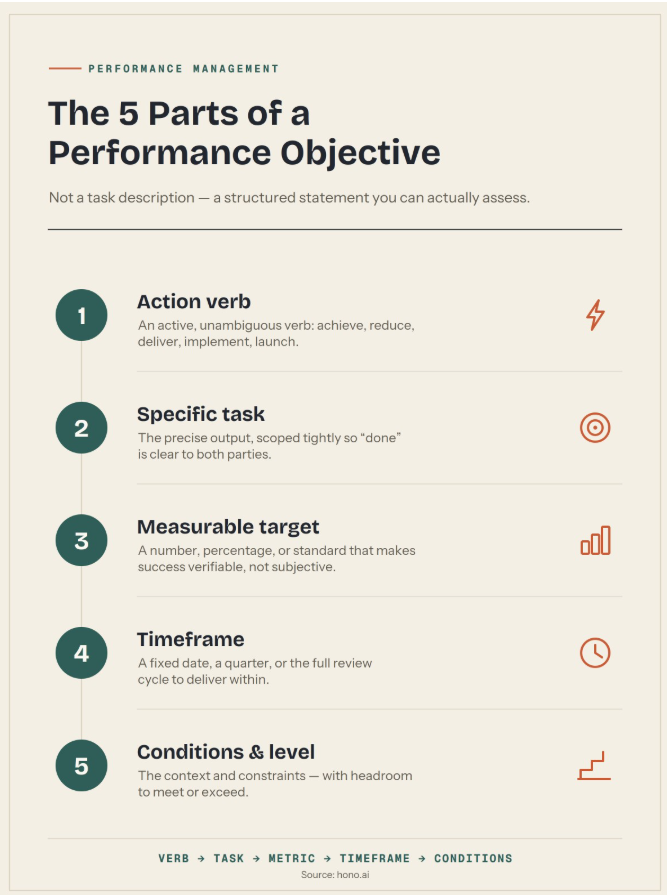
A performance objective is not a task description. It is a structured statement with five distinct components that together make the objective assessable and actionable.
- Action verb. An active, unambiguous verb that states what the employee will do: achieve, reduce, deliver, implement, increase, resolve, design, launch.
- Specific task or work activity. The precise output or project the verb applies to, scoped tightly enough that both parties agree on what done looks like. For more on how objectives relate to broader role accountabilities, see our glossary entry on key responsibility areas.
- Measurable target or metric. A number, percentage, rating, or observable standard that makes success verifiable rather than subjective.
- Timeframe or deadline. The period within which the objective must be achieved, whether a fixed date, a quarter, or the full review cycle.
- Conditions and expected level. The context or constraints under which the work is performed, written with enough headroom that an employee can both meet the objective and demonstrably exceed it.
Performance Objectives vs Goals vs KPIs vs OKRs
These four terms are frequently used interchangeably, but each operates at a different level of specificity and serves a different purpose.
| Term | Definition | Scope | Timeframe | Example |
| Performance objective | A specific, measurable commitment an individual employee is expected to meet | Individual | Quarterly or annual | Reduce customer churn by 5% by end of Q4 |
| Goal | A broader intended outcome, often aspirational, that guides direction without prescribing exact measures | Team or individual | Medium to long term | Become the market leader in customer retention |
| KPI | An ongoing metric used to monitor the health of a process, function, or business | Team, function, or organisation | Continuous | Monthly churn rate; Net Promoter Score |
| OKR | A cascading framework linking an ambitious qualitative objective to quantitative key results, used to align teams to organisational priorities | Organisation down to team | Quarterly | Objective: Deliver a best-in-class onboarding experience. KR: Reduce time-to-first-value from 14 days to 7 |
Performance objectives are specific, time-bound individual commitments that translate broader intent into personal accountability. Goals describe the larger outcomes those commitments serve. KPIs provide ongoing measurements that indicate whether a function is healthy. OKRs supply the alignment framework that connects individual effort to organisational direction.
Types of Performance Objectives
Outcome-based objectives focus on a concrete, quantifiable result the employee is expected to deliver. They represent the "what" of performance, independent of how it is achieved. They are the most common type in commercial roles because success is determined by data rather than observation. Example: Increase upsell revenue from existing accounts by 15% by the end of the financial year.
Behavioural and competency-based objectives shift focus to how work is done. They target the conduct, skills, and professional standards an employee demonstrates consistently. They are particularly valuable in roles where output is hard to quantify, or where culture and collaboration are explicit organisational priorities. Example: Demonstrate active listening and constructive challenge in all cross-functional project meetings, evidenced by 360-degree feedback scores of 4 or above from at least five peers by mid-year review.
Developmental objectives address growth rather than immediate performance. They cover skills to build, capabilities to acquire, or experiences to gain that will strengthen the employee's contribution over time. They are often set in parallel with outcome objectives and are especially common at career transition points. Example: Complete the internal data literacy programme and independently produce the monthly commercial dashboard, without analyst support, from Q2 onwards.
Project-based objectives are scoped to a defined piece of work with a clear start, end, and deliverables. Unlike outcome objectives, which measure ongoing results, project-based objectives measure successful delivery of a discrete initiative on time, to brief, and to the required standard. Example: Lead the CRM migration from scoping to go-live by 30 September, with fewer than five P1 issues logged in the first 30 days post-launch.
How to Write Performance Objectives: 6 Steps
Writing a performance objective takes more than adding a number to a task description. The six steps below move from broad role analysis to a documented, agreed commitment.
Step 1: List the role's main work activities and prioritise the top 3 to 6
Start by mapping everything the employee is responsible for. Then identify the activities with the greatest impact on team or business outcomes. Not everything belongs in an objective. Only include work where clarity, accountability, and measurement will materially improve performance.
Step 2: Convert each activity into an end result
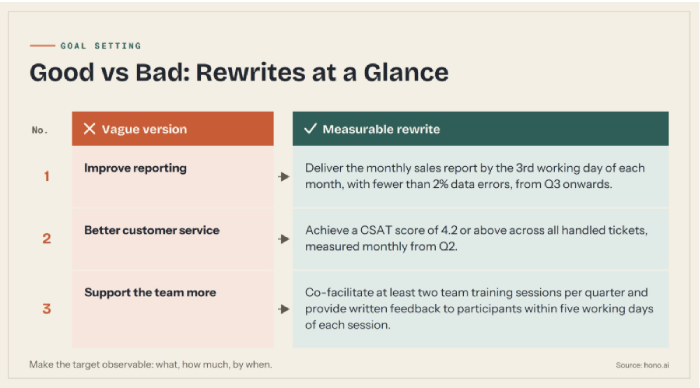
Activities describe what someone does. Objectives describe what gets produced or changed as a result. Shift the language from process to outcome. "Performs research" becomes "produce a competitor analysis report." "Manages social media" becomes "grow LinkedIn follower engagement rate." This step forces both parties to agree on what the work is actually for.
Step 3: Apply the formula
Structure each objective using four components in sequence:
Action verb + specific task + measurable target + deadline
If any element is missing, the objective is incomplete. Run this check before moving on.
Step 4: Pressure-test with SMART
Before finalising, run each objective through the SMART framework: Specific, Measurable, Achievable, Relevant, and Time-bound. SMART is not a writing method; it is a quality filter that catches objectives that are too broad, unmeasurable, or disconnected from real priorities. For a full walkthrough, see our guide to SMART goals.
Step 5: Set the bar at "successful," leaving room to exceed
The target should represent genuine, stretching but achievable success. Avoid setting it so high that only exceptional performance clears it, or so low that it becomes a formality. A well-calibrated objective has a "meets" threshold that most strong performers can reach, and enough headroom for a standout performer to demonstrably go further.
Step 6: Agree, document, and schedule check-ins
An objective that has not been explicitly agreed is a task. One that has not been documented is a conversation. Once both parties have aligned on the wording, record the objective in your performance platform or HR system and set a check-in cadence of monthly or quarterly to track progress and surface blockers early.
Action verb bank
Achieve, Deliver, Reduce, Increase, Implement, Launch, Produce, Resolve, Develop, Maintain, Improve, Lead, Complete, Establish, Streamline
How Many Performance Objectives Should an Employee Have?
The widely cited standard, used across major performance frameworks and supported by CIPD guidance, is 3 to 6 objectives per review cycle, though some organisations permit up to 10 for annual appraisal cycles covering broader role scopes.
Fewer, sharper objectives consistently outperform longer lists. When an employee has three genuinely measurable commitments, they know exactly where to focus and a manager can assess progress with confidence. When they have nine loosely worded ones, effort diffuses across too many fronts to be meaningfully evaluated by either party.
Setting and Reviewing Performance Objectives
Best practice follows a three-stage rhythm: objectives are agreed and documented at the start of the cycle, reviewed and recalibrated at quarterly check-ins where progress is discussed and targets adjusted if business priorities shift, and formally assessed at the end-of-cycle review where performance against each objective informs ratings, development conversations, and reward decisions. The check-in stage is the one most commonly skipped and the one that makes the difference between objectives that guide behaviour and objectives that gather dust.
Managing objectives in HONO
HONO's performance management module lets managers and employees set, weight, and track objectives in one place, with progress updates, continuous feedback, and mid-cycle edits all logged against each objective so nothing is reconstructed from memory at review time. See how HONO supports the full performance cycle through its talent management solution.
Performance Objective Examples
The following examples span a range of functions and seniority levels, each written in the measurable format set out in this guide.
Sales Executive: Achieve £480,000 in new business revenue by 31 December, with a minimum of 60% from net-new accounts acquired during the cycle.
Customer Support Agent: Maintain a CSAT score of 4.3 or above and a first-contact resolution rate of at least 78%, measured monthly across all handled tickets from Q1 to Q4.
HR Business Partner: Reduce average time-to-hire for mid-level roles from 52 days to 35 days by end of Q3, across all business units supported.
Software Engineer: Deliver all sprint commitments at a completion rate of 90% or above across each quarter, with fewer than three P1 bugs attributed to personally authored code per cycle.
Marketing Manager: Launch the refreshed brand campaign by 1 September, achieving 2 million impressions and a cost-per-lead of under £18 within the first 60 days post-launch.
For 30+ ready-to-use examples by category, including finance, operations, people management, and senior leadership, see our performance objectives examples guide.
Frequently asked
FAQs
See it live
Ready to see HONO in action?
Book a 20-minute demo tailored to your team's HR stack.
Request a demo
About the author
Mazna Majeed
Mazna is a strategic HR leader with over 10 years of experience driving talent success and organizational growth. As Head of Talent Acquisition and Operations at HONO, she leads HR initiatives across India and South-East Asia, including manpower planning, employee lifecycle management, talent development, engagement, and retention. Mazna is known for aligning people strategy with business goals, building inclusive high-performing teams, and strengthening culture to enable sustainable growth.