
In Singapore, human resource platforms do not just exist to drive operational efficiency. They are compliance mechanisms. Every localized payroll cycle directly touches Central Provident Fund contributions that adjust across dynamic age bands and residency status. They must sync with the Inland Revenue Authority of Singapore Auto-Inclusion Scheme for mandatory income tax reporting, satisfy the Ministry of Manpower itemized payslip criteria, and calculate statutory levies like the Skills Development Levy, Foreign Worker Levy, and Self-Help Group allocations.
Managing these calculations through manual spreadsheets or generic global software platforms introduces substantial compliance vulnerabilities. Non-compliance exposes organizations to systemic reporting errors, missed statutory deadlines, and serious legal or regulatory penalties.
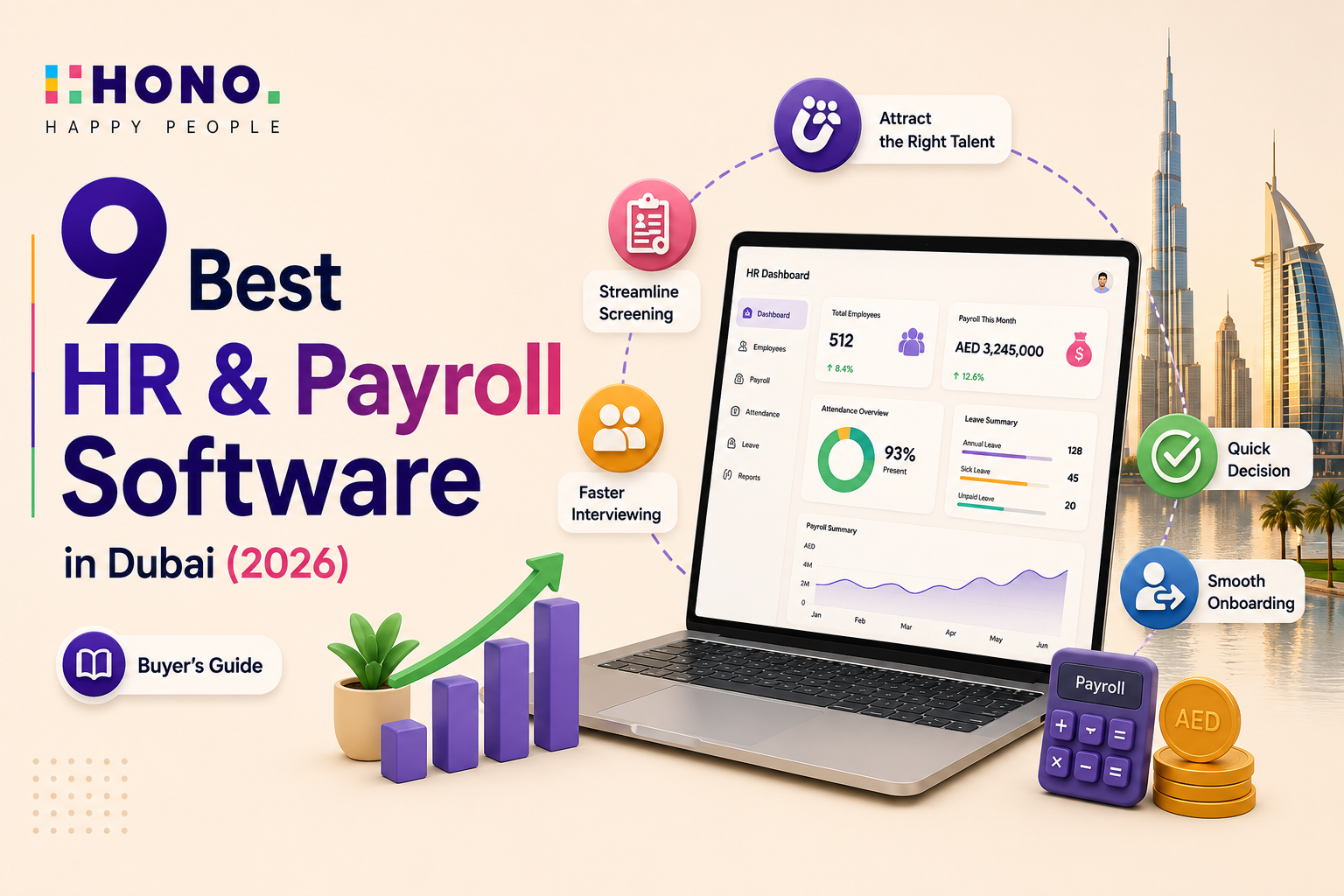
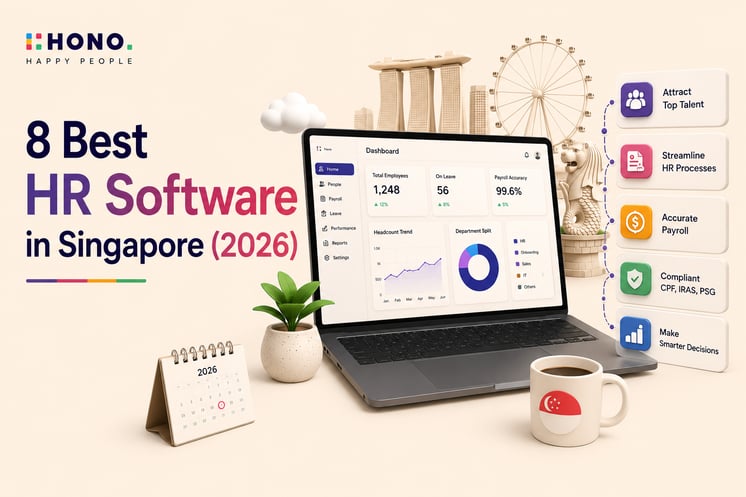
This comparative buyer's guide evaluates the top eight HR software systems built for the Singapore corporate ecosystem. Each system is assessed across four critical pillars: statutory depth, workforce configuration alignment, automation capability, and financial optimization through available state grants.
Scope Note: This guide focuses strictly on unified, self-serve HR software and payroll automation applications. It does not evaluate third-party HR outsourcing agencies or Employer of Record services.
8 Best HR Software in Singapore (2026): CPF, IRAS & PSG-Ready Compared
Key Takeaways
- Financial Subsidies: The Productivity Solutions Grant offsets up to 50% of software costs for eligible local enterprises, with a maximum cap of S$30,000 per financial year.
- Statutory Thresholds: The CPF Ordinary Wage ceiling is set at S$8,000 per month, representing the final stage of a multi-year national adjustment.
- Operational Fit: Workforce dynamics determine the right application choice. Frontline retail and food and beverage teams require dynamic shift rostering and biometric validation, whereas professional offices focus on compliance and strategic performance tracking.
- Subsidy Validation: Enterprise leaders must verify the current pre-approval status of a vendor via the GoBusiness portal before executing agreements, as government registries update regularly.
- Custom Selection: No single system serves all market segments perfectly. Optimal fit depends on internal headcount, sector requirements, and whether payroll is automated in-house or managed via hybrid models.
Feature Comparison of Best HR Software In Singapore
| Vendor | Best For | Payroll & CPF | Leave & Claims | Attendance & Tracking | Mobile & Self-Service | Core Automation & AI | Starting Price Point |
|---|---|---|---|---|---|---|---|
| Talenox | Early-stage startups and lean professional teams | Localized automation with direct AIS filing | Integrated tracking with automated rules | Basic manual time tracking fields | Mobile-responsive web interface | Core data validations | From ~S$8.72 per employee monthly |
| QuickHR | Multi-sector SMEs seeking an all-in-one platform | Fully automated compliance and filings | Dynamic approval routing matrices | Geofenced GPS and mobile validation | Native iOS and Android apps | Document parsing engines | From ~S$5.00 per employee monthly |
| Payboy | F&B, retail, and shift-based rosters | Automated generation from hours worked | Comprehensive policy engines | Advanced drag-and-drop scheduling | Shift management interface | Shift allocation matching | Custom tiered volume pricing |
| JustLogin | Long-established, modular requirements | Category A verified IRAS architecture | Intelligent receipt scanning tools | Smart biometric facial recognition | Unified self-service application | Justina conversational assistant | Customized quote by module |
| BrioHR | Mid-market scaling firms needing analytics | Fully localized core compliance engine | Modular expense management | Custom clock-in configurations | Comprehensive dashboard app | Predictive workforce analytics | From S$70 base monthly fee |
| HReasily | Multi-market teams operating in ASEAN | Cross-border regional payroll engines | Standardized multi-currency tool | Geofenced facial tracking tools | Multi-country employee login | Regional currency mapping | Interactive tiered calculation |
| Swingvy | Visual-first teams focused on employee culture | Built-in Singapore compliance modules | Visual team leave calendars | Automated timesheet compilation | Premium interactive mobile hub | Organizational data mapping | From S$4.25 per user monthly |
| HONO | Large enterprises requiring custom AI tools | Enterprise-grade multi-market engines | Flexible global policy modules | Enterprise hardware integrations | Chat-first messaging interface | Advanced generative AI engines | Custom enterprise pricing structures |
What Is HR Software?
An HR software platform unifies core human resource administration, employee records, leave monitoring, time tracking, payroll processing, and expense claims into a single secure ecosystem. In the Singapore business market, these systems eliminate paper records and disjointed spreadsheets by automating complex statutory workflows like localized tax reporting, labor compliance, and mandatory pension fund contributions. Modern platforms also embed employee self-service mobile interfaces and automated receipt scanning to minimize routine manual data entry.
HR Software, HRMS, HRIS, and Payroll Software Explained
While vendors use these industry terms interchangeably in their marketing campaigns, they represent distinct functional scopes:
- Payroll Software: Dedicated tools designed exclusively to process gross-to-net salary metrics, generate bank clearing files, and submit statutory tax and pension documents.
- HRIS (Human Resource Information System): A foundation platform focused on the management of employee records, digital profile directories, corporate compliance documentation, and general organizational charts.
- HRMS (Human Resource Management System): A broader, end-to-end platform that combines core payroll workflows with operational tracking tools like leave administration, expense tracking, and time attendance modules.
- HR Software: The widest industry umbrella term, frequently used by service providers to denote modern cloud-based HRMS ecosystems.
What to Look for in HR Software in Singapore?
When choosing a platform, prioritize comprehensive localization and statutory accuracy over extensive, non-essential feature lists. An application with highly polished analytics dashboards but flawed statutory calculation logic creates significant financial risk, administrative re-work, and potential regulatory non-compliance fines.
CPF Automation
The platform must dynamically calculate employer and employee CPF contributions based on automated age-group rules and specific residency timelines for Permanent Residents. The monthly Ordinary Wage ceiling is S$8,000, while the comprehensive annual salary ceiling remains capped at S$102,000.
For employees aged 55 and below who earn above S$750 per month, the total contribution rate stands at 37%, consisting of a 17% employer contribution and a 20% employee deduction. For older workers, contribution rates scale downwards across defined age bands (such as ages 55 to 60, 60 to 65, and above 65) to support senior employment retention while rebuilding retirement funds. Tracking these shifting parameters across a multigenerational workforce manually is highly error-prone.
IRAS AIS Filing
Organizations employing five or more personnel at any point during a calendar year must submit employee compensation data electronically through the IRAS Auto-Inclusion Scheme. This mandatory process requires employers to file Form IR8A along with relevant components like Appendix 8A for non-cash benefits-in-kind, Appendix 8B for equity gains, or Form IR21 for foreign worker tax clearance.
Submissions must be completed by the strict annual deadline of 1 March. Statistics show that thousands of organizations miss this deadline every year, facing administrative composition fines up to S$5,000, along with potential personal liability risks for company directors. Direct software integration via the official IRAS API minimizes manual input errors and streamlines data validation.
SDL, FWL, and Self-Help Group Funds
The platform must accurately process monthly employee levies and voluntary funds alongside standard salary calculations:
- Skills Development Levy (SDL): A mandatory employer-paid levy set at 0.25% of each employee's total monthly remuneration, calculated down to a minimum floor of S$2 and capped at a maximum ceiling of S$11.25.
- Foreign Worker Levy (FWL): A sector-specific, tiered tax levied on businesses employing Work Permit or S Pass holders, calculated using complex dependency ratio ceilings determined by the Ministry of Manpower.
- Self-Help Group (SHG) Funds: Small, progressive payroll deductions mapped directly to an employee's ethnic or religious community registration, such as CDAC, MBMF, SINDA, or ECF, unless the employee explicitly opts out.
MOM-Compliant Payslips and Leave
Under the Employment Act, companies must issue detailed, itemized payslips within three working days of payment. These records must clearly show basic salaries, itemized allowances, specific deductions, and precise pension allocations. Leave management architectures must also handle complex statutory rules automatically, managing pro-rated leave allocations for mid-year hires, tracking progressive childcare leave entitlements, and computing tenure-based annual leave accruals without manual calculation.
PSG Pre-Approval and Funding
The Productivity Solutions Grant, managed by Enterprise Singapore and the Infocomm Media Development Authority, offers local SMEs up to 50% co-funding support for pre-approved software solutions, with total grant disbursements capped at S$30,000 per eligible entity each financial year.
To qualify, an enterprise must be actively operating within Singapore, hold a minimum of 30% local shareholding, and maintain an annual sales turnover below S$100 million or employ fewer than 200 workers. Crucially, companies must secure official grant approval before signing any contracts or issuing payments to the vendor, as retrospective claims are rejected.
Eligible entities can also utilize the SkillsFuture Enterprise Credit scheme to access a one-off S$10,000 credit allocation. This credit can cover up to 90% of out-of-pocket expenses for supported enterprise transformation projects like the PSG. Unused credit tranches under the current framework are scheduled to expire on 30 November 2026, ahead of an official program restructuring taking effect on 1 December 2026.
Cloud Security, PDPA, and Data Residency
Because employee records contain sensitive personally identifiable information, platforms must prioritize rigorous security standards. Look for vendors holding established frameworks like ISO 27001 certification, the multi-tier cloud security standard, or the Data Protection Trustmark from the Infocomm Media Development Authority.
Under the Personal Data Protection Act, the primary employer remains fully responsible for any data processing activities handled by third-party platforms. It is vital to confirm physical data center locations and ensure comprehensive Data Protection Agreements are put in place.
Payroll and Accounting Integration
Efficient platforms export standard GIRO or FAST electronic payment files optimized for major commercial banking institutions like DBS, OCBC, and UOB. They should also feature direct, native API integrations with cloud accounting platforms like Xero or QuickBooks. This eliminates manual ledger reconciliation and prevents transcription errors during monthly journal entries.
Attendance, Self-Service, and AI Automation
For frontline and service-driven industries, field-level verification tools like geofenced GPS verification or biometric facial recognition are essential for tracking attendance. A modern employee self-service mobile application enables staff to view historical payslips, submit claims via smartphone cameras, and request time off seamlessly. Advanced systems also leverage AI automation to scan invoices, detect anomalies in timesheets, and run conversational virtual assistants across platforms like WhatsApp or Microsoft Teams.
8 Best HR Software in Singapore (2026)
The following matrix and detailed profiles evaluate eight leading options against a standardized four-pillar framework: statutory depth, workforce configuration alignment, automation capability, and overall value.
1. HONO
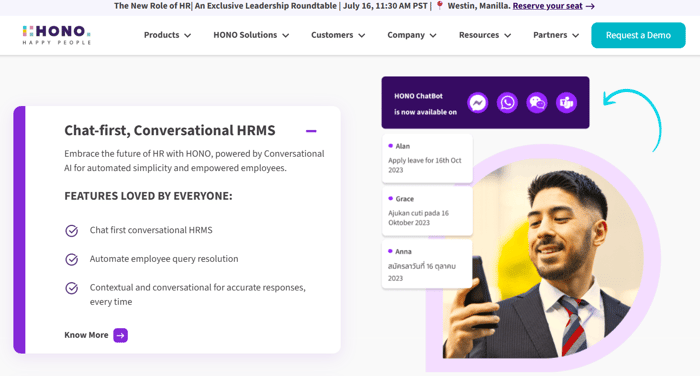
HONO is an enterprise-grade, AI-native Human Capital Management platform built around conversational interfaces and deep people analytics for large-scale operations.
Statutory Depth: Fully supports complex multi-market corporate compliance requirements. For its Singapore operations, statutory compliance with CPF frameworks and IRAS AIS direct filing must be verified during system scoping, given its enterprise focus.
Workforce Fit: Positioned for mid-to-large organizations and complex corporate groups that require deep data configuration, sophisticated talent planning, and extensive third-party ERP software integrations.
Automation & Self-Service: Implements a conversation-first design philosophy. Employees do not need to navigate complex software menus; instead, they interact with an advanced generative AI agent through everyday tools like Microsoft Teams, Slack, or WhatsApp to log attendance, check leave balances, or view payslips.
Value & Grants: Operates strictly via custom enterprise contract quotes based on system complexity and internal headcount, with no public free trial options.
2. Talenox
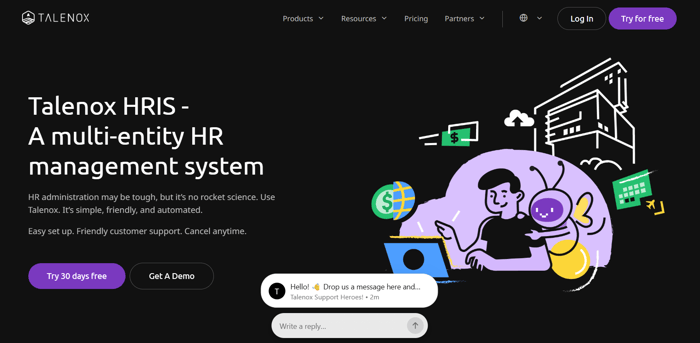
Talenox is a streamlined, cloud-based payroll and leave management system built primarily for small professional teams and early-stage startups seeking simplicity over complex enterprise features.
Statutory Depth: Fully localized for Singapore, providing automated calculation of CPF contributions, SDL, and Self-Help Group deductions. It generates direct files for the IRAS Auto-Inclusion Scheme and carries ISO 27001 data security certification.
Workforce Fit: Ideally suited for office-based corporate teams with regular schedules. It lacks advanced shift-scheduling mechanisms or biometric geofencing tools, making it less optimal for intense retail or industrial operations.
Automation & Self-Service: Provides a direct, mobile-optimized web portal where employees can view itemized payslips and submit digital leave requests. AI functionality is limited, focusing instead on clean user interfaces and standard data validation rules.
Value & Grants: The unified Suite plan covers payroll and leave modules, charging a flat baseline of S$43.60 per month for the first five active profiles, and scaling at roughly S$8.72 per additional user monthly. It is fully pre-approved for PSG funding support.
3. QuickHR
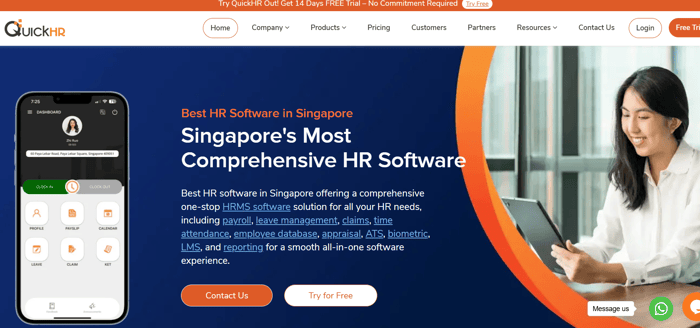
QuickHR is an all-in-one human resource management system designed specifically for the Singapore market, providing comprehensive modules that scale from small teams up to large mid-market enterprises.
Statutory Depth: Delivers excellent statutory compliance with automated updates for the S$8,000 CPF wage ceiling, direct API filing for IRAS AIS, and automatic calculations for Foreign Worker Levies across diverse sectors. It is backed by ISO 27001 and MTCS Tier 3 certifications.
Workforce Fit: Highly adaptable across diverse business structures. The platform features powerful geofenced mobile clock-in options, tailored timesheets, and flexible appraisal workflows that support both office environments and distributed field crews.
Automation & Self-Service: Features comprehensive, native mobile applications for iOS and Android. The system automates end-to-end employee onboarding workflows, document expiry alerts, and biometric time tracking data syncs directly with monthly payroll runs.
Value & Grants: Commercial pricing averages S$2 to S$5 per employee monthly depending on active headcount and selected module tiers. As a prominent pre-approved PSG solution provider, eligible enterprises can access standard 50% grant subsidies.
4. Payboy
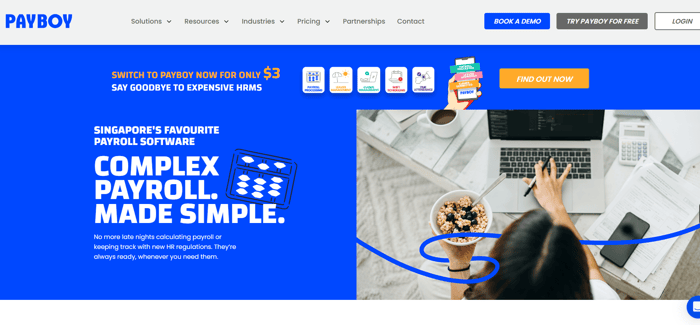
Payboy is an operations-focused HRMS designed specifically for shift-based workforces like retail, food and beverage, hospitality, and field logistics operations.
Statutory Depth: Automatically translates complex shift attendance data into MOM-compliant itemized payslips. It manages statutory CPF, SDL, and levy deductions in the background based on verified hours worked.
Workforce Fit: Outstanding for shift-heavy teams. The platform features an intuitive drag-and-drop rostering interface that allows floor managers to plan intricate schedules, handle shift swaps, and set up automated overtime calculations.
Automation & Self-Service: Integrates with specialized attendance solutions like StaffAny and links with commercial biometric hardware. Employees can review schedules, view real-time shift changes, and claim overtime hours directly through the mobile application.
Value & Grants: Operates on a modular, use-based pricing model starting from a baseline of roughly S$3 per employee for core services. The platform is pre-approved for PSG subsidies, making it highly cost-effective for high-turnover frontline business models.
5. JustLogin
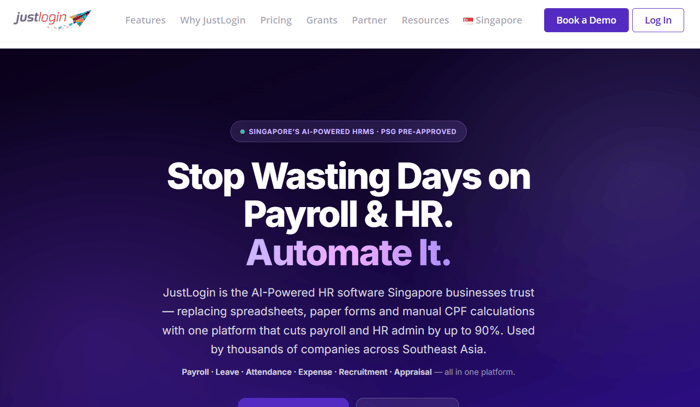
JustLogin is one of the longest-running human resource software providers in Singapore, now modernized with an intelligent automation layer and an enterprise-grade feature set.
Statutory Depth: Holds an official Category A validation status with IRAS, ensuring seamless electronic submission of IR8A tax returns, Appendix 8A/8B, and Form IR21. Its compliance engine is deeply rooted in local employment laws.
Workforce Fit: Highly modular design allows scaling organizations to activate specific tools as needed, making it suitable for mixed office and service teams across multiple locations.
Automation & Self-Service: Features advanced AI tools, including an intelligent mobile scanning assistant that parses photo receipts for expense claims. It also features Justina, a specialized conversational AI assistant that lets workers request leave or check payslips via text on communication apps like WhatsApp.
Value & Grants: Offers custom commercial quotes based on selected modules and team size. The platform is fully pre-approved for the PSG grant and supports SkillsFuture Enterprise Credit matching to maximize savings.
6. BrioHR
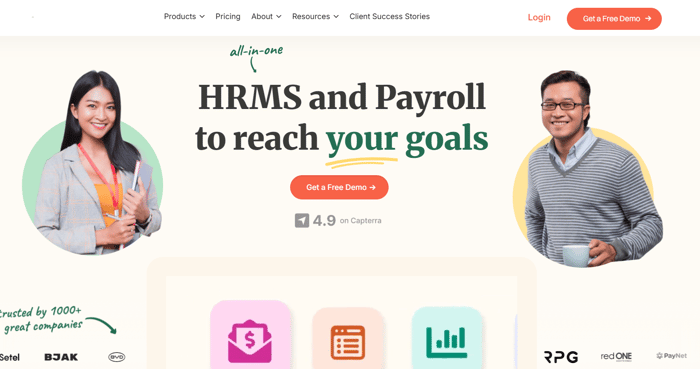
BrioHR is an all-in-one corporate HR platform designed for scaling SMEs and regional businesses that require robust workforce analytics and talent management modules.
Statutory Depth: Delivers full localization for Singapore statutory requirements, including automated calculations for CPF contributions and multi-tier bank GIRO compilation.
Workforce Fit: Excellent for fast-growing corporate teams. Alongside standard payroll and leave tracking, it offers advanced enterprise modules like recruitment applicant tracking, performance appraisal mapping, and structured employee onboarding paths.
Automation & Self-Service: Features comprehensive management dashboards with real-time tracking of attrition metrics, headcount costs, and demographic distributions. Its employee self-service tools automate the routing of multi-level expense approvals.
Value & Grants: Singapore pricing models start at a minimum baseline of S$70 per month for small operations, scaling according to activated modules. It is PSG-eligible and offers optional hybrid payroll outsourcing services for firms looking to hand off administrative processing entirely.
7. HReasily
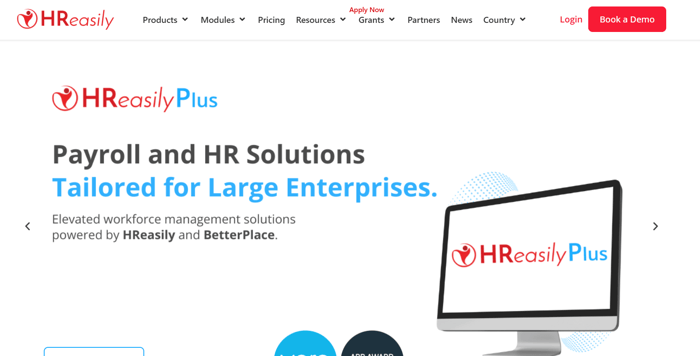
HReasily is a regionally focused human resource application built for companies that manage multiple cross-border entities across Singapore, Malaysia, Indonesia, Thailand, and Hong Kong from a centralized interface.
Statutory Depth: Fully localized across multiple jurisdictions simultaneously. In Singapore, it complies with CPF configurations, SDL mandates, and IRAS electronic submission rules, while concurrently running localized tax computations for regional branch offices.
Workforce Fit: Ideal for growing local companies expanding into neighboring ASEAN countries. It provides centralized visibility for regional HR directors while maintaining local statutory compliance for each country's workforce.
Automation & Self-Service: Features geofenced facial recognition clock-in via mobile devices, allowing real-time tracking of remote or regional field teams. Employees can access localized self-service applications tailored to their country's currency and regulatory rules.
Value & Grants: Uses an interactive calculator structure based on headcount tiers, typically averaging S$5 to S$10 per user monthly. This regional platform is eligible for local corporate digitization grants.
8. Swingvy
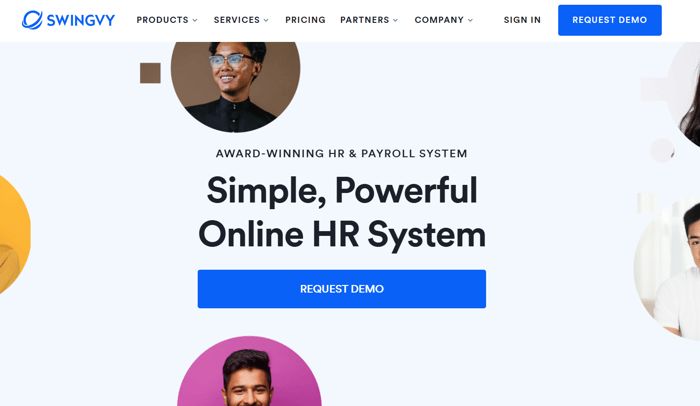
Swingvy focuses heavily on employee engagement and modern user experience, replacing rigid corporate interfaces with a visually appealing, mobile-first design.
Statutory Depth: Offers robust localized compliance within its core payroll module, managing calculations for the S$8,000 CPF wage ceiling, standard itemized payslips, and annual tax documentation.
Workforce Fit: Highly popular among creative agencies, technology startups, and mid-market enterprises that value transparent workplace culture, collaborative scheduling, and high employee app adoption rates.
Automation & Self-Service: Features an interactive corporate directory, visually shared team calendars, and a mobile application designed like a modern social feed. Timesheet data flows directly into payroll processing to minimize monthly administrative touchpoints.
Value & Grants: Standard packages use clear, modular pricing. Billed annually, the HR Hub, Leave, and Claims bundle costs S$4.25 per user monthly, with the Payroll module costing an additional S$4.25 per user monthly. A five-user minimum applies along with standard setup fees. Enterprise grant options are available to help lower upfront costs.
How to Choose the Best HR Software for Your Singapore Business
The primary decision factor when choosing an HR platform should be your actual workforce structure and headcount requirements, rather than general brand popularity. A sophisticated global enterprise platform is often inefficient for a fifteen-person office, while a lean startup payroll tool will struggle under the demands of complex, multi-site shift scheduling.
Small Teams and Early-Stage Startups (Fewer than 30 Employees)
Prioritize cost-effective, payroll-first cloud platforms that eliminate manual spreadsheet tracking without long setup timelines. Platforms like Talenox or basic tiers of QuickHR fit this segment well, providing smooth statutory filings with pricing structures that scale gently alongside your hiring roadmap.
F&B, Retail, and Shift-Based Operations
Prioritize dynamic scheduling engines, automated overtime calculation rules, and geofenced mobile verification systems. Because monthly compensation is tied directly to variable hours worked, tools like Payboy are ideal, as they prevent scheduling errors and automatically sync time-tracking data with localized payroll processing.
Growing Local SMEs (30 to 200 Employees)
At this size, single-function tools become inefficient. Look for comprehensive, all-in-one HRMS platforms that unify employee onboarding, leave management, claims tracking, and performance appraisals into one dashboard. QuickHR, BrioHR, or JustLogin are highly competitive in this tier, and their PSG pre-approval helps offset scaling software costs.
Multi-Country and Regional ASEAN Operations
If your corporate headquarters is in Singapore but you manage payroll and engineering teams across neighboring markets like Malaysia or Indonesia, prioritize regional engines like HReasily. This avoids the fragmentation of managing completely separate payroll platforms for each regional entity.
Enterprise and Multi-Entity Corporations
Large organizations require deep data configuration, strict internal audit logs, advanced user access controls, and predictive workforce analytics. For these environments, highly customizable engines or AI-native architectures like HONO are worth evaluating, provided local statutory rules are fully mapped during setup.
Grant Optimization: A Practical Scenario
To understand how government grants can reduce software costs, look at this realistic corporate example:
Consider a local Singapore enterprise employing 150 staff members that subscribes to an integrated HR platform with a standard contract fee of S$12,000 per annum.
By leveraging the PSG grant, the baseline cost drops immediately to S$6,000. If the business also qualifies for the SkillsFuture Enterprise Credit, the credit can cover up to 90% of that remaining balance. This reduces the net out-of-pocket investment to S$600 for the first year. Enterprise leaders can check their actual grant balances and confirm eligibility requirements securely through the official Business Grants Portal using corporate CorpPass credentials.
How Much Does HR Software Cost in Singapore?
Commercial software subscriptions typically range from S$2 to S$15 per employee monthly, depending on your total user count and active modules.
Streamlined, payroll-focused applications sit at the more accessible end of the market once past their entry-level plans. Conversely, comprehensive platforms that bundle advanced performance tracking, custom analytics, and recruitment automation require a higher baseline investment, often using minimum monthly billing thresholds rather than simple per-head rates.
When analyzing vendor quotes, look closely for potential hidden costs outside the advertised price. Common examples include:
- Separate add-on fees for IRAS AIS automated submissions or advanced expense modules
- One-time system configuration or mandatory implementation support fees
- Charges for technical data migration from legacy applications
- Extra licensing costs for additional corporate administrative logins
By utilizing the standard PSG grant framework, most eligible local companies can safely halve their net annual software spend before factoring in any additional SkillsFuture enterprise credits.

Mazna is a strategic HR leader with over 10 years of experience driving talent success and organizational growth. As Head of Talent Acquisition and Operations at HONO, she leads HR initiatives across India and South-East Asia, including manpower planning, employee lifecycle management, talent development, engagement, and retention. Mazna is known for aligning people strategy with business goals, building inclusive high-performing teams, and strengthening culture to enable sustainable growth.