Key Takeaways
-
Most HR chatbots in the market today still answer from a knowledge base. They retrieve information but cannot write back to your HRIS, trigger a workflow, or execute a transaction.
-
The critical dividing line in 2026 is between tools that retrieve and tools that execute. Only agentic HR sit in the second category.
-
Data grounding is the biggest accuracy risk. A bot answering from a stale knowledge base without live HRIS access will return incorrect leave balances, payroll figures, and policy details.
-
HRMS-native tools hold a structural advantage over bolt-on chatbots because they own the data and do not need external API calls to read or act on it.
-
Choosing the right HR chatbot starts with one question: do your employees need answers, or do they need complete actions resolved end to end?
9 Best HR Chatbots in 2026 at a Glance
| # | Tool | Best For | Native to HRMS or Bolt-On | Answers From | Can It Execute Transactions? | Main Channels |
|---|---|---|---|---|---|---|
| 1 | HONO (HONObot) | HRMS-native agentic HR; Zero-UI conversational HR | Native | Live HRMS data | Yes | Teams, Slack, WhatsApp, Web |
| 2 | Leena AI | Multi-HRIS answer and workflow bot | Bolt-on | Connected HRIS + KB | Limited | Teams, Slack, Web |
| 3 | Moveworks | IT and HR employee support | Bolt-on | Knowledge base + ITSM | Limited (via connectors) | Teams, Slack |
| 4 | Paradox (Olivia) | Recruiting and candidate engagement | Bolt-on | ATS + scripted flows | Yes (recruiting only) | SMS, WhatsApp, Web, Teams |
| 5 | Workativ | HR and IT helpdesk automation | Bolt-on | KB + workflow triggers | Yes (via app workflows) | Teams, Slack, Web |
| 6 | ServiceNow Virtual Agent | ITSM-first enterprise support | Native to ServiceNow | ServiceNow records | Yes (within ServiceNow) | Teams, Slack, Web, Mobile |
| 7 | Rezolve.ai | Teams-native HR and IT support | Bolt-on | KB + ITSM connectors | Limited | Teams |
| 8 | MeBeBot | SMB HR FAQ and policy bot | Bolt-on | Curated HR knowledge base | No | Teams, Slack, Web |
| 9 | Infeedo.ai | Employee listening and HR engagement | Bolt-on | Pulse data + KB | No | Web, WhatsApp, Slack |
What is an HR Chatbot?
An HR chatbot is a conversational AI tool that lets employees interact with HR systems, policies, and data through natural language, on channels they already use, without navigating a separate HR application.
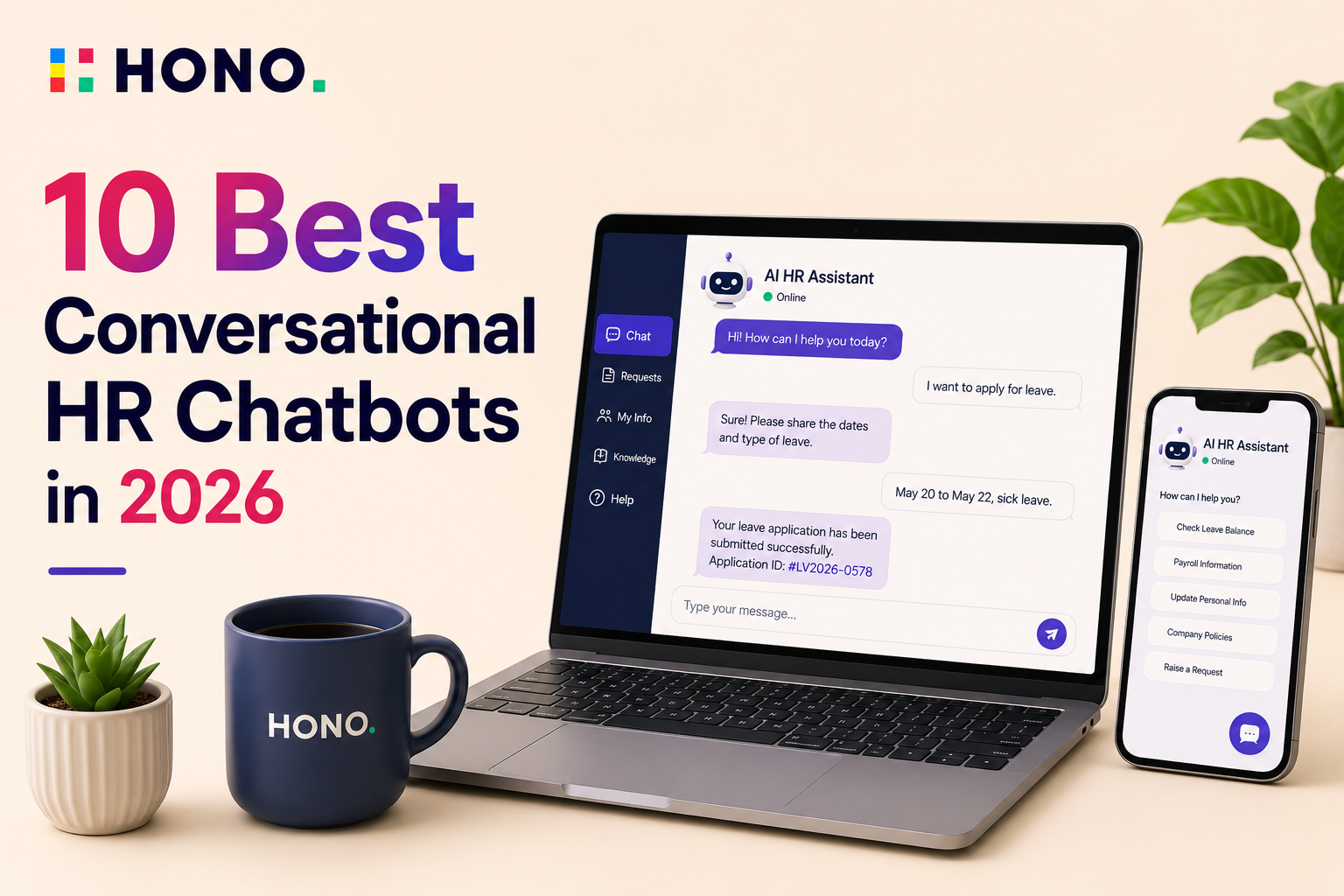
The word "chatbot" today covers a wide range of capability. A basic HR chatbot answers a question. An advanced one processes a leave request, checks payroll records, notifies a manager, and confirms the outcome, all within a single conversation thread on Teams or WhatsApp. The interface looks similar. What happens behind it is entirely different.
Three things define what an HR chatbot actually does:
- Where it gets its answers from - a static knowledge base, connected HRIS records, or live system data
- Whether it can act - retrieve only, or read and write back to HR systems
- Where it lives - embedded in the HRMS, or bolted on top of existing tools via API
The 4 Types of HR Chatbot: From FAQ Bot to Agentic
HR chatbots in 2026 sit across four distinct capability levels. The difference between them is not cosmetic. Each level determines what the bot can do, where it gets its information, whether it can act on a request, and how much HR workload it genuinely removes. The four types are: rule-based FAQ bots, NLP answer bots, integrated action bots, and HRMS-native agentic.
| Type | What it Does | How it Answers | Can it Act? | Example Tools |
|---|---|---|---|---|
| Rule-based FAQ bot | Follows scripted decision trees | Pre-written responses only | No | MeBeBot, basic intranet bots |
| NLP answer bot | Understands natural language, retrieves answers | Knowledge base or uploaded documents | Rarely | Infeedo.ai, early Leena AI |
| Integrated action bot | Connects to HRIS via API, can trigger workflows | Live or near-live system data | Yes, with limitations | Workativ, Rezolve.ai, Moveworks |
| HRMS-native agentic | Owns the data, chains multi-step actions end to end | Live HRMS records natively | Yes, fully | HONObot (HONO) |
Rule-Based FAQ Bots: Scripted, Brittle
A rule-based FAQ bot operates on a fixed decision tree. It matches an employee's input to a pre-written question and returns a pre-written answer. There is no language understanding involved. If the employee phrases the question differently from how it was programmed, the bot either fails or routes to a fallback message.
These bots are cheap to deploy and easy to set up, but their ceiling is low. Every new question requires a manual update. Policy changes require someone to go back into the bot and rewrite responses. At scale, the maintenance burden grows faster than the value it returns. They answer. They do not learn. They do not act.
NLP Answer Bots: Understand Phrasing, Still Mostly Tell
NLP answer bots bring natural language understanding into the picture. An employee can ask the same question in five different ways and get the same accurate response. These bots are trained on company documents, policy PDFs, and HR knowledge bases, so they handle a much wider range of queries without manual scripting.
The key limitation is that NLP bots still mostly retrieve and respond. They pull information from whatever they are trained on. If that source is outdated, the answer is wrong. If the employee wants to do something, not just know something, most NLP bots hit a wall. They tell employees what to do rather than doing it for them.
Integrated Action Bots: Execute via HRIS Connectors
Integrated action bots move beyond answering. They connect to HRIS platforms, payroll systems, or ticketing tools via API and can trigger actions: submitting a leave request, checking a real-time payroll record, or raising an IT ticket. The employee asks, the bot acts.
The constraint here is integration depth. These bots sit on top of existing systems and depend on API connections to function. When the underlying system changes, the integration needs updating. Actions are possible but bounded by what the connected APIs permit. Complex multi-step transactions often still require human follow-up.
HRMS-Native Agentic: Own the Data, Chain Actions
This is the most capable category, and the least common. An HRMS-native agentic does not connect to an HR system. It is the HR system, with a conversational layer replacing the traditional interface entirely.
Because it owns the data natively, it reads and writes to live records without external API calls. It can chain multiple actions in a single conversation: check a leave balance, apply the leave, notify the reporting manager, update the payroll impact, and confirm the outcome to the employee. It does this without the employee opening a dashboard, filling a form, or raising a ticket.
The difference between an integrated action bot and a native agentic is the difference between a translator and a native speaker. One converts. The other simply knows.
What to Look for in an HR Chatbot?
The deciding question is simple: do you need a bot that answers or one that acts? Everything else, channels, integrations, security, analytics, follows from that. Here are the six criteria that matter most when evaluating an HR chatbot in 2026.
1. Answer vs Action: Does it Resolve or Just Route?
This is the most important criterion and the one most buyers skip. Many HR chatbots are positioned as automation tools but function as sophisticated search engines. They find the right policy paragraph and surface it to the employee. The employee still has to do something with that information.
The better question to ask any vendor is not "can it answer HR questions?" but "what is your auto-solve rate?" Auto-solve rate measures the percentage of HR requests fully resolved by the bot without any human involvement. A bot that deflects a ticket is not the same as a bot that closes it. Deflection moves the problem. Resolution eliminates it.
Before signing any contract, ask for auto-solve rate data from comparable deployments, not deflection figures.
2. Data Grounding: Live Record or Knowledge Base Scrape?
Where a bot gets its information determines how accurate its answers are. A bot trained on a PDF of last year's leave policy will return last year's answers. A bot connected to live HRIS records returns what is actually true today, for that employee, in that location, under that contract type.
The risk is not just wrong answers. It is confidently wrong answers. Generative AI bots that answer from static documents can hallucinate figures with complete apparent certainty. For HR, where a wrong leave balance or incorrect payroll figure has real consequences, data grounding is a non-negotiable evaluation point.
Ask vendors specifically: does the bot answer from live system data or from uploaded documents? If documents, how often are they updated and who is responsible for maintaining them?
3. Channels: Where Does it Actually Work?
Employees should not have to go somewhere new to use an HR chatbot. The best deployments meet employees in the tools they already use every day: Microsoft Teams, Slack, WhatsApp, or a mobile app. A bot that only works on the HR portal competes for attention against every other app in an employee's day.
For deskless workers, field staff, or blue-collar workforces, WhatsApp availability is often the difference between adoption and abandonment. For office-based teams, Teams or Slack integration matters most. Evaluate channel support not just by what is listed in the brochure, but by what is actually live and tested in production.
4. Integrations: HRIS, ATS, and Payroll Connectivity
A bolt-on HR chatbot is only as useful as its integrations. If it cannot read from and write to your HRIS, attendance system, and payroll platform, it will always be an answer tool, never an action tool.
Check whether integrations are native and pre-built or require custom API development. Custom integrations mean implementation cost, maintenance overhead, and a fragile connection that breaks when either system updates. Pre-built connectors to platforms like SAP, Oracle, Workday, or BambooHR are meaningfully faster and more reliable.
For teams already on a full-suite HRMS, a native chatbot within that system eliminates the integration question entirely. The data is already there.
5. Security and Data Residency: Where Does Employee Data Go?
HR conversations contain some of the most sensitive data in any organisation: payroll figures, medical leave details, performance records, and personal information. Every HR chatbot evaluation must include a security review.
Key questions to ask:
- Where is employee conversation data stored and for how long?
- Does the bot use employee queries to train its models?
- What certifications does the vendor hold: ISO 27001, SOC 2 Type 2, GDPR compliance?
- Can data residency be configured by country or region for multinational deployments?
6. Analytics: Deflection Rate, Auto-Solve Rate, and CSAT
A deployed HR chatbot with no measurement is a cost centre with no accountability. The minimum analytics any HR chatbot should provide:
- Auto-solve rate: percentage of requests fully resolved without human intervention
- Deflection rate: percentage of queries handled without an HR ticket being raised
- CSAT score: employee satisfaction ratings on chatbot interactions
- Query volume by topic: which questions are asked most, which the bot fails to answer, and where knowledge gaps exist
9 Best HR Chatbots in 2026
1. HONObot (HONO) - HRMS-Native Agentic HR
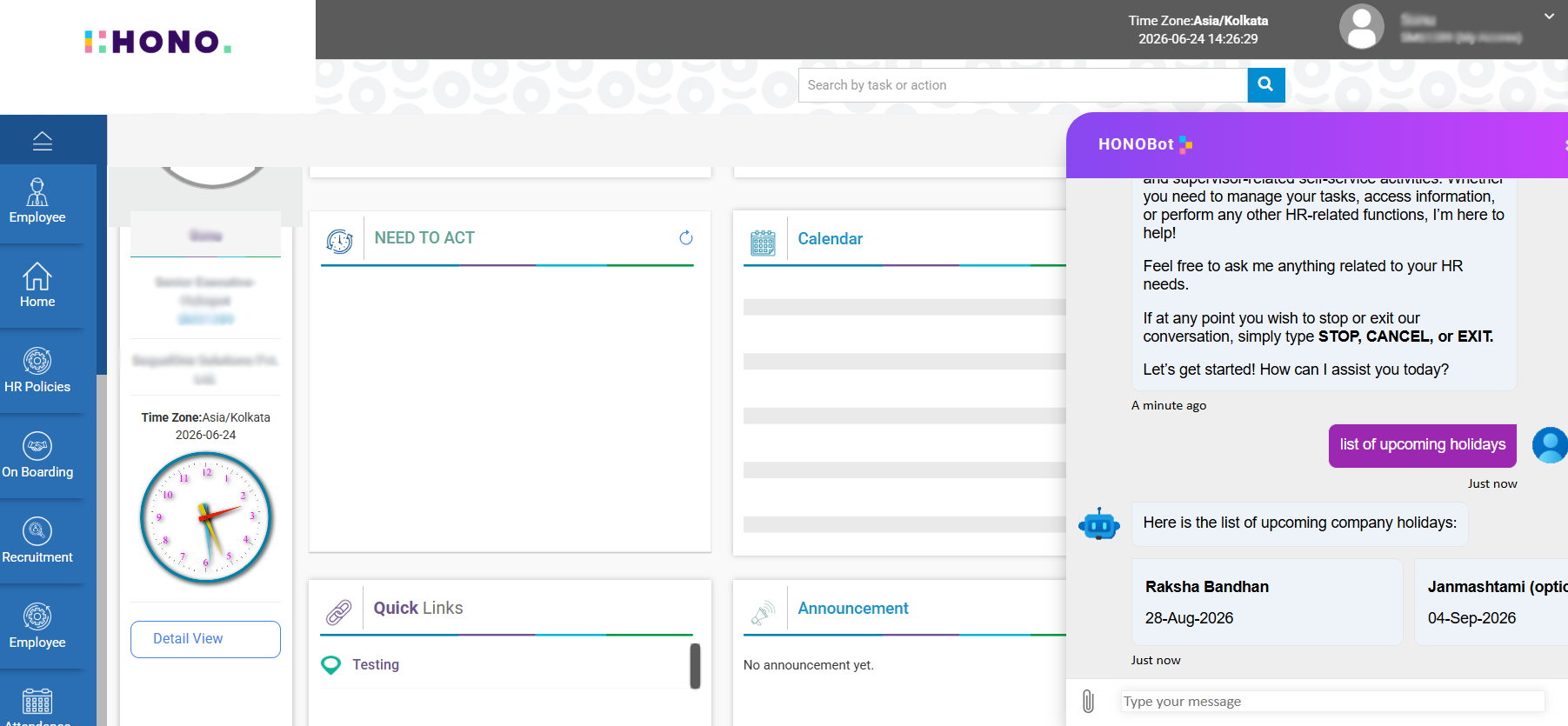
HONObot is the conversational AI layer built into HONO's Headless HRMS platform. It is not a chatbot placed on top of an HR system. It is the interface to the HR system itself. Employees interact with payroll, leave, attendance, onboarding, and compliance through natural language conversation on Teams, Slack, WhatsApp, or the web, without opening a dashboard or navigating a menu. Because HONObot sits natively inside the HRMS, it reads and writes to live records directly. There are no API calls to an external system, no knowledge base that goes stale, and no integration layer that can break. An employee asking about their leave balance gets a real-time answer from their actual record. An employee applying for leave gets it processed, approved, and confirmed in the same conversation.
This is what separates HONObot from every bolt-on tool on this list. The data grounding is native. The action capability is complete. And the employee never has to learn a new interface because there is no interface to learn.
HONO is trusted by 300+ enterprises across 50+ countries, with clients including Kohler, Yokohama, Accor, and Eveready Industries. It holds multiple G2 Leader badges across Asia, Asia Pacific, India, and Enterprise categories.
Key Features:
- Zero-UI conversational HR: all HRMS functions accessible through a single chat interface, with no dashboards, menus, or navigation required.
- Native HRMS data grounding: answers and actions draw from live payroll, attendance, and employee records, eliminating hallucination risk.
- Agentic workflow execution: chains multi-step HR transactions such as leave application, manager notification, payroll impact check, and employee confirmation within a single conversation
- MCP-native architecture: connects to SAP, Jira, Salesforce, Microsoft 365, and other enterprise platforms through Model Context Protocol, extending the conversational layer beyond HR.
- Multilingual and channel-agnostic: operates in 100+ languages across Microsoft Teams, Slack, WhatsApp, and web with no forced migration to a new tool.
- Enterprise-grade security: ISO/IEC 27001 certified, SOC2 Type 2 compliant, with configurable data residency and role-based AI access controls.
Pricing: Custom enterprise pricing. Contact HONO for a tailored quote based on organisation size and deployment scope.
2. Leena AI - Multi-HRIS Agentic Answer and Workflow Bot
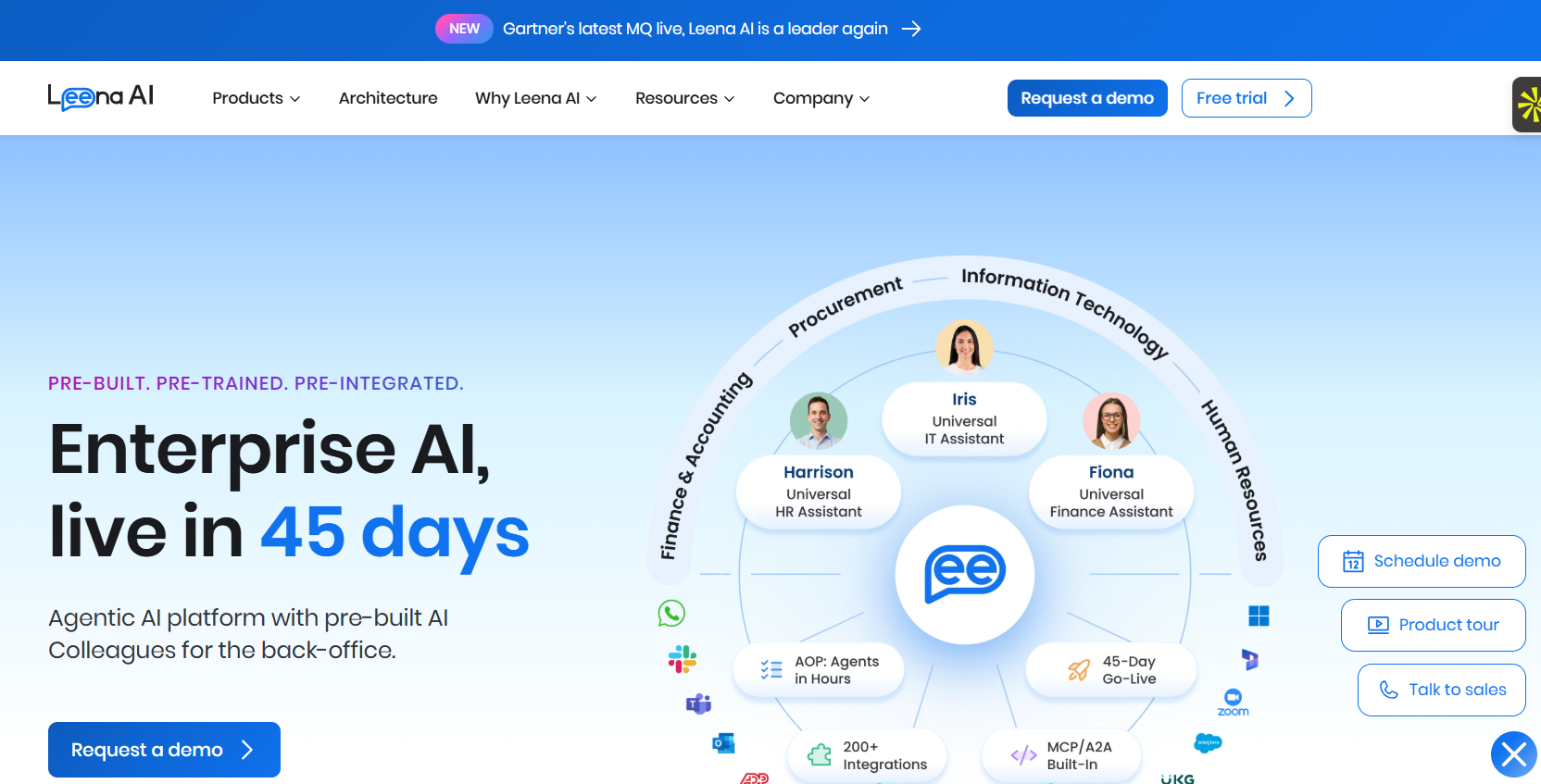
Leena AI is an independent agentic AI platform that deploys pre-built AI agents, which the company calls AI Colleagues, across HR, IT, and finance functions. Its agents connect to Workday, SAP SuccessFactors, Oracle HCM, BambooHR, and ServiceNow through pre-built integrations, and can resolve queries and trigger workflows across those systems from a single conversational interface on Teams, Slack, or mobile.
Key Features:
- Pre-built AI Colleagues for HR, IT, and finance, deployable within 45 days
- Agent Operating Protocols (AOPs) that let HR teams define workflows in plain language without engineering involvement
- Pre-built integrations with Workday, SAP, Oracle, ServiceNow, and Salesforce
- 100+ language support with voice-enabled access
- Centralised knowledge base with contextual memory across conversations
- Analytics dashboard covering ticket volume, resolution rates, and employee engagement trends
3. Moveworks - IT-First Enterprise Support with HR Coverage
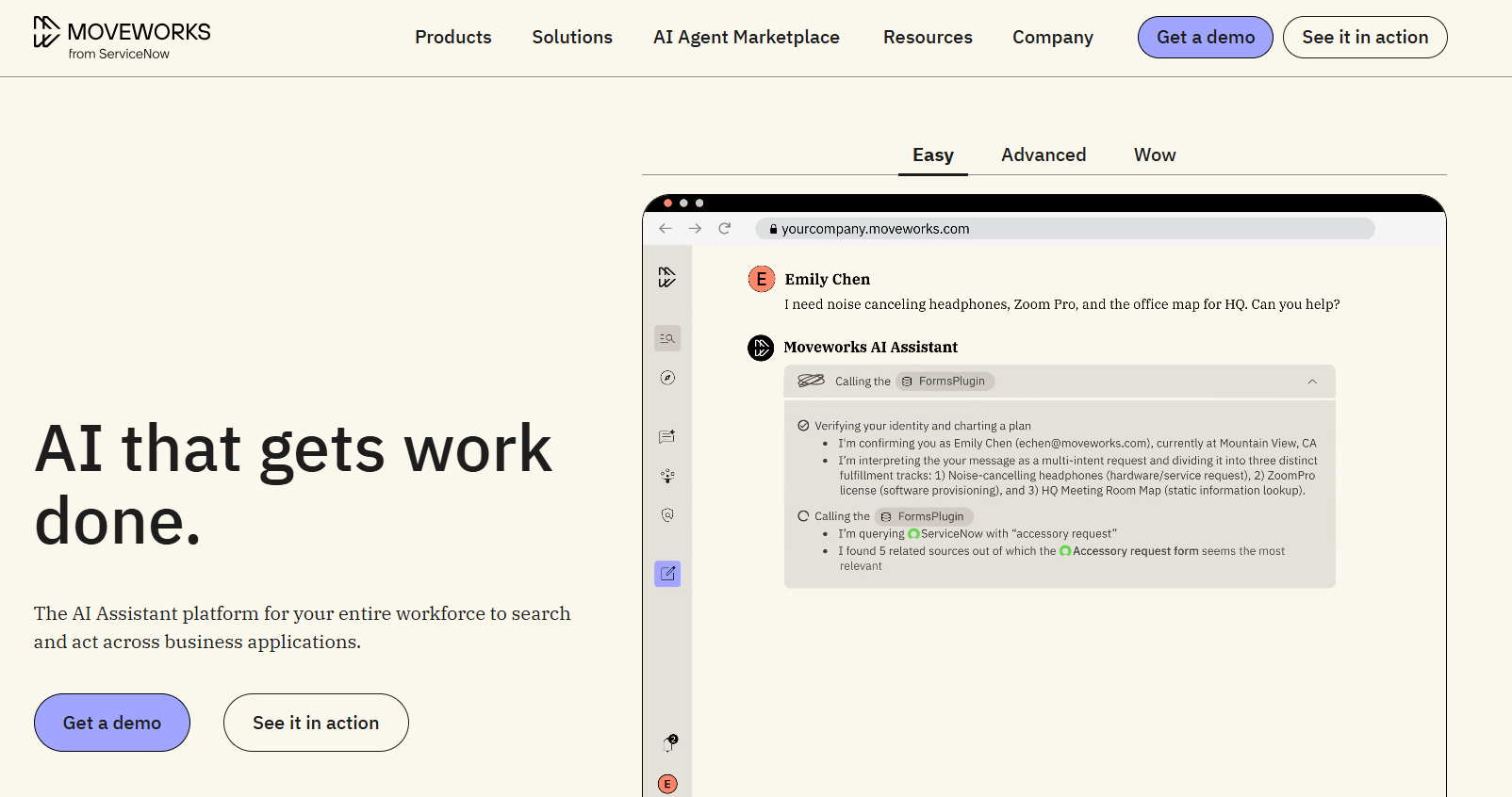
Moveworks was built originally as an IT support automation tool and expanded into HR. That origin shows in where the product is strongest. Its resolution rates for IT requests, password resets, software provisioning, and access management are well-documented. Its HR capability is genuine but secondary to that core IT strength. Enterprises that need a single bot covering IT and HR support from one interface, and are comfortable with Teams or Slack as the primary channel, will find Moveworks a strong fit. Enterprises whose primary need is deep HR transaction capability should evaluate whether the HR coverage matches their specific use cases.
Key Features:
- Agentic Reasoning Engine that interprets natural language, plans steps, and executes multi-step workflows across enterprise systems
- Pre-built integrations with ServiceNow, Workday, Okta, Salesforce, Jira, and Microsoft 365
- Agent Studio for building custom AI agents through a low-code editor
- FedRAMP authorised deployment for regulated and government-sector organisations
- HR and IT support from a single conversational interface in Teams and Slack
- Analytics covering deflection rates, resolution metrics, and employee satisfaction scores
4. Paradox (Olivia) - Conversational Recruiting Specialist
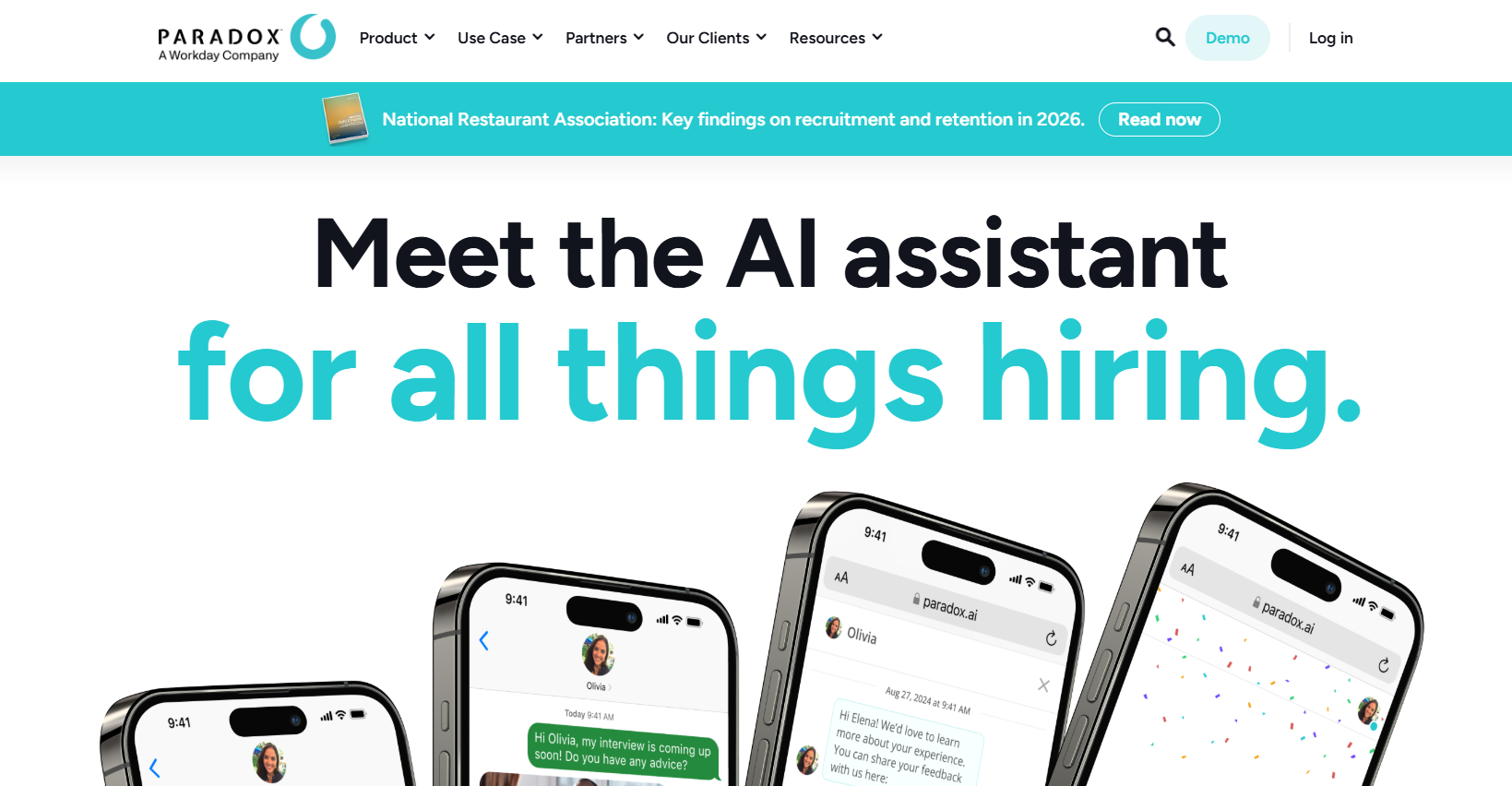
Paradox is not a general HR chatbot. It is a recruiting-focused conversational AI platform, and its AI assistant Olivia is purpose-built for candidate engagement, screening, and scheduling at high volume. Olivia handles the front end of hiring: answering candidate questions, collecting applications, screening against role criteria, scheduling interviews, and sending offer letters, all through conversational text or WhatsApp, without a recruiter manually involved.
Key Features:
- Conversational candidate screening via text, WhatsApp, and web chat, available 24 hours a day
- Automated interview scheduling that connects to recruiter and hiring manager calendars directly
- ATS integration with Workday, SAP SuccessFactors, Oracle Taleo, iCIMS, and Greenhouse
- Offer letter generation and onboarding document collection within the same conversational flow
- Multilingual support for global hiring, with candidates applying in their native language
- Recruiting analytics covering time-to-hire, conversion rates, no-show rates, and candidate satisfaction
5. Workativ - HR and IT Helpdesk Automation via App Workflows
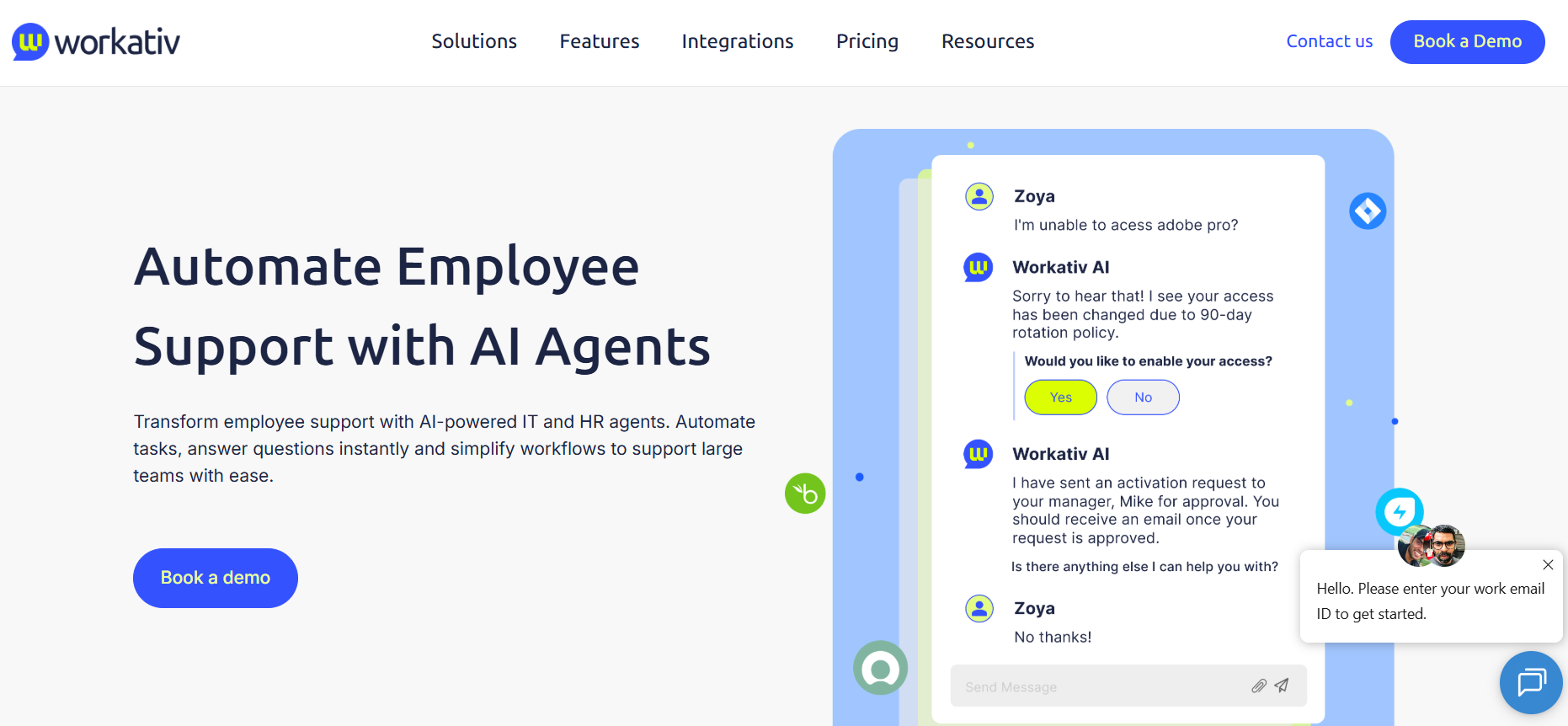
Workativ is a no-code platform that lets HR and IT teams build AI agents for employee support by connecting to existing applications through pre-built workflow templates. It sits on top of tools already in use, pulls data from connected apps, and executes actions by triggering those apps through its workflow engine.
The practical use case for Workativ is teams that want chatbot-driven automation across HR and IT without a long implementation cycle. It deploys on Teams, Slack, and web, and connects to apps like Workday, BambooHR, Freshservice, Jira, and Microsoft 365.
Key Features:
- No-code workflow builder with pre-built templates for common HR and IT scenarios
- App workflow automation across Workday, BambooHR, Freshservice, Jira, and 70+ other apps
- AI agent deployment on Teams, Slack, and web portal from a single configuration
- Conversational ticketing that creates, tracks, and resolves HR and IT requests through chat
- Knowledge base integration for policy queries and FAQ resolution
- Session-based pricing model that can offer more cost predictability than per-employee contracts
6. ServiceNow Virtual Agent - ITSM-Native Bot with HR Service Delivery
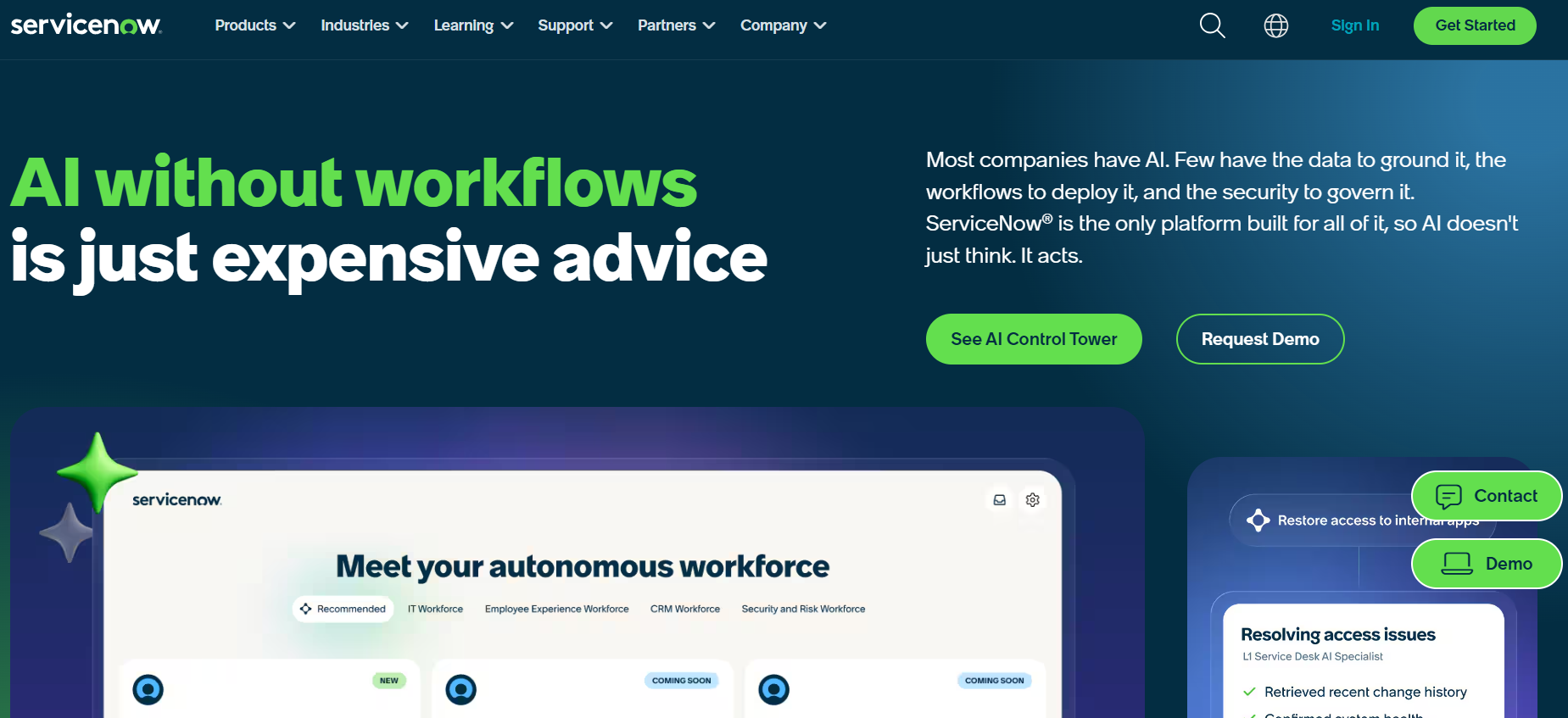
ServiceNow Virtual Agent is the conversational interface built into the ServiceNow platform. For organisations already running ServiceNow for IT service management, it provides a natural extension into HR Service Delivery. It pulls answers from ServiceNow's knowledge articles and HR case records, and every action and conversation is logged within ServiceNow's audit trail.
Its strength is tight integration with ServiceNow workflows. Leave requests, onboarding tasks, and policy queries resolved through Virtual Agent automatically create or update HR cases in ServiceNow, keeping records clean without manual data entry.
Key Features:
- Native integration with ServiceNow HR Service Delivery and ITSM modules
- Pre-built conversation flows for common HR topics including leave, onboarding, and policy queries
- Automatic HR case creation and update for any request that requires follow-up
- Multi-channel deployment across web portal, Teams, Slack, and mobile
- Complete audit trail for every conversation and action within ServiceNow
- Now Intelligence for AI-powered intent recognition and response generation
7. Rezolve.ai - Microsoft Teams-Native HR and IT Support
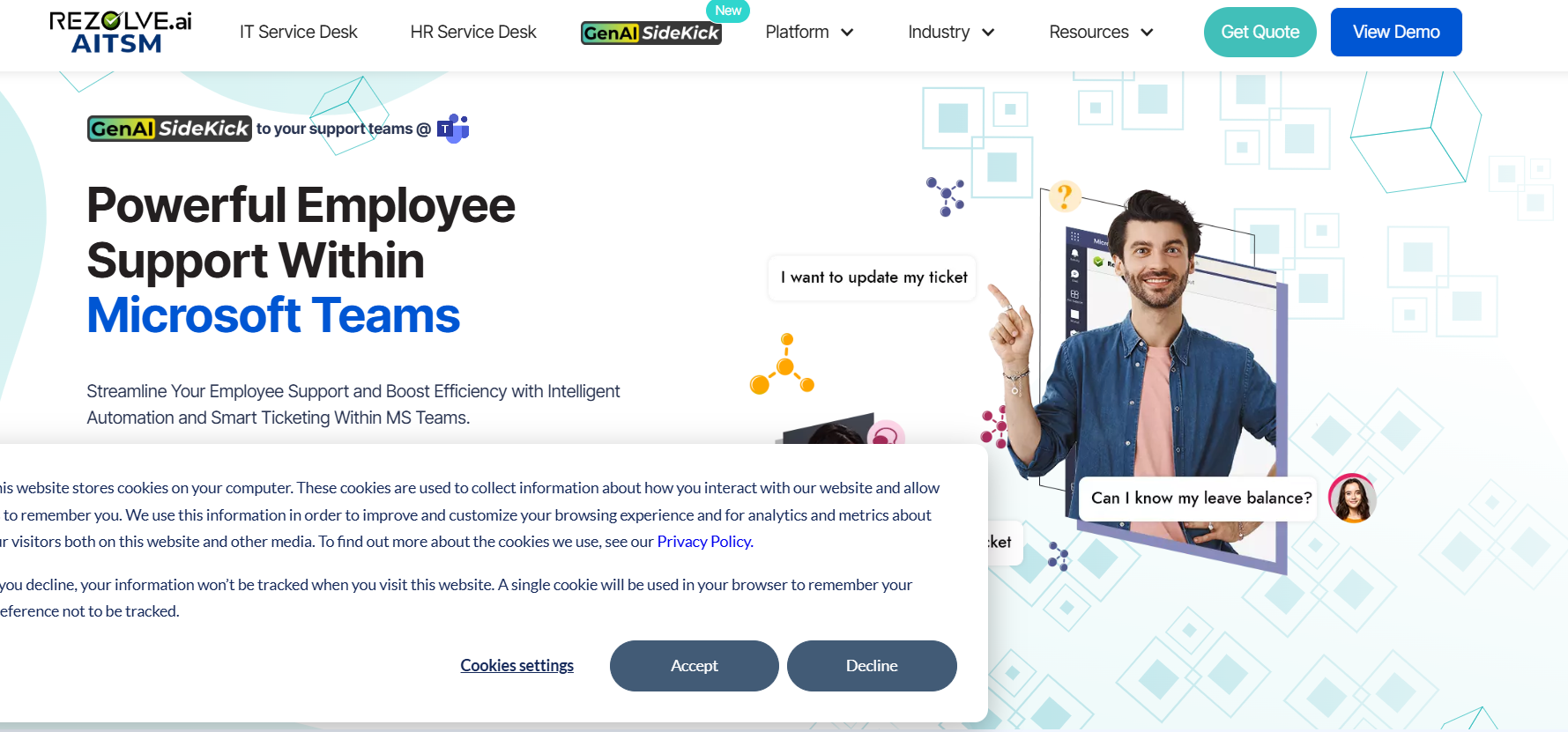
Rezolve.ai is built primarily for teams that run Microsoft Teams as their primary collaboration platform and want HR and IT support to live natively inside that environment. Employees ask questions, raise tickets, and track resolutions without leaving Teams. The bot pulls from connected knowledge bases and ITSM tools to answer queries, and creates structured tickets for anything requiring human follow-up.
Key Features:
- Native Microsoft Teams integration for HR and IT query resolution within the collaboration tool
- AI-driven knowledge base search pulling from connected documentation and policy libraries
- Conversational ticketing that creates, tracks, and escalates HR requests directly through chat
- Live agent handoff for complex queries that fall outside automated resolution
- Integration with Jira, Microsoft 365, ServiceNow, and common ITSM platforms
- Analytics on query volume, resolution rates, and trending employee questions
8. MeBeBot - SMB HR FAQ and Policy Assistant
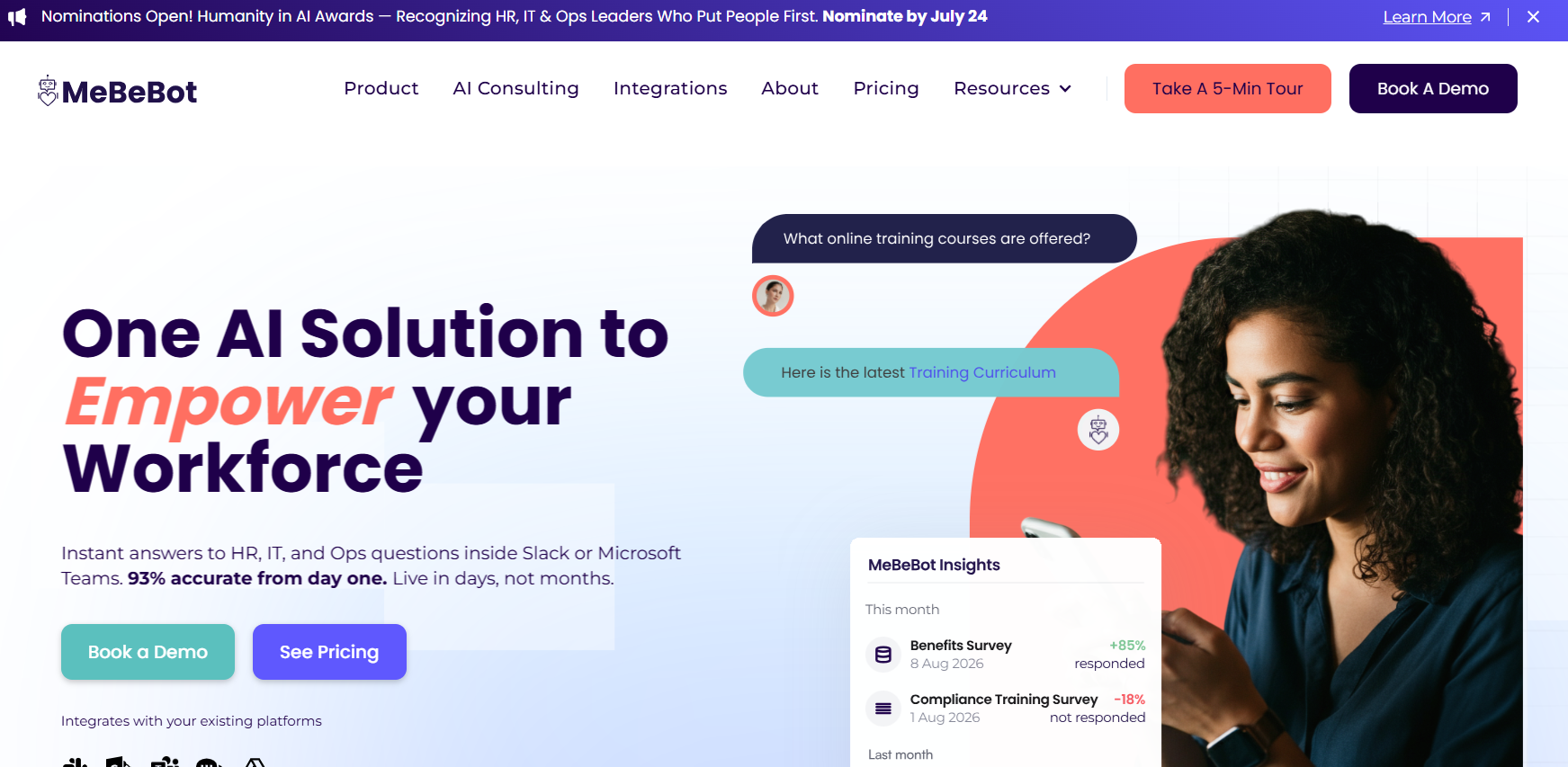
MeBeBot is a purpose-built FAQ and policy assistant for small to mid-sized organisations. It comes with 300+ pre-loaded HR and IT questions covering common topics such as leave policies, benefits, holidays, and payroll FAQs. Teams can edit these or add their own without technical involvement. It deploys directly into Teams and Slack, and is live within days of setup.
MeBeBot's value is speed to deployment and low maintenance overhead. For organisations that do not need deep HRIS integration or transaction execution, and simply want employees to get accurate answers to common HR questions without emailing the HR team, MeBeBot delivers that at a low cost.
Key Features:
- 300+ pre-loaded HR, IT, and operations questions editable without technical skills
- No-code setup with deployment directly into Teams and Slack within days
- Pulse survey delivery through chat for quick employee feedback collection
- Multilingual support for global teams
- Proactive notification capability for reminders and policy updates
- Analytics on question frequency and response coverage gaps
9. Infeedo (Amber) - Employee Listening and Engagement Bot
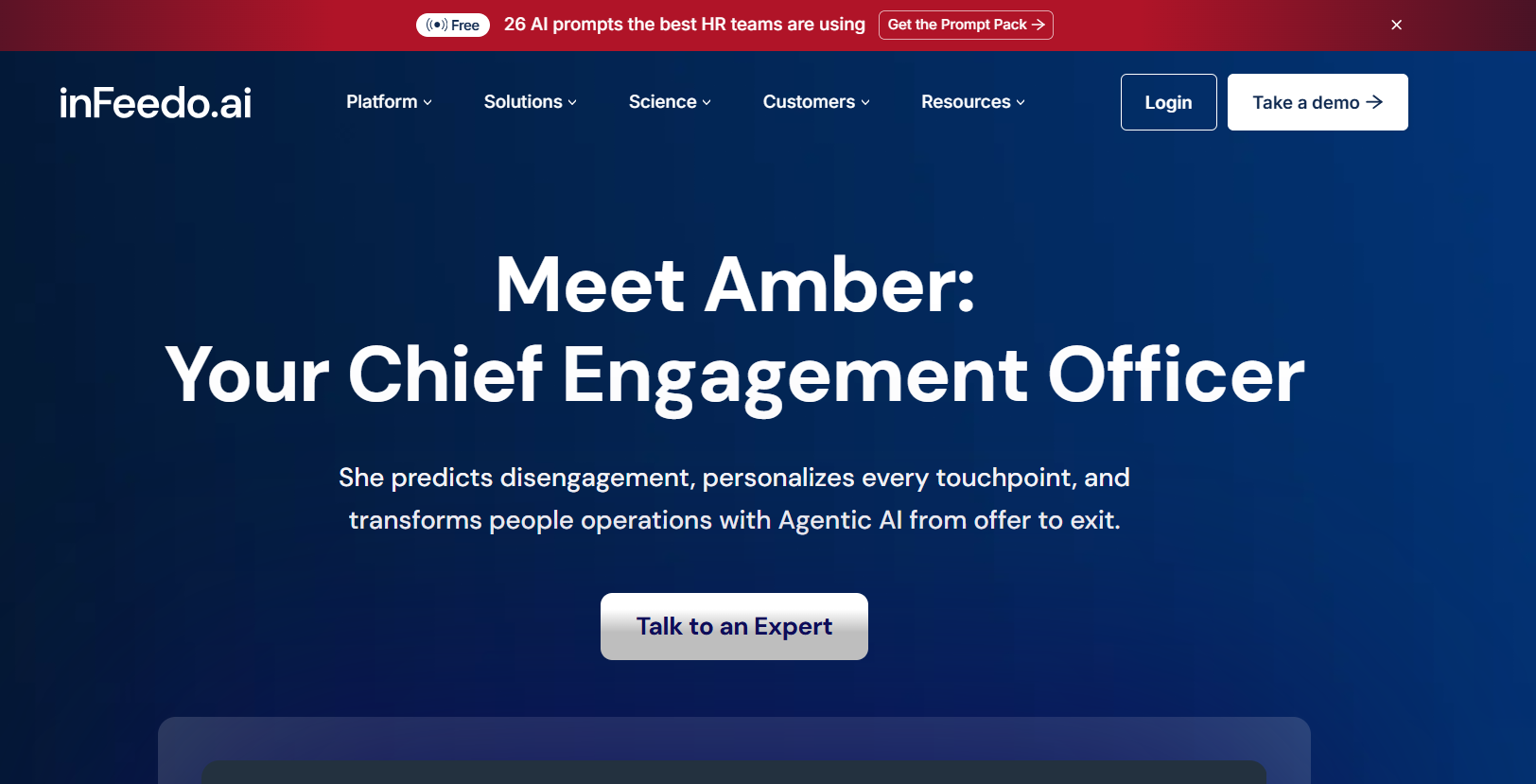
Amber by inFeedo sits in a distinct category from every other tool on this list. Where most HR chatbots respond to employee questions, Amber proactively reaches out to employees. Its primary function is continuous employee listening: running structured conversations at key milestones in the employee lifecycle, from onboarding to anniversary check-ins to exit, collecting sentiment data, predicting attrition risk, and surfacing disengagement signals to HR leaders before they result in resignations.
Key Features:
- Proactive employee listening across the full employee lifecycle with milestone-triggered check-ins
- Sentiment analysis and attrition prediction powered by NLP and machine learning
- AI Assist layer for routine HR query resolution and ticket routing
- Real-time engagement analytics dashboard segmented by department, tenure, and location
- Pulse survey delivery through conversational chat rather than traditional survey forms
- Available on WhatsApp, Slack, and web with personalised conversation tone per employee
How to Choose the Right HR Chatbot for Your Team?
Start with one question: do your employees need answers or actions? Everything else follows from that. Here is how to match your specific situation to the right type of tool.
If you need to answer employee HR FAQs fast: Deploy an NLP answer bot or a pre-loaded FAQ assistant. Tools like MeBeBot get this done within days and require no technical setup. The priority here is coverage and speed of deployment, not integration depth.
If you need to act on HR transactions, not just answer questions: You need either an integrated action bot or an HRMS-native agentic. The deciding factor is whether you want a bolt-on layer over your existing HRIS or a platform where the chatbot and the HR data live in the same system.
If employees need access without opening any app: Channel availability is the deciding factor. For deskless workers, field staff, or blue-collar workforces, WhatsApp access is often the difference between adoption and zero usage, HONObot and Leena AI both support Teams, Slack, WhatsApp, and web from a single deployment.
If you are already on an HRMS : A native chatbot inside your existing platform eliminates the integration question, removes data latency, and typically reduces implementation time significantly. HONO's Headless HRMS includes HONObot natively.
If you need multilingual support: Shortlist only tools that have verified multilingual capability in the specific languages your workforce uses, not just English plus a handful of European languages. Leena AI supports 100+ languages including South and Southeast Asian languages. HONObot supports multilingual conversations across its channel deployments.
Related Articles: 5 Best AI powered Employee Self Service Software in 2026Frequently asked
FAQs
See it live
Ready to see HONO in action?
Book a 20-minute demo tailored to your team's HR stack.
Request a demo
About the author
Prasanth
Prasanth is a Disruptive Technology Specialist and technical leader who translates complex business needs into secure, innovative software solutions. A master at guiding and elevating development teams, he specializes in making high-level IT strategies clear, accessible, and highly impactful for the modern enterprise.