
Key Takeaways
-
Top candidates are gone within 10 days, but average time-to-hire runs 42 to 44 days, and the mismatch is what costs you the best people.
-
Most delay sits in controllable internal stages, requisition approval, scheduling, and feedback collection, not in a shortage of qualified candidates.
-
A single approver out of office, an interviewer with no open calendar slot, or feedback that sits in someone's inbox can each add days that have nothing to do with talent supply.
-
Pre-approved headcount, automated scheduling, standardized screening, and a warm talent pipeline are the highest-leverage fixes, and most can be set up once and reused for every requisition.
-
Speed and quality are not opposites: the goal is to cut idle waiting time, not interview rigor, and the way to confirm that is tracking time-to-hire alongside 90-day retention.
Why does it take so long to fill positions?
The honest answer is that it is usually an internal process problem, not a talent shortage. Most of the days added to a hiring timeline come from controllable stages inside the company: approvals, scheduling, and decision-making, not from a lack of qualified applicants in the market.
The process got more layered
Hiring has quietly become heavier over the last few years, with more checkpoints added at almost every stage.
-
More interview rounds per hire than a few years ago, often without a clear reason for each added round.
-
More layers of resume and skills screening before a candidate ever speaks to a human.
-
More sign-offs required before a requisition is even opened, often from people who are not actively involved in the hire.
-
More stakeholders pulled into final decisions, which multiplies scheduling complexity.
-
More documentation and compliance steps added "just in case," many of which duplicate each other.
None of these additions are inherently bad. The problem is that they accumulate without anyone removing the older steps they were meant to replace, and the timeline absorbs all of it.
Where the days actually go: a stage-by-stage breakdown?
The fastest way to fix time-to-hire is to stop treating it as one number and start treating it as a sequence of stages, each with its own owner and its own typical leak point.
| Stage | Typical days | Who owns the delay | Most common leak |
|---|---|---|---|
| Requisition approval | 3 to 10 days | Finance, department head, HR leadership | Sequential sign-offs with no backup approver |
| Sourcing | 5 to 15 days | Recruiter, hiring manager | Vague job description producing the wrong applicant pool |
| Resume screening | 2 to 7 days | Recruiter | Manual review of high application volume with no shortlisting logic |
| Interview scheduling | 3 to 10 days | Recruiter, interviewers | Calendar back-and-forth across multiple stakeholders |
| Interview feedback and decision | 2 to 8 days | Hiring panel | Feedback collected informally, with no deadline or single source of truth |
| Offer and sign-off | 2 to 7 days | Hiring manager, HR, finance | Compensation approval routed through the same slow approval chain as the requisition |
| Background check and start | 5 to 15 days | Third-party vendor, HR | No parallel processing alongside the offer stage |
Add these up and it becomes obvious why a "simple" hire stretches past six weeks even when no single stage looks unreasonable on its own.
Why are job requisitions stuck in approvals for weeks?
Requisition approval is usually the first leak in the funnel, and it happens because most approval chains are built sequentially: one person has to sign off before the next person even sees the request, so any single delay at the top pushes the entire chain back.
The sequential-inbox problem
If a requisition needs sign-off from a department head, then finance, then HR, and any one of them is traveling, in back-to-back meetings, or simply slow to check email, the entire requisition sits frozen. Nobody downstream can act until the person upstream clears their inbox. This single point of failure is responsible for a large share of the "weeks of nothing happening" that hiring managers complain about before a job is even posted.
Fixes
HONO's requisition and approval module replaces the inbox chain with a system where requests for hiring can be set up with pre-defined approval matrices, automatic escalation when an approver does not respond within a set window, and visibility into exactly where a requisition is stuck at any moment. Instead of a recruiter manually following up over email, the system routes the request, flags the delay, and surfaces it to the right person automatically, so a single unavailable approver no longer holds the whole process hostage.
How do we reduce time-to-hire? 8 fixes that actually move the metric?
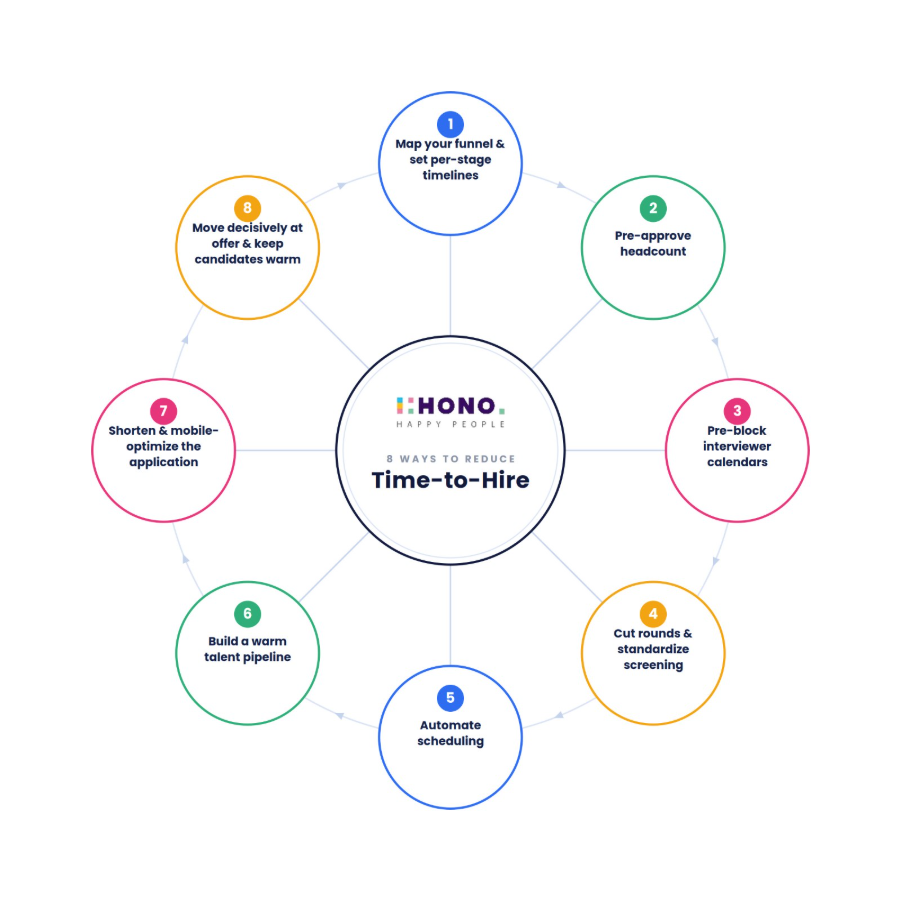
1. Map your funnel and set per-stage timelines
You cannot fix what you have not measured. Build the same stage map shown above for your own roles, attach a target number of days to each stage, and track actual performance against it. This alone usually surfaces two or three stages that are quietly responsible for most of the delay.
2. Pre-approve headcount
A large share of requisition delay disappears the moment headcount approval happens before the role is urgent, not after. A built-in "approve a request for recruitment" workflow lets finance and leadership sign off on headcount during planning cycles, so when a vacancy actually opens, the recruiter is posting the role on day one instead of waiting on a fresh approval chain.
3. Pre-block interviewer calendars
Instead of chasing interviewer availability after a candidate is ready, reserve recurring interview slots on hiring panel calendars in advance for active roles. This turns scheduling from a multi-day email chain into a same-day confirmation.
4. Cut rounds and standardize screening
Moving from four or more interview rounds down to two well-structured ones can shave weeks off the timeline without compromising the decision. AI-suggested job matching and candidate shortlisting tools help here directly, by surfacing the candidates most relevant to a role's requirements upfront and keeping a clean, ranked list of candidates for evaluation, so the panel is reviewing a tighter, better-matched pool instead of screening everyone manually from scratch.
5. Automate scheduling
Recruiters routinely lose a meaningful share of their week to back-and-forth scheduling emails. Automated scheduling tools that sync with interviewer calendars and let candidates self-select a slot remove almost all of that friction and usually cut days off the interview stage alone.
6. Build a warm talent pipeline
The fastest hire is one where you are not starting from zero. A referral portal that lets HR track referral status end to end keeps a steady stream of pre-vetted candidates flowing in. An internal job portal supports internal mobility, letting employees apply to or save open roles and track the status of their pending applications, which often produces faster, lower-risk fills than external sourcing. And a candidate module that supports blacklisting and whitelisting, locking and unlocking records, and reusable candidate profiles means a strong candidate from a past requisition can be pulled back into consideration for a new one instead of recruiters rebuilding the pipeline from scratch every time. Together, these turn your candidate history into an actual talent pool rather than a forgotten database.
7. Shorten and mobile-optimize the application
A meaningful share of job seekers abandon an application that takes too long or does not work cleanly on a phone. Most candidates expect the application step itself to take well under half an hour. Cutting form fields down to what is actually needed at this stage, and making sure the experience works on mobile, keeps more strong candidates from dropping out before a recruiter ever sees their resume.
8. Move decisively at offer and keep candidates warm
Among the fastest-hiring companies, a large share extend offers within about a week of the final interview. Once a decision is made, the gap between "we want this person" and "they have an offer in hand" should be measured in days, not weeks, and the candidate should hear from someone, even informally, while the formal offer is being finalized.
That contact usually lands better over messaging than email, so some small recruiting teams handle it in a tool like WhatsApp CRM - WAPlus, to organize candidate conversations and schedule short follow-up updates, helping ensure nobody goes silent while the paperwork clears.
For enterprise-level recruiting and onboarding, HONO's full-suite HRMS takes things further. It brings recruiting, onboarding, employee management, and broader HR processes together in one platform, helping larger organizations create a more connected and streamlined experience from candidate to employee.
Also read: Key features of recruitment software
How do we stop losing candidates to faster-moving competitors?
Slow processes do not just delay a hire, they actively lose strong candidates to companies that move faster on the same talent.
-
Communicate clear timelines upfront so candidates are not left guessing about next steps.
-
Shorten the gap between interview stages instead of letting a week pass between each round.
-
Give feedback or rejections quickly rather than letting candidates sit in silence.
-
Keep candidates engaged with brief check-ins during background checks or approval waits.
-
Make the offer stage fast and clear, since hesitation here is often read as disinterest.
How to speed up hiring without lowering quality?
Faster is not the same as careless. The goal is to remove idle time, the waiting, the scheduling back-and-forth, the deliberation that drags on without new information, not to shorten the actual evaluation of a candidate's skills. The way to confirm you are doing this correctly is to track time-to-hire and quality-of-hire (commonly measured through 90-day retention) side by side, so a faster process is never mistaken for a weaker one.
How an HRMS helps you cut time-to-hire?
Most of the delay described in this article is structural: approvals that sit in one inbox, scheduling that depends on manual back-and-forth, candidate data that gets rebuilt from scratch for every new role. An HRMS built for the full hiring lifecycle removes these one by one instead of asking recruiters to work around them.
HONO's recruitment module lives inside its AI-driven HCM platform, so hiring runs on the same system as onboarding, payroll, and core HR, with no disconnected spreadsheets. Because HONO is "chat-first," recruiters, hiring managers, and employees act on it right where they work: the web dashboard, mobile app, or WhatsApp, Slack, and MS Teams.
Trusted at scale: 300+ enterprises and 1M+ employees across India, MENA, and Southeast Asia, on a platform built for enterprises with enterprise-grade security and Infosec compliance.
Key capabilities
-
Requisition-to-offer automation: configurable approval workflows with escalation replace inbox sign-offs, so headcount approval stops being a bottleneck.
-
AI resume parser & candidate matching: auto-screens and ranks applicants against role requirements, cutting screening time without dropping qualified people.
-
Smart shortlisting & recommendations: surfaces the most relevant candidates and next best actions, so panels review a tighter pool.
-
Internal mobility & referrals: an internal job posting section and trackable employee referrals build a steady candidate source.
-
Reusable candidate database: every profile stays searchable across future roles, with whitelist/blacklist controls, so past strong candidates are one click from reconsideration.
-
Digital onboarding handoff: selected candidates flow straight into automated onboarding, keeping data intact from day one.
-
Analytics: track time-to-fill, source effectiveness, and other hiring metrics.
Conclusion
Top candidates are off the market in 10 days, while the average company takes 42 to 44 days to hire. Most of that gap is internal and fixable, not a function of how few good candidates exist. Start by measuring where your own days actually go, stage by stage, and you will almost always find the fix sitting inside your own process rather than in the job market.
See it live
Ready to see HONO in action?
Book a 20-minute demo tailored to your team's HR stack.
Request a demo
About the author
Neha Sinha
Neha Sinha is a Talent Acquisition Lead at HONO with around 9 years of experience in HR and recruitment. She specializes in data-driven hiring, HR analytics, and strategic talent management, and has worked with organisations like CarDekho (Girnar Group) and American Cyber Systems. She is passionate about building high-performing teams, aligning people strategy with business goals, and mentoring aspiring HR professionals.