
Key Takeaways
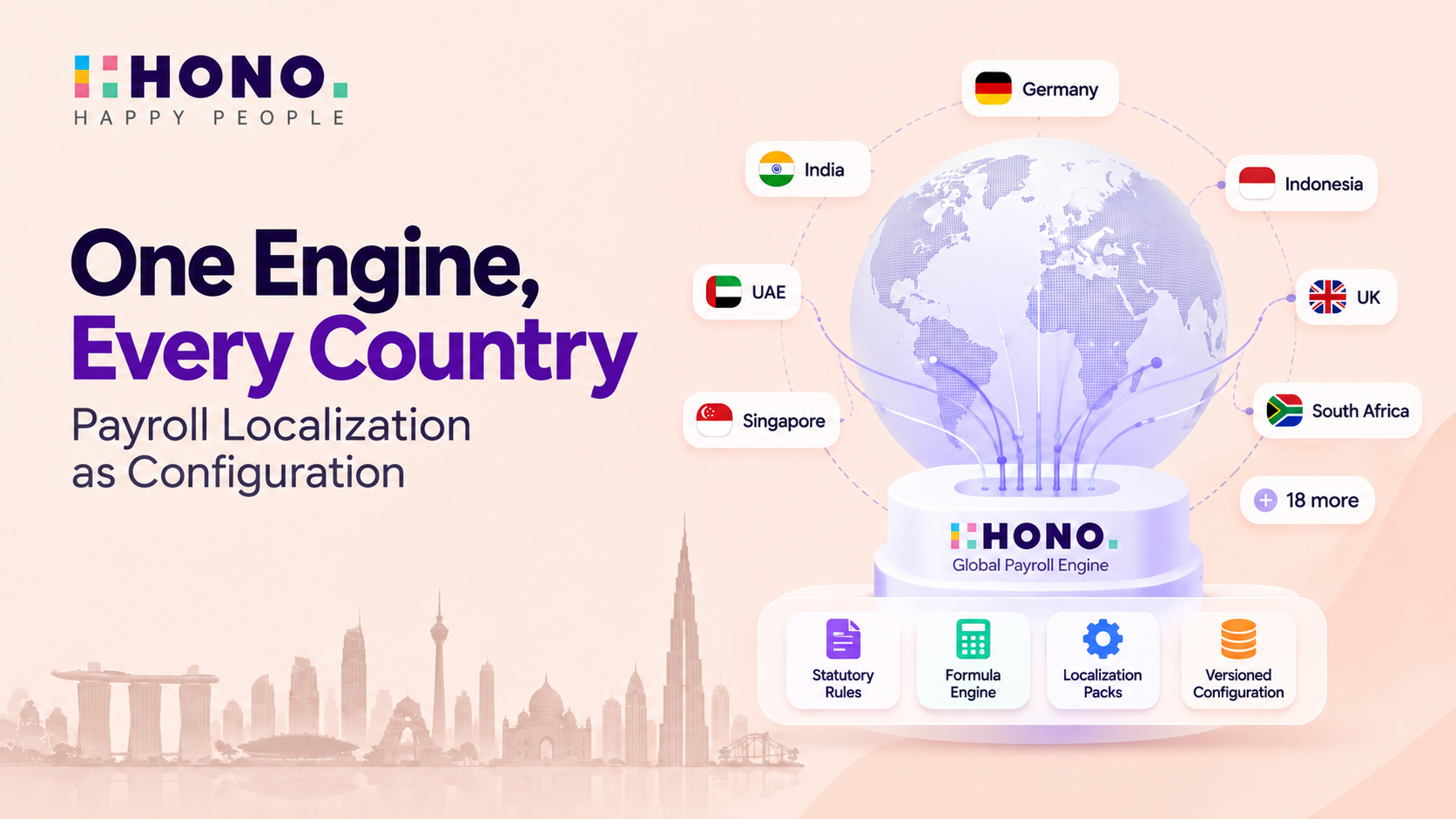
A country is described, not built. Everything that makes India different from Germany is data the engine reads, not logic the engine contains. We call that bundle of data a localization pack, one per country.
The pack has a fixed shape. The same list applies to every country. Only the values change. So onboarding a country becomes a research job with an engineering safety net, instead of an engineering job with a research footnote.
Formulas are data, and every rule is dated. When a tax slab or contribution ceiling changes, you edit an expression with an effective date on it. No branch, no build, no release, and no risk to the other 24 countries.
Germany is not harder to build. It is more law to read. Lohnsteuer, church tax, four branches of social insurance, SEPA pain.001, works councils and GDPR residency. All of it goes into the pack. None of it touches the engine.
The engine is a quarter of the work. Keeping 25 rulebooks legally current is the other three quarters. Configuration makes a change cheap to apply, but it does nothing to make the change cheap to know about.
The Country Problem
In our earlier piece on Zero Touch Payroll, we wrote about removing the cut-off date. That cut-off was a leftover from an older way of working, where payroll had to close early only because the data stopped coming in early. This article is about the other side of the same product. Not when payroll runs, but where it runs.
The same engine runs the payroll cycle in India, in the UAE, in Indonesia and in Singapore. That is 25 markets in total, across South-East Asia, the Middle East and Africa, Europe, and India. Here is how it works.
Multi-country payroll is hard for a reason that has nothing to do with software. Every country is its own sovereign statutory regime, built on decades of accumulated law. Each one has its own tax method. Its own social security branches. Its own idea of what a payslip must legally contain. Its own file format that the receiving bank expects. Its own calendar of filing deadlines. And its own rules about where an employee's data is allowed to physically sit.
The obvious way to handle all of this is to build each country into the code. One module for India. One branch for the UAE. One fork for Germany. This works for three countries and breaks down at thirty. Every statutory change becomes a code release. Every new country becomes an engineering project. And over time, the codebase turns into a museum of every country's exceptions, which no new engineer wants to touch.
“Every country is a sovereign statutory regime that has never heard of your architecture.”
Country Is Configuration, Not Code
One decision makes global payroll workable. It is a simple flip in thinking.
A country is not something you build. It is something you describe.
Everything that makes India different from Germany is data. The tax method. The contribution bands. The pay components. The formulas. The payslip layout. The report set. The payment file. The calendar. The engine reads all of it. The engine does not contain any of it.
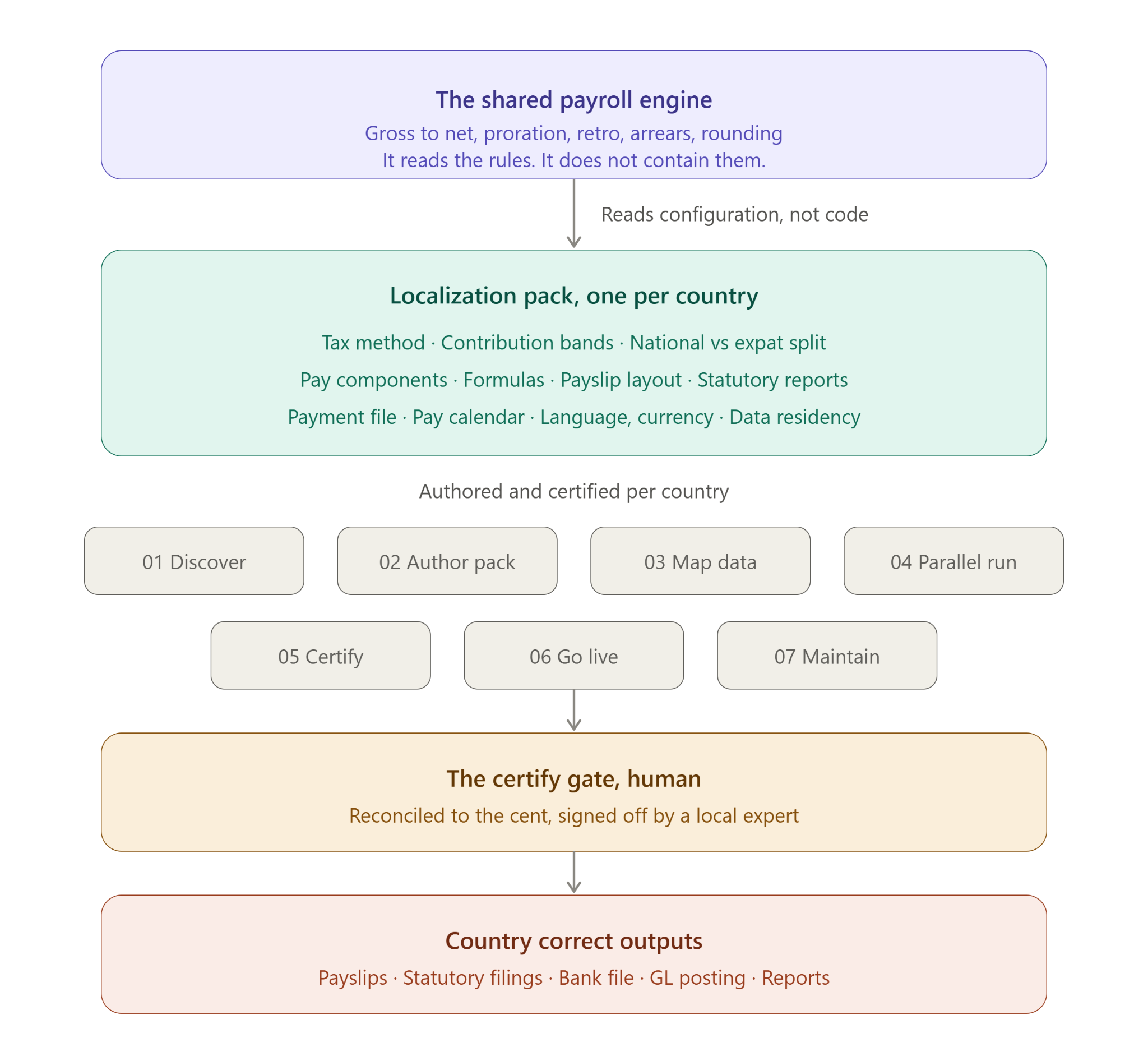
We call this bundle of data a localization pack. It is the country's DNA, written down in a declarative way.
So onboarding a country means two things. Write its pack. Certify it.
The engine that runs the cycle never changes. It reads a different pack and produces a different, correct result.
This is the same lesson we keep learning across the HONO platform. Find the invariant. Push everything else into configuration.
What Is Actually Inside a Localization Pack?
A country's pack is not a vague blob of settings. It is a precise list. Someone had to research each item, encode it, and certify it.
The statutory model
The income tax method, whether it is slab based, cumulative, or withholding at source. The social security and contribution rules, with their bands, ceilings, and the employer and employee split. The mandatory funds. The rounding conventions.
The national versus expat split
In much of the Gulf, social insurance applies only to nationals and other GCC citizens. Expats are treated in a completely different way. Get this wrong and every contribution is wrong.
The payslip
The layout and fields that the law demands. The language. The currency and decimal conventions. The rules for showing year to date figures.
Statutory reports
The filing forms and how often they are due. The file formats each authority expects. Year end certificates. New hire and leaver notifications.
The payment file
SEPA pain.001 in the euro zone. BACS in the UK. The Wage Protection System file in the GCC. Local ACH elsewhere. Each one has its own validation rules.
The calendar and compliance frame
Pay frequency norms. Statutory due dates. Thirteenth month or holiday allowance conventions. Data residency and retention obligations.
Here is the engineering insight. This list is the same list for every country.
What changes is the values, not the shape.
Once the pack has a fixed schema, onboarding a country simply means filling it in. That makes it a research task with an engineering safety net, instead of an engineering task with a research footnote.
Formula Is Data, Not Logic
The load bearing piece of the pack is the formula engine.
Pay components, which means earnings, deductions and contributions, do not carry hardcoded arithmetic. They carry expressions that the engine evaluates.
Two things make this work. A dependency graph that works out the order in which things must be calculated. And a library of reusable functions for the primitives every country shares: band lookups, ceilings, floors, min and max, and proration.
This is what makes statutory change survivable.
Somewhere in a book of 25 countries, a tax slab gets revised or a contribution ceiling gets lifted several times a year. When it happens, the fix is simple. You edit an expression and put an effective date on it.
No branch. No build. No release train. No regression risk to the other 24 countries.
The same engine that calculated last month's cycle calculates next month's cycle with a different number. The number lived in data all along.
“When the tax slab changes, you edit data with a date on it. You do not ship code.”
Statutory Rules as a Versioned Plugin
Effective dating is not a nice to have. It is the difference between a payroll system and a spreadsheet.
Every rule in a pack is versioned and dated. This April's rates and last April's rates sit side by side.
When a cycle runs for a given period, it resolves against the rules that were in force for that period. Not the rules in force today.
The moment this proves its worth is retro.
Take a simple case. An employee's salary is restructured, backdated by three months. That change creates arrears which must be recalculated across three earlier periods. Each period has to be recalculated against the rule version that applied then, which may be different from now if a statutory boundary fell somewhere in between.
The provident fund arrears story in our Zero Touch Payroll piece is exactly this problem inside one country. The versioned plugin model is what stops it from becoming 25 separate problems.
“Last year's payslip and this year's rules have to coexist, because an audit will ask for both.”
Onboarding Germany, the Worked Example
Germany is the country we are onboarding right now. It is a good stress test, because it is genuinely demanding.
Working through its pack is the clearest way to show that the hard part is reading the law, not writing the engine.
What the German pack has to encode?
Lohnsteuer, the wage tax, along with its tax classes.
Church tax, which is a derived component for employees who are liable for it.
Four branches of social insurance: health, pension, long term care, and unemployment. Each one has its own rate and its own contribution ceiling, split between employer and employee.
The payment file, which is SEPA pain.001.
The payslip, which has a shape prescribed by law, in German.
Then there are two things that never show up in a tax rate table, but shape the work just as much as the rates do.
Works councils. Their agreements can bind rules that sit next to pay.
GDPR data residency. This governs where payroll data is allowed to be physically processed and stored.
None of this requires touching the engine.
It requires a pack. Authored against the same schema every other country uses. Reconciled to the cent against a parallel run. And signed off by someone who knows German payroll law.
The seven step pipeline stays the same: discover, author the pack, map the statutory data fields, parallel run against the incumbent, certify, go live, maintain. It is the same pipeline that onboarded the country before Germany, and the same one that will onboard the country after.
“Germany is not harder to build. It is more law to read.”
Twenty-Five Countries, Five Shapes
What stops a book of 25 countries from feeling like 25 unrelated problems is that they cluster.
Learn the shapes, and most of the detail becomes predictable.
The Gulf
There is no personal income tax here, so the traps are not in the maths. The traps are the Wage Protection System file, end of service gratuity accrual, and social insurance that applies to nationals only. The mistake everyone makes is assuming that no tax means easy.
Francophone Africa
These are French derived systems. Progressive salary tax, a social security fund, training levies, and often a second reporting currency running alongside the local one.
Anglophone Africa
Pay as you earn, plus a social fund, plus a rotating cast of new levies covering housing, skills development and health. These legislate fast. The trap here is staying current.
South Asia
Provident fund heavy. Employer and employee retirement contributions dominate. In India, there is also variation by state sitting on top of the national rules.
South-East Asia
Social insurance with caps, a mandatory thirteenth month or holiday allowance, and contribution tables that get revised mid year.
Europe is the sixth shape, and the outlier. It is not a coverage problem. It is a depth and integration problem, which is why it gets its own section further down.
The Part Nobody Puts on a Slide
The engine is the easy quarter of the work.
The expensive, unglamorous, never finished part is statutory content operations. That means keeping every country's pack legally current as the law keeps moving underneath it.
A tax slab shifts in one country. A contribution ceiling is lifted in another. A health insurance scheme replaces the old one in a third.
Every one of those changes has to be researched. Encoded as dated configuration. Regression tested against the countries it must not affect. And shipped before the cycle that depends on it.
This is why "country is configuration" is a means, not the whole answer.
Configuration makes the change cheap to apply. It does nothing to make the change cheap to know about.
The real global payroll business is three things put together. A legislative tracking function. A local expert network. And the discipline to release effective dated updates on time, in every country, forever.
The architecture buys you the ability to keep that promise. It does not make the promise for you.
“The engine is a quarter of the work. Keeping twenty-five rulebooks current is the other three.”
Why Europe Is a Different Kind of Hard?
Everywhere else, you can group countries into shapes. Europe resists that, for three reasons that never appear in a rate table.
Data residency is a sales gate, not a footnote
GDPR says EU personal data must stay inside the region. The law also sets retention limits and gives every employee a right to erasure. Payroll holds the most sensitive HR data there is. So where the compute physically sits becomes an architectural pre-condition, not a deployment detail.
You integrate with the state, you do not file to it
The UK sends data to HMRC in real time on every pay run, through RTI. France uses DSN, one monthly nominative declaration that replaced dozens of separate filings. Germany reports electronically to both the tax authority and the social insurance authorities.
You build against these systems. You do not email them a PDF.
Collective agreements override the statutory floor
Sector and company agreements change pay rules by industry and by region. The French convention collective. The German Tarifvertrag. Works council co-determination. None of this lives in the national statute.
The pack has to carry all of it. That is exactly why a pack that only models tax and social security will produce a confidently wrong German payslip.
“In Europe the government does not receive your file. It runs a system you integrate with.”
Where Humans and Safety Sit?
Country agnostic does not mean country careless.
Payroll carries legal exposure everywhere. So the localization model has to be as disciplined about correctness as the guard rails on our HR assistant are about authority.
Two controls gate every new country.
The parallel run
Before a country goes live, we shadow run its pack against the incumbent system or the manual calculation. Then we reconcile it to the cent, case by case. Joiners. Leavers. Retro. Whatever statutory edge cases the country is known for.
A pack that does not match does not ship.
Certification
A local expert signs off that the tax, the filings and the payslip are legally correct.
The engine can be confident. The country cannot go live on confidence alone.
Everything downstream inherits the same audit discipline our single country product already had. Every figure on every payslip traces back to its input, its formula version, and its approval.
That traceability is what turns a mid cycle rule change in one country into a configuration edit, instead of a controlled explosion.
Closing
The engine that runs one country runs the next one. The country is a pack, and someone authors that pack, reconciles it, and certifies it. The real work, the work that never ends, is keeping every pack legally true as the world underneath it keeps moving. That is the shape of Zero Touch Payroll across 25 markets, and it is the shape of the twenty-sixth.
See it live
Ready to see HONO in action?
Book a 20-minute demo tailored to your team's HR stack.
Request a demo
About the author
Harshita Bhalla
Harshita Bhalla is an Assistant Manager - HR at HONO and a Certified HR Payroll Specialist with around 4 years of experience in HR operations, payroll, and employee lifecycle management. She has worked across domestic and international payroll functions and brings a detail-oriented, people-first approach to everything she does. Harshita is passionate about building efficient HR systems that support both people and business growth.