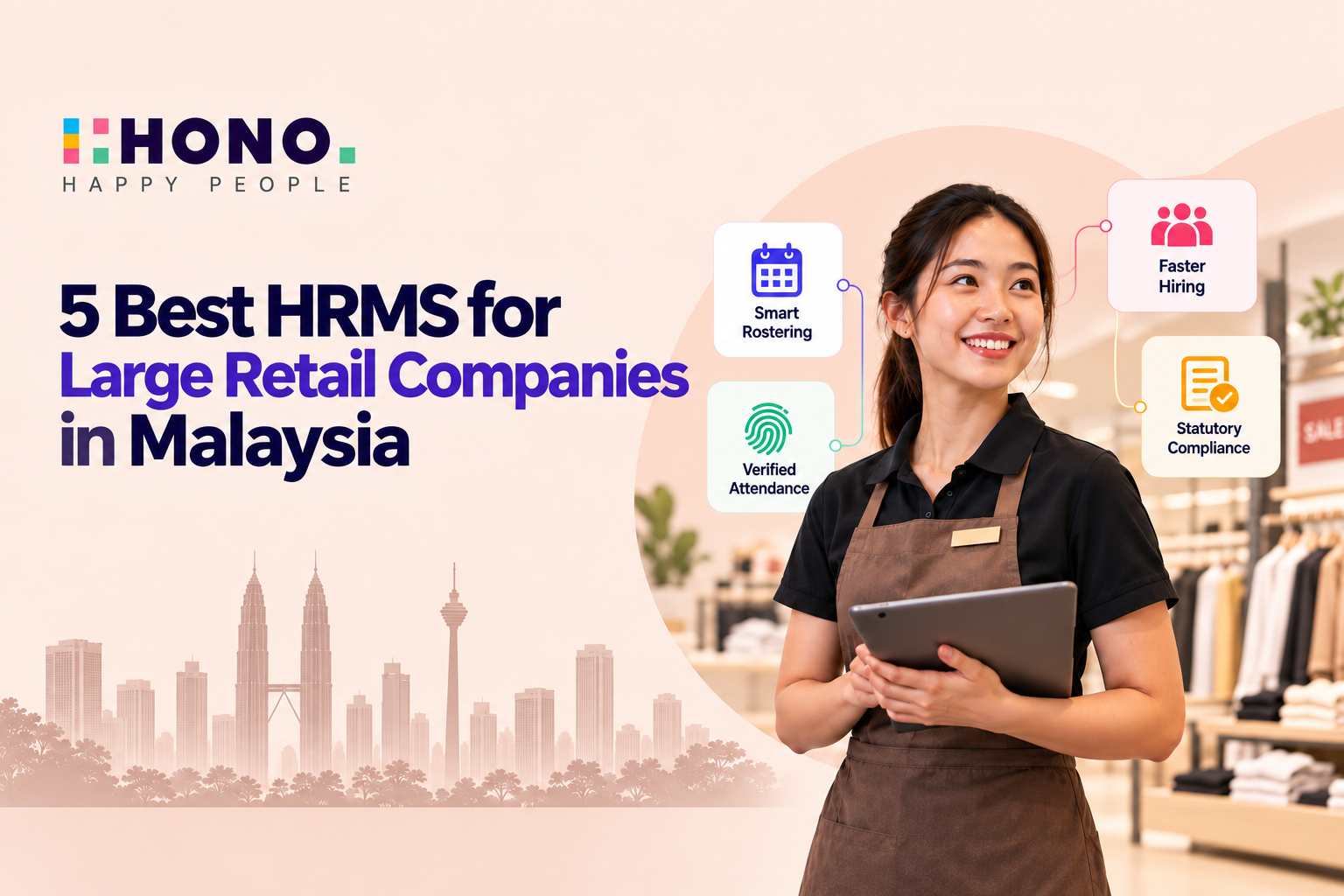
5 Best HRMS for Large Retail Companies in Malaysia
Quick Summary
The five platforms compared: HONO, Akrivia HCM, SAP SuccessFactors, Workday and WebHR, judged on how well each one runs HR for a large Malaysian retail chain.
Retail HR is an outlet problem, not a head office problem: Every store runs its own roster and shift pattern, so the system has to work store by store, not company wide.
Attendance decides everything downstream: If a punch cannot be tied to a person and a store, payroll, overtime and manpower cost all inherit the error.
Buddy punching is the quiet cost: Shared cards and manual registers let one staff member clock in for another, and nobody notices until the wage bill rises.
Statutory accuracy: EPF, SOCSO, EIS, PCB and the HRD Corp levy must run inside the payroll engine, not in a side spreadsheet at head office.
Hiring speed matters in retail: A chain hiring in batches before festive season needs onboarding measured in days, not weeks.
Fragmented HR is the root cause: When hiring, attendance and payroll sit in three systems, head office never sees one true number for headcount or cost.
Pricing: Every platform here quotes on request, so the number depends on headcount, outlets, modules and rollout scope.
HONO leads this list: It brings outlet level rostering, attendance verification and payroll onto one platform for chains running 1,000 plus staff, which the sections below explain.
Why Do Large Retail Companies in Malaysia Need a Dedicated HRMS?
Retail HR is an outlet problem before it is a head office problem. Each store runs its own roster, its own opening hours and its own mix of full timers and part timers, while head office carries the statutory risk for all of them. That risk is real. EPF contributions are due by the 15th of the following month, and a late payment brings both a late payment charge and a dividend charge on top of the arrears. The wholesale and retail trade sector continues to lead employment growth in Malaysia's services sector, so most chains are adding staff faster than their HR systems can absorb.
Here is where a general purpose HR tool fails:
Head office does not know today's headcount. Stores send joiner and leaver updates late, so your report shows last month.
Short staffed stores lose sales. Two people call in sick on a Saturday, and the manager rings around for cover while the queue grows.
Staff churn fills your HR team's day. Retail hires and loses people all year, and the paperwork takes all their time.
New joiners wait to start work. The store waits days while HR collects documents, checks ID and sets up payroll for one person.
Payroll begins with fixing data. Stores send attendance files at month end, so your team corrects errors instead of paying people.
Store staff cannot do things on their own. They have no desk, so every leave request goes through a busy manager.
Head office cannot compare stores. Without one system, you cannot see which stores spend too much on wages and which run short on staff.
Quick Comparison of 5 Best HRMS for Large Retail Companies in Malaysia
Use this table to shortlist two or three options, then explore the detailed sections below to compare their capabilities before booking a demo.
Platform | Best for | Pricing |
|---|---|---|
HONO | Global retail chains running 1,000+ staff across many outlets, need rostering, attendance checks and payroll on one unified platform without using dashboards | Quote based |
Akrivia HCM | Mid to large companies in Asia and the Middle East wanting a single hire to retire suite | Quote based |
SAP SuccessFactors | Large retail groups already running SAP who want HR sitting on the same stack | Quote based |
Workday | Global retail groups that want HR and finance data in one cloud, with strong reporting | Quote based |
WebHR | Mid-size companies across Asia wanting broad module coverage with a mobile first design | Starts at RM 8.00* per employee |
Note: None of these vendors publish a fixed price for enterprise rollouts, and packaging changes often. Check each vendor’s site and ask for a written quote before you shortlist.
Which HRMS Works Best for a Large Retail Chain in Malaysia?
1. HONO
Verdict
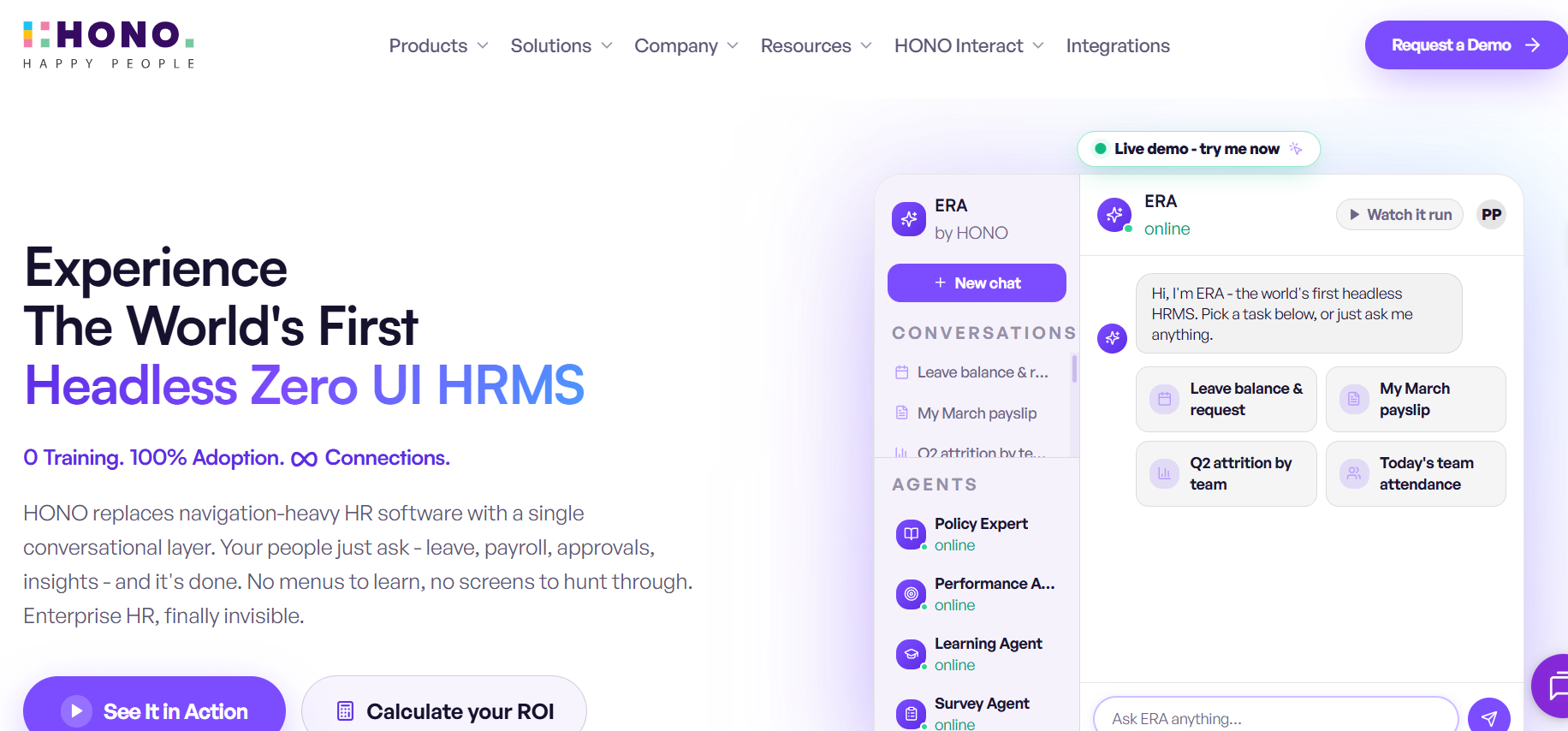
HONO is the strongest fit for large Malaysian retail chains having 1,000 plus employees who do not want to use complex dashboards. Its rostering engine ARASMAS predicts which staff will not turn up, then assigns cover by skill before the shift opens, so stores stay staffed without reflex overtime. Attendance runs on face check with geo fencing, and those verified hours flow straight into payroll.
Overview
HONO is a Zero UI global HR platform used by large retail, hospitality and manufacturing groups across South East Asia, India, the GCC and Africa. Retail HR breaks down because rosters sit with store managers and payroll sits at head office. HONO closes that gap. Two products do the heavy lifting. HAPAC, the attendance and personnel access control system, checks who is clocking in and where they are standing. ARASMAS, the auto rostering and shift management system, predicts absences and fills the gap before the shift starts. Around them sits the rest of the cycle, from hiring and onboarding to payroll and exit, so a chain does not run three vendors to manage one store assistant.
Key Features
Face check and geo fencing: Staff clock in through AI facial recognition with GPS and geo fencing, so buddy punching stops and every punch belongs to a store.
ARASMAS auto rostering: It predicts absences early and assigns cover by skill, which keeps stores staffed without reflex overtime.
Policies per store: Set separate attendance and shift rules for each region, store or team instead of forcing one policy on all outlets.
Smart Hiring agents: Twelve AI agents screen, rank, schedule and onboard candidates, which matters when you hire in batches before a festive season.
ERA handles complex questions: Store staff and managers ask things like how their overtime compares to the team average or which staff are running low on leave this quarter, and specialist agents pull the data and answer on Teams or Slack.
One view across outlets: Separate policies per entity with a single group level view, plus payroll cost tracking by store and cost centre.
Best for
Retail chains running 1,000 plus staff across many outlets in Malaysia or other countries, with a mix of full time and part time store employees.
Pricing
Quote based.
2. Akrivia HCM
Verdict
Akrivia HCM is a capable hire to retire suite for large companies in Asia and the Middle East. It covers the full employee lifecycle in one modular platform. It works well as a single system.
Overview
Akrivia HCM is a cloud HR platform built for companies with 1,000 plus employees across India, the GCC and South East Asia. It brings recruitment, employee records, leave, time, payroll, performance, learning and exits into one modular suite, so a company can start with a few areas and add more later.
Key Features
Time and attendance: Tracks attendance and gives managers a live view instead of month end reports.
Mobile check in: Supports location based mobile clock in for staff working away from a desk.
Payroll for the region: Handles local pay rules across South East Asia, including shift and holiday pay.
Full lifecycle coverage: Runs recruitment, onboarding, leave, performance, learning and offboarding in one place.
Modular rollout: Lets a company switch on selected modules and add more without starting again.
Integrations: Connects with third party ERP and other business systems through its integration layer.
Best for
Large companies in Asia that want one modular HR suite rather than several separate tools. Retail groups needing deep store level rostering and absence cover should test that area closely in the demo.
Pricing
Custom pricing.
3. SAP SuccessFactors
Verdict
SAP SuccessFactors is a solid choice for retail groups already running SAP. It covers core HR, time and payroll with wide country support. Rollouts take time, and you will need an implementation partner.
Overview
SAP SuccessFactors is SAP's cloud HR suite, used by large enterprises across many countries. Employee Central holds the core HR record, with Time Tracking and payroll sitting alongside it, so hours reach payroll inside the same system. For a retail group already standardised on SAP, it keeps HR on the same stack as the rest of the business.
Key Features
Employee Central: Manages employee records, org structures and job information across entities and countries.
Time Tracking: Records working hours and absences for hourly and shift based staff.
Payroll: Processes pay with time data already reconciled inside the platform.
Talent modules: Covers performance, goals, compensation and learning as connected modules.
Workforce reporting: Gives head office analytics across countries and business units.
Controls: Offers configurable workflows, role based permissions and built in encryption.
Best for
Large retail groups already running SAP that want HR sitting on the same stack. Chains wanting a fast rollout across many outlets will find the effort heavy.
Pricing
Quote based, with licence cost separate from partner implementation cost.
4. Workday
Verdict
Workday is a strong platform for global retail groups that want HR and finance in one cloud. Its reporting and planning tools are well regarded. It suits head office teams more than hourly store staff.
Overview
Workday is a cloud HR and finance platform used by large global enterprises. It covers core HR, talent, workforce planning, payroll in selected countries and analytics on a single data model, which is why finance led groups often choose it. Payroll coverage varies by country, so a Malaysian chain needs to check how local pay and statutory filing get delivered.
Key Features
Core HR: Holds employee records, job data and org structures for the whole group.
Workforce planning: Supports headcount and cost planning alongside HR data.
Talent modules: Covers performance, goals, learning and succession in one suite.
Time tracking: Records worked hours and absences for hourly and salaried staff.
Reporting: Gives head office strong analytics across regions and business units.
Finance link: Shares one data model with Workday Financial Management.
Best for
Global retail groups that want HR and finance data in one cloud with strong reporting. Chains whose main need is store rostering and local statutory payroll should check country coverage first.
Pricing
Quote based, priced per employee with implementation billed separately.
5. WebHR

Verdict
WebHR is a practical cloud HRMS for retailers that want attendance, scheduling and payroll in one system. It covers the main HR tasks with a modular pricing model. Retail groups with complex store level rostering should test those workflows before committing.
Overview
WebHR is a cloud based HR Software used by businesses of different sizes across multiple countries. It brings employee records, leave, attendance, recruitment, payroll and performance into one system, with optional modules for scheduling and other HR tasks. For Malaysian retailers, it supports mobile attendance, shift planning and local payroll deductions, so store managers and HR teams can manage daily workforce tasks in one place.
Key Features
Time and attendance: Tracks working hours, breaks, overtime and absences with live attendance reports.
Mobile check in: Supports GPS based attendance, geofencing and biometric check ins for store and field staff.
Shift scheduling: Lets managers create rosters, manage shift swaps and fill open shifts with approval controls.
Malaysian payroll: Supports salary calculations and statutory deductions for EPF, SOCSO, EIS and PCB.
Core HR: Holds employee records, leave requests, documents and staff information in one place.
Modular setup: Lets companies add recruitment, payroll, performance and scheduling modules as needed.
Best for
Small and mid sized retail chains that want attendance, shift scheduling and HR in one affordable cloud platform. Groups running many stores with complex rostering and payroll rules should test those areas closely in the demo.
Pricing
Starts at RM 8.00* per employee per month, with payroll and scheduling available as paid add ons.
Why Is a Cloud HRMS Better Than Spreadsheets for a Large Retail Chain?
Most chains start with spreadsheets because they work fine for one store. The trouble begins at store number ten, when every manager keeps his own file and head office spends the first week of the month merging them. A cloud HRMS removes that step.
Here is what changes when you move off spreadsheets:
Head office sees today, not last month. Every store updates the same system, so you check headcount and attendance whenever you want.
Statutory rates update on their own. The vendor applies EPF, SOCSO, EIS and PCB changes centrally, so nobody maintains rate tables by hand.
Attendance reaches payroll by itself. Verified hours flow into the pay run, so your team stops copying files before payday.
Every change leaves a record. When an auditor asks how a figure was reached, you show the trail instead of an old saved file.
Salary data stays protected. Access sits behind roles and passwords, not in a file that anyone can forward.
Staff answer their own questions. Employees check and apply leave and check payslips themselves, which frees store managers for the floor.
You compare stores properly. One system means you see wage cost and staffing gaps by outlet, side by side.
How to Choose the Best HRMS for a Large Retail Company in Malaysia?
Every demo looks good on a laptop at head office. The real test comes in month two, when fifty store managers use it on a busy Saturday. Use this checklist when you shortlist.
Store level rostering: Ask how each outlet builds its own shift plan, and whether head office sees all of them in one place.
Attendance you can trust: Check that the system proves who clocked in and where, so shared cards and proxy punching stop.
Absence cover: Ask what happens when two staff call in sick, and whether the system suggests replacements before the shift opens.
Statutory accuracy: Confirm EPF, SOCSO, EIS, PCB and the HRD Corp levy all run inside payroll, with rates updated automatically.
Part timer pay rules: Check how the system handles hourly staff, split shifts, public holiday work and overtime for store teams.
Bulk hiring: Ask how fast you can onboard a batch of seasonal staff, and how much of the paperwork the system handles itself.
Integration: Confirm it connects to your existing attendance devices, ERP and finance system before you sign.
Related Articles:
Frequently asked
FAQs
See it live
Ready to see HONO in action?
Book a 20-minute demo tailored to your team's HR stack.
Request a demoAbout the author
Akanksha Shekhar
With over 9 years immersed in the world of content marketing for SaaS, Cloud, HRMS and multiple other industries, Akanksha Shekhar currently leads the content initiatives as Manager of Content Marketing. Her expertise lies in the art of bringing words to life, creating engaging narratives and technically sound pieces that are both catchy and deeply informative.