Quick Summary
- The seven HR platforms: HONO, HROne, Qandle, Darwinbox, Pocket HRMS, BambooHR and Keka.
- What makes frontline HR software different: It has to work without a desk, without stable internet, while calculating pay that changes every cycle.
- What decides your shortlist: field attendance capture, statutory compliance depth, support for daily and weekly wage cycles, ease of use for workers, and multi-site rollout.
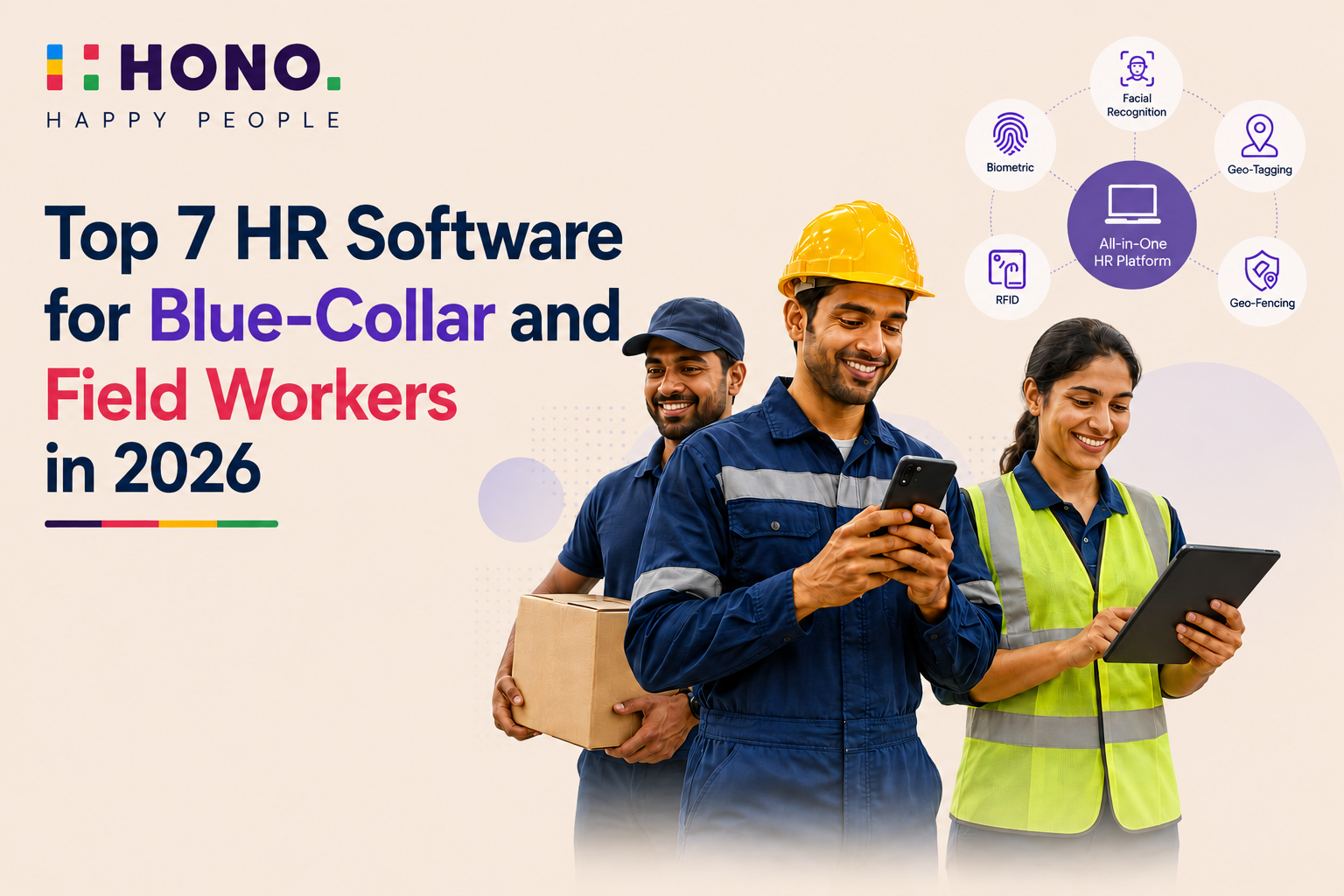
- Why HONO leads: Workers transact over MS Teams and Slack instead of logging into a portal, the software handles 100+ languages, and attendance covers facial recognition, biometrics, RFID, geo-tagging and geo-fencing in one unified system.
- HONO on Indian statutory compliance: PF and ESI with ECR generation, perquisite calculation, quarterly eTDS returns, Form 16 and payslip generation, plus income tax calculation and country-specific statutory forms.
- Best fit varies: Some platforms suit large multi-site enterprises with mixed workforces, some suit Indian mid-market companies with heavy contract labour, and some suit smaller teams needing basic records and self-service.
- A note on fairness: All product names belong to their respective owners. Features and pricing change often, so please verify on vendor websites before you decide.
Why Blue-Collar and Field Teams Break Standard HR Software?
Most HR platforms were built for someone who sits at a desk, has a laptop, has a company email ID and draws the same salary every month. Almost none of that is true for a plant worker, a delivery rider or a field technician. The software does not fail loudly. It fails quietly, in small ways that add up by the 30th of every month.
Here is where the cracks show:
- The login itself is a barrier: Most frontline workers have no company email ID, so HR ends up doing their data entry for them.
- Attendance breaks where the network is weak: Punches do not register in factory belts, warehouses and rural beats, and the dispute lands straight in payroll.
- Proxy attendance is hard to control: Without location checks and identity verification, you cannot confirm the worker was actually at the site.
- Pay is not a fixed monthly number: Shift differentials, overtime, weekly and daily wage cycles and advances rarely fit a standard monthly payroll engine.
- Compliance is heavier and less forgiving: Registers, muster rolls, contractor records and multi-state PF and ESI filings pile up when each site keeps its own copy.
- Worker data brings new risk: Location, selfie and biometric punches are sensitive personal data and need consent, retention limits and access control.
- Language and literacy get ignored: An English-only dashboard pushes the worker to call his supervisor instead, and adoption collapses.
- You end up buying two systems: Head office runs one HRMS, the plant runs a separate attendance tool, and someone reconciles both in Excel every month.
What Changed in Frontline HR Tech in 2026?
For years, "HR software for blue-collar workers" simply meant a biometric machine at the gate plus a payroll tool. That is no longer the case. Over the last two years the category has moved in a clear direction, and the platforms that adapted early are the ones now worth shortlisting.
Here is what changed:
- AI moved from answering to acting: Earlier chatbots only replied to questions, while newer agentic systems actually complete the task, from applying the leave to updating the record.
- Chat replaced the portal: Workers now transact on MS Teams and Slack, which removes the login, the password and the training that a portal demands.
- Attendance became multi-mode by default: Facial recognition, biometrics, RFID, geo-tagging and geo-fencing now sit in one system instead of three separate tools.
- Payroll velocity became a real requirement: Daily, weekly and bi-monthly cycles now run alongside the monthly cycle rather than being pushed into a spreadsheet.
- Absenteeism prediction moved ahead of absenteeism reporting: Shift notifications go out before the shift starts so supervisors can fill gaps instead of discovering shortages at the line.
- Multilingual stopped being optional: Platforms now respond in the worker's own language automatically, without asking him to change a language setting.
- Worker data governance became a board topic: Location and biometric capture now needs encryption, masking, multi-factor access and a clear retention policy.
- One system of record replaced the patchwork: Enterprises are consolidating recruitment, attendance, payroll and talent into a single platform to remove reconciliation entirely.
How We Selected These 7 Platforms
A frontline HR platform cannot be judged on module count. A system with forty modules is useless if the worker on the shop floor cannot mark his attendance without calling his supervisor. So we evaluated these seven platforms on what actually decides success in a deskless rollout.
Here is what we looked at:
- Deskless readiness: Whether the platform captures attendance through facial recognition, biometrics, RFID, geo-tagging and geo-fencing, and how it handles shifts, rosters and overtime.
- Worker-side adoption: Whether a worker can transact on a channel he already uses, in any language he is comfortable.
- Payroll velocity: Whether the payroll engine runs daily, weekly and bi-monthly cycles alongside monthly, with advances, arrears and full and final settlement built in.
- Indian statutory compliance: Depth on PF and ESI with ECR generation, perquisite calculation, quarterly eTDS returns, Form 16 and state-specific statutory forms.
- Single system of record: Whether recruitment, attendance, payroll and talent sit on one data model, or whether you will be reconciling exports every month.
- Data security and governance: Encryption, data masking, multi-factor authentication and recognised certifications, since location and biometric data is sensitive personal data.
Top 7 HR Software for Blue-Collar and Field Workers at a Glance
Use this table to narrow down two or three platforms, then read the detailed sections below before you shortlist for a demo.
| Platform | Best for | Standout strength for frontline teams | Pricing model |
|---|---|---|---|
| HONO | Enterprises running blue-collar and white-collar teams on one platform across multiple sites and countries | Workers transact over Teams and Slack plus attendance through facial recognition, biometrics, RFID, geo-tagging and geo-fencing in one system. | Quote-based |
| HROne | Indian mid-market companies with heavy contract labour and multi-state operations | Attendance and payroll built around Indian factory and field realities | Quote-based |
| Qandle | Growing companies that want a configurable, modular HR system | Modular structure lets you switch on only what you need | Custom quote |
| Darwinbox | Large enterprises wanting broad module coverage across Asia | Suite breadth with geo-fence and face recognition on the mobile app | Quote-based |
| Pocket HRMS | Indian businesses wanting cloud HR with mobile self-service and location tracking | Mobile-first self-service with geotracking for distributed teams | Custom quote |
| BambooHR | Companies standardising employee records and core HR data | Clean core HRIS and reporting on employee data | Custom quote |
| Keka | Smaller teams with a light frontline footprint | Simple interface for core HR, leave and self-service | Custom quote |
Top 7 HR Software for Blue-Collar and Field Workers in 2026
1. HONO
Verdict
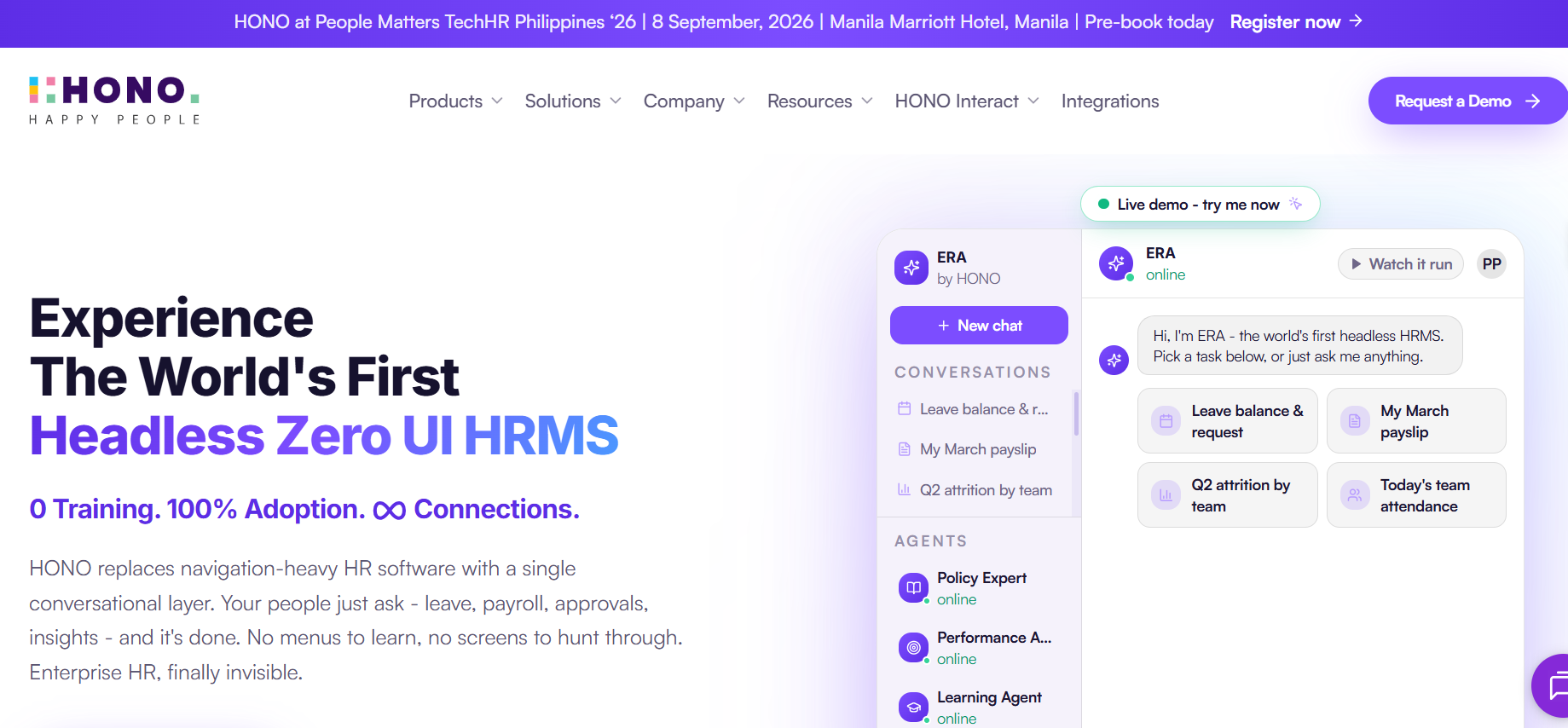
HONO is the strongest fit for blue-collar workers. It lets workers finish their HR tasks in a chat window, in their own language. HONO adds multi-mode attendance, variable wage cycles and built-in Indian compliance, and one platform covers the plant, the field and the head office.
Overview
HONO is an AI-native HR platform, headquartered in Gurugram with presence across the Middle East and Southeast Asia and Africa. It reports 300+ enterprise clients and around 1 million platform users across 50+ countries, with strong presence in manufacturing, EPC, facility management, retail and hospitality. The platform covers 15+ modules across the full employee lifecycle, but its real differentiator is ERA, the headless, zero UI HRMS, which means the worker states what he needs in plain language instead of navigating menus to complete the tasks.
Key Features
- Chat-first transactions: ERA by HONO lets workers apply for leave, check balances and view payslips on MS Teams and Slack.
- Multilingual engine: HONO detects the worker's language automatically and replies in it, across 100+ languages, with no setting to change.
- Multi-mode attendance: HONO captures attendance through facial recognition, biometrics, RFID, geo-tagging and geo-fencing in a single system.
- Variable payroll cycles: Automatically runs daily, weekly, bi-monthly and monthly payroll with salary advances, loans, arrears and full and final settlement.
- Indian statutory compliance: HONO handles PF and ESI with ECR generation, perquisite calculation, quarterly eTDS returns and Form 16.
- Absenteeism Management: HONO notifies workers before the shift starts and shows supervisors real-time confirmations, so line shortages get filled in advance.
Best for
Enterprises and large mid-market companies running 1000+ blue-collar and white-collar workers across multiple plants, sites or countries. It suits manufacturing, EPC, facility management, logistics, retail and hospitality, where shifts, overtime and multi-site compliance all have to work together.
2. HROne
Verdict
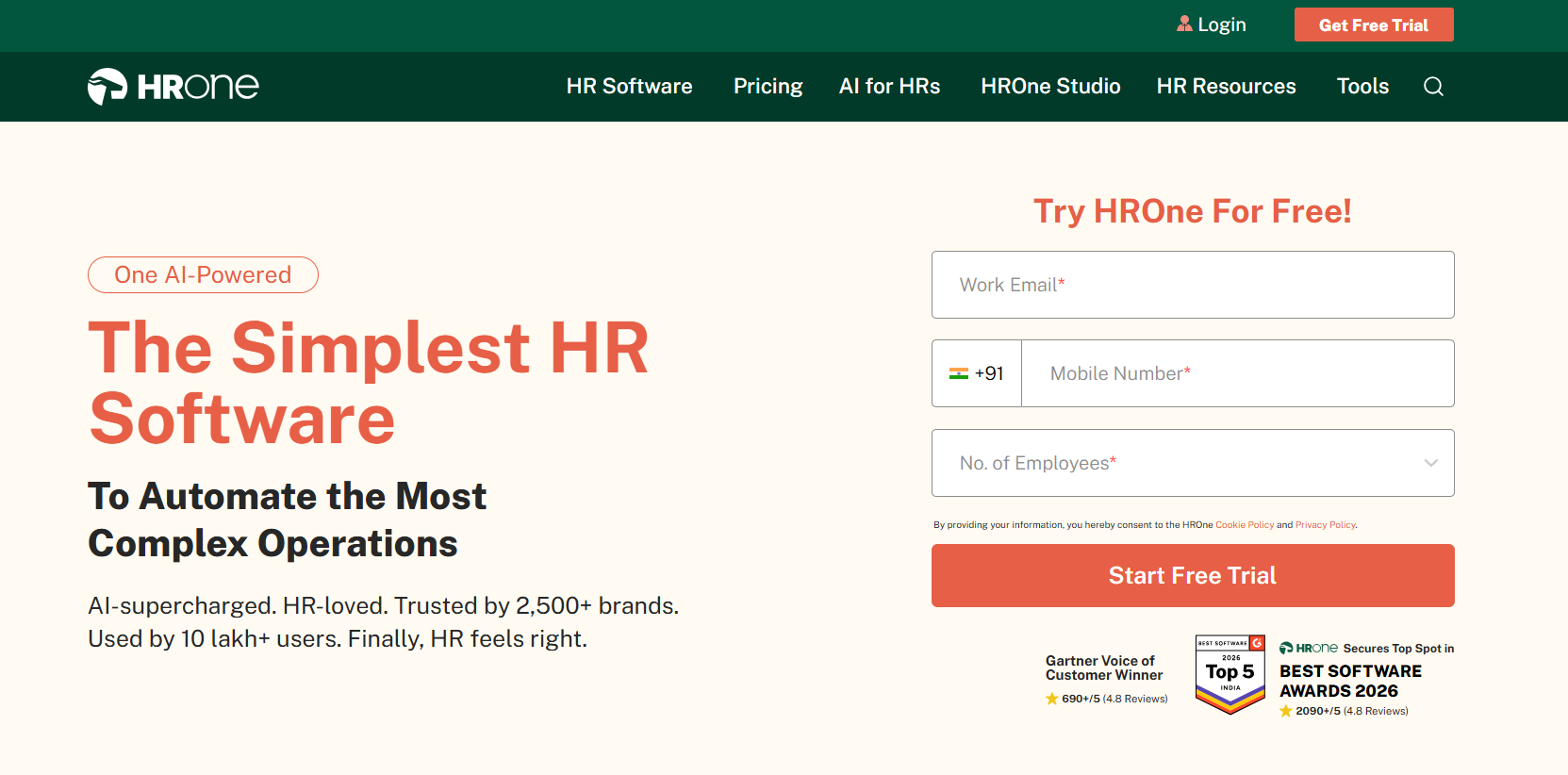
HROne is a dependable India-focused option for mid-market companies running factory or field teams. It handles attendance, shifts and payroll for multi-state Indian operations. It suits organisations whose workforce sits entirely within India.
Overview
HROne is a cloud HCM used by Indian factories, retail chains, logistics operations and BFSI field-sales teams. It offers modules across core HR, recruitment, workforce management, attendance, payroll, expense, performance, engagement and helpdesk. HROne serves organisations in the roughly 100 to 5,000 employee range, and it does its best work on attendance and payroll for companies running across several Indian states.
Key Features
- Geo-fenced attendance: HROne captures field attendance through GPS and geo-fencing with mobile check-ins.
- India payroll: HROne automates salary processing with PF and ESI deductions, payslips and statutory filings.
- Shift and leave management: HROne handles shift scheduling, flexible leave policies and multi-level approvals.
- Core HR and workflows: HROne centralises employee data with a self-service portal and configurable workflows.
Best for
Indian mid-market companies with factory, warehouse or field teams spread across multiple states. Organisations with multi-country operations should check coverage before shortlisting.
3. Qandle
Verdict
Qandle is a practical choice for Indian small and mid-sized businesses that want easy-to-use HR software. It covers attendance, payroll and self-service in a modular structure. It suits companies with a moderate frontline group.
Overview
Qandle is an HR platform serving Indian SMBs and growing businesses. It offers modules across core HR, attendance and leave, payroll, recruitment, performance, expense and employee self-service. Qandle builds its product around ease of use, so employees can mark attendance, apply for leave and view payslips without HR stepping in. It also offers a field force tracking module for sales and service teams that move between locations.
Key Features
- Multiple attendance methods: Qandle supports biometric check-ins, GPS-based attendance and web marking with shift scheduling.
- Indian statutory payroll: It handles PF, ESI, PT and TDS with automated tax calculations and salary slips.
- Employee self-service: Qandle lets employees mark attendance, apply for leave and view payslips on their own.
- Modular structure: It allows you to start with a few modules and add more as your needs grow.
Best for
Indian small and mid-sized businesses wanting simple, configurable HR software for attendance and payroll. Large multi-plant enterprises with complex shift and contract labour needs should check depth carefully.
4. Darwinbox
Verdict
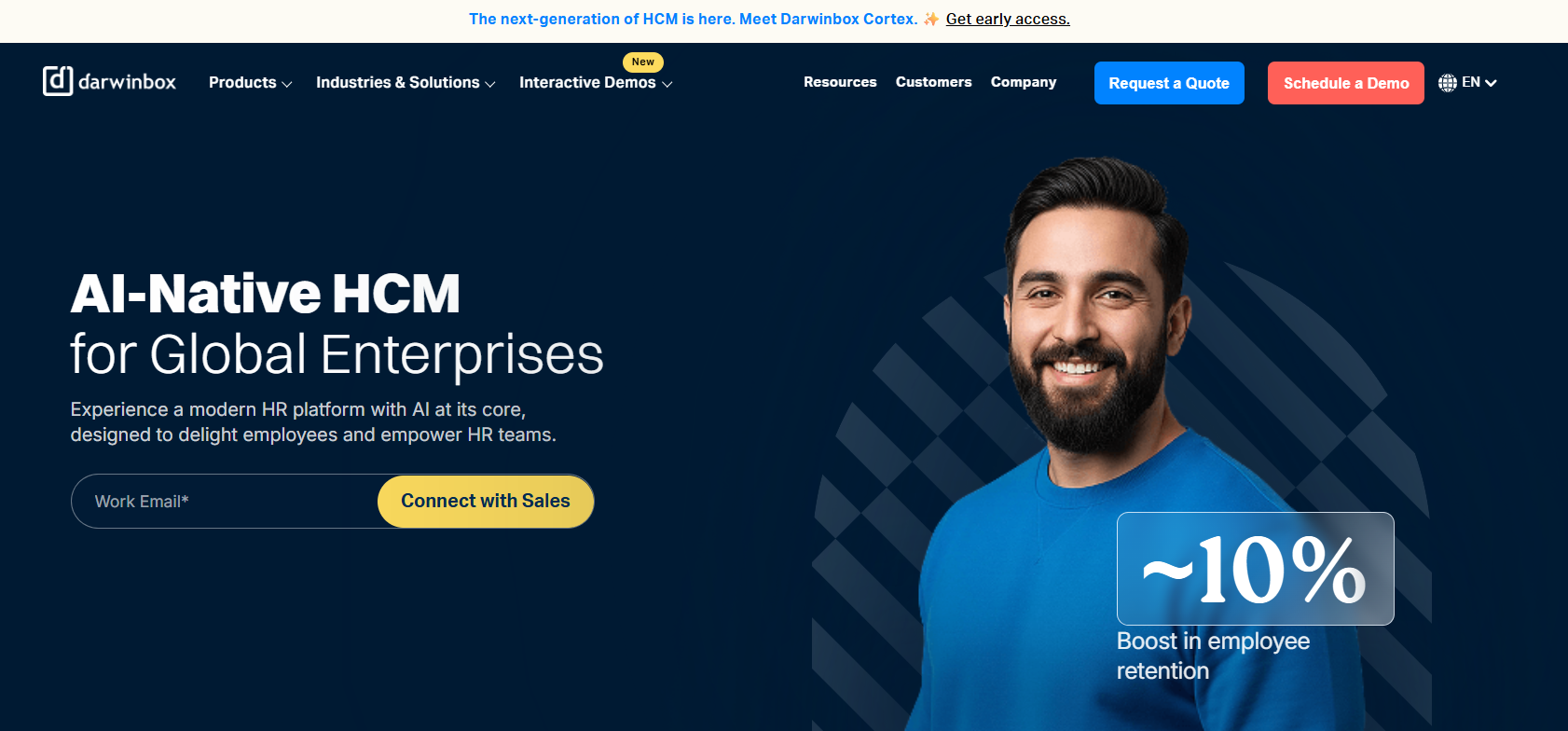
Darwinbox is an enterprise HCM suite with wide module coverage across Asia. It offers geo-fencing and face recognition on its mobile app for distributed teams. It suits large organisations that want breadth across the employee lifecycle.
Overview
Darwinbox cloud HCM founded in 2015, used by enterprise customers across India, Southeast Asia and the Middle East, and it usually appears in evaluations at the 1,000-plus headcount level. The platform spans core HR, talent acquisition, talent management, workforce management, employee financials and reimbursements, and reports and analytics. Darwinbox runs Indian payroll natively and covers global payroll through partner integrations.
Key Features
- Geo-fencing and face recognition: It supports field attendance with selfie punch and configurable radius rules.
- Core HR and lifecycle: Darwinbox centralises employee records and manages transfers, confirmations and offboarding.
- Workforce management: Tracks attendance via biometric or geofencing devices and manages shifts, leave and overtime.
- Talent and performance: It covers goal setting, continuous feedback, 360 degree reviews and succession planning.
Best for
Large enterprises above 1,000 employees want broad module coverage across India and Asia. Mid-market companies needing a quick go-live should factor in longer implementation timelines.
5. Pocket HRMS
Verdict
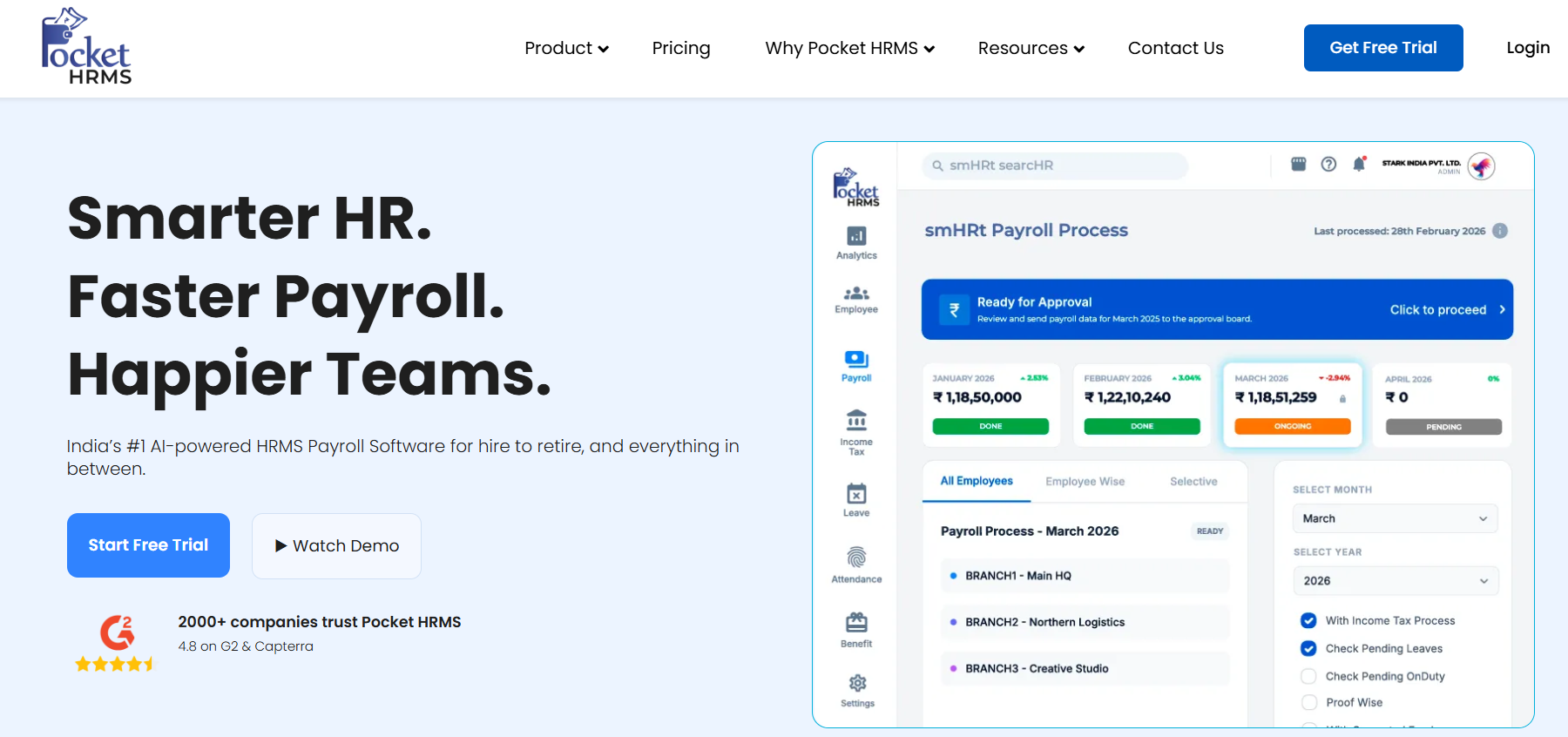
Pocket HRMS is a cloud HR and payroll platform suited to Indian businesses with employees working away from the office. It handles location-based attendance and payroll through a mobile app. It fits companies that mainly need attendance and payroll running cleanly.
Overview
A cloud-based HRMS and payroll solution from Greytrix, used by businesses across India from SMBs to larger enterprises. The platform covers payroll, attendance, leave, onboarding, recruitment, appraisal, expense claims and employee self-service. Its most useful capability for field teams is remote attendance marking with selfie and GPS, along with geotagging, geofencing and biometric hardware support. There is also a multilingual mobile app supporting several regional Indian languages, and an AI chatbot called smHRty that answers employee queries and handles basic tasks.
Key Features
- Location-based attendance: Supports selfie and GPS marking with geotagging, geofencing and biometric hardware.
- Attendance fraud detection: Uses built-in algorithms and Machine ID detection to check attendance authenticity.
- Statutory payroll: Auto-updates for PF, ESI, PT and tax regulations, with payslip delivery on WhatsApp.
- Multilingual app and chatbot: Gives employees regional language access plus the smHRty chatbot for queries.
Best for
Indian SMBs and mid-sized companies wanting cloud HR and payroll with location-based attendance for distributed staff. Large enterprises running complex shift rosters across many plants should check depth before committing.
6. BambooHR
Verdict
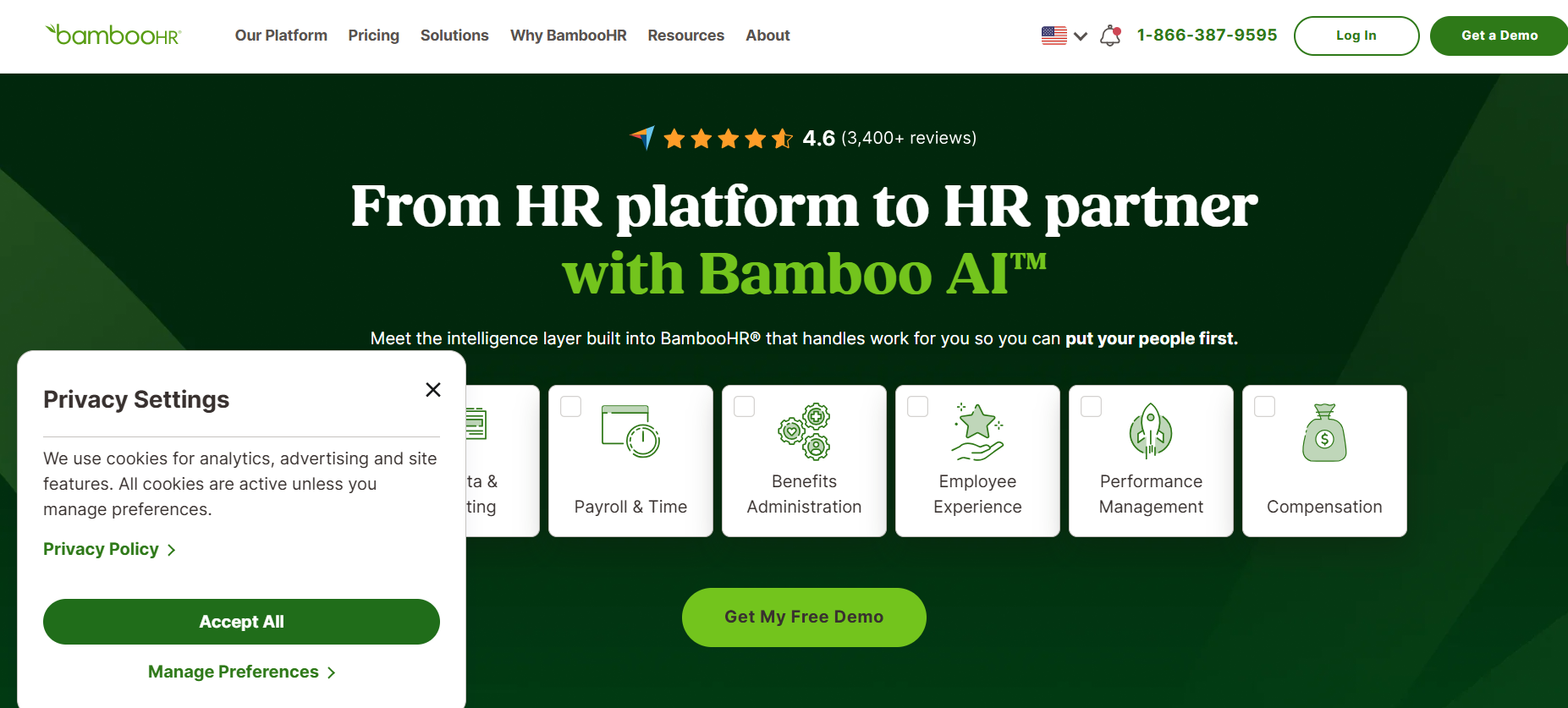
BambooHR is a clean, easy-to-use HRIS built mainly around employee records and core HR. It offers time tracking with geolocation as an add-on. It fits companies whose frontline group is small and whose workforce sits outside India.
Overview
BambooHR is a US-based HR platform widely used by small and mid-sized companies for employee records, onboarding, time off, performance and reporting. Time Tracking is available as an add-on, letting employees clock in and out from the mobile app with geolocation, and it syncs hours with payroll and its Employer of Record partnership supports hiring across 90+ countries. The platform does not offer Indian statutory payroll, and it has no native employee scheduling, so shift and roster planning depends on third-party tools.
Key Features
- Mobile clock-in with geolocation: Turns the employee's phone into a time clock and digital timesheet for on-site work.
- Overtime and shift differentials: Calculates overtime automatically across US states and supports shift differentials.
- Centralised employee records: Keeps employee data, documents and lifecycle events in one organised system.
- Reporting and analytics: Offers standard reports plus a drag-and-drop builder for headcount, turnover and time-off data.
Best for
Small and mid-sized companies outside India that want strong employee records with basic on-site time tracking. Indian organisations needing PF, ESI and TDS compliance or shift rosters will need a different platform.
7. Keka
Verdict
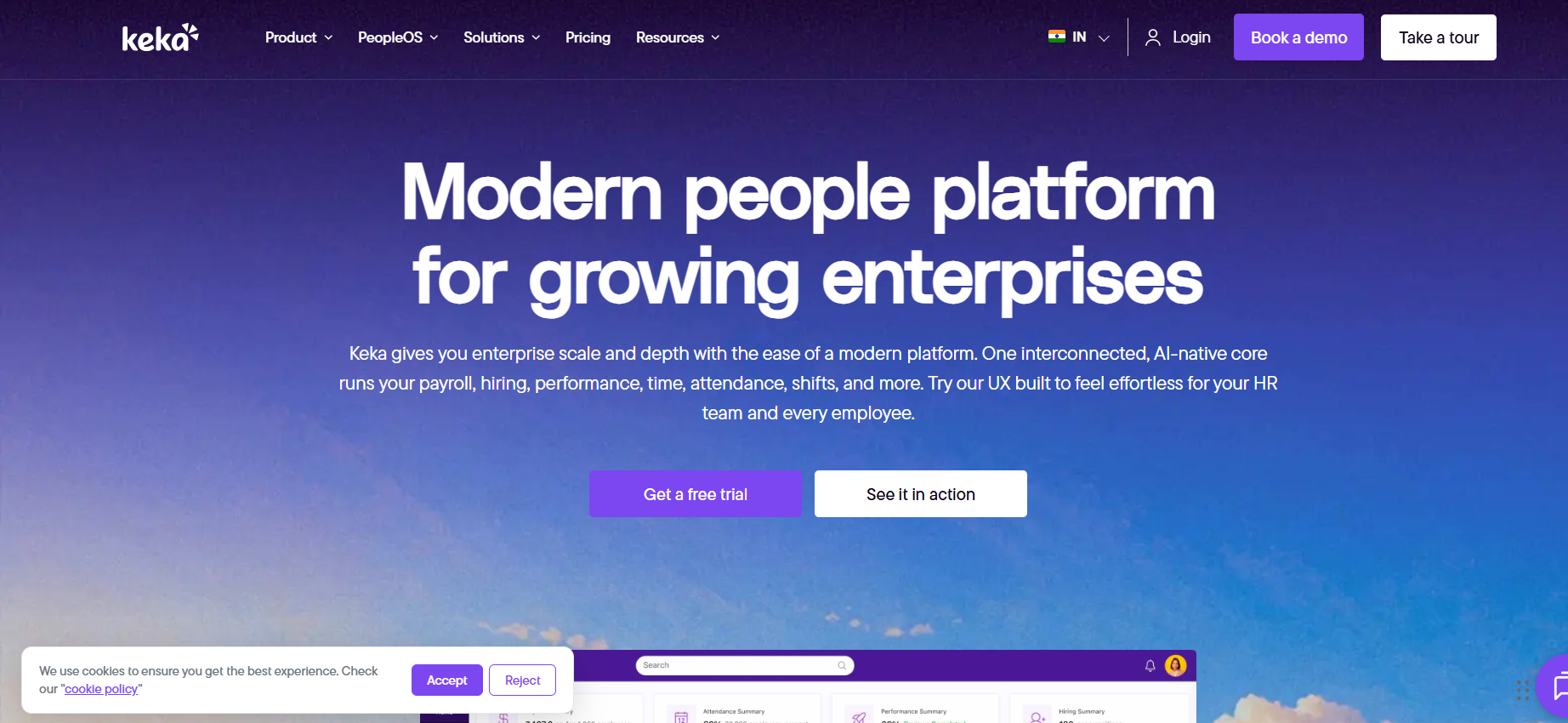
Keka is a clean, easy-to-use HR platform popular with Indian SMBs. It covers core HR, leave, payroll and attendance with a simple interface. It works best when your team is mostly office-based with a limited frontline group.
Overview
Keka is a Hyderabad-based HRMS founded in 2015, used mainly by companies below 500 employees. The platform brings together core HR, payroll, time and attendance, expense management and performance management. It offers GPS and selfie-based attendance, shift scheduling and overtime automation, along with mobile apps and integrations with Slack and MS Teams. Keka is known for an interface most teams pick up without much training.
Key Features
- GPS and selfie attendance: Captures attendance on mobile with location and selfie for employees working outside the office.
- Shift and overtime handling: Manages shift scheduling, overtime automation and leave policies.
- Indian statutory payroll: Automates salary processing with PF, ESI and TDS along with benefits administration.
- Mobile app and integrations: Gives employees mobile self-service with Slack and MS Teams integration.
Best for
Indian SMBs under 500 employees with a mainly office-based team and a small field or frontline group. Companies running large shift-based operations across multiple plants should look higher up this list.
Must-Have Capability Checklist for a Frontline HRMS
- Attendance and time: Facial recognition, biometrics, RFID, mobile and web capture in one system, with geo-tagging and geo-fencing to confirm the punch happened at the site. Shift rosters, overtime, on-duty marking and regularisation should all run with proper approval flows.
- Payroll: Daily, weekly, bi-monthly and monthly cycles running on the same engine, not the odd ones pushed into a spreadsheet. Salary advances, loans, arrears and full and final settlement handled inside the system.
- Compliance: PF and ESI with ECR generation, quarterly eTDS returns, Form 16 and perquisite calculation. State-specific statutory forms covered, with an audit trail on every field-level change.
- Worker experience: Access on a channel the worker already uses, in his own language. Payslips, leave balances and attendance on mobile or chat, plus a helpdesk route for grievances.
- Governance and security: Encryption at rest and in transit, data masking, multi-factor authentication and role-based access. Certifications like ISO 27001 and SOC, with clear retention rules for location and biometric data.
- Scale and integration: Multi-entity, multi-location and multi-country structures modelled without workarounds. Integration with your ERP, biometric hardware and finance systems, and reports HR can build without an IT ticket.
Frequently asked
FAQs
See it live
Ready to see HONO in action?
Book a 20-minute demo tailored to your team's HR stack.
Request a demo
About the author
Mazna Majeed
Mazna is a strategic HR leader with over 10 years of experience driving talent success and organizational growth. As Head of Talent Acquisition and Operations at HONO, she leads HR initiatives across India and South-East Asia, including manpower planning, employee lifecycle management, talent development, engagement, and retention. Mazna is known for aligning people strategy with business goals, building inclusive high-performing teams, and strengthening culture to enable sustainable growth.