Quick Summary
- Enterprises running ESS across multiple plants, shifts, and worker types end up with tools holding different versions of the same record.
- What breaks first: HR ticket volume, payroll mismatches, and near-zero adoption among field and factory staff who never open a laptop.
- This guide compares five ESS platforms on self-service depth, non-desktop access, payroll and attendance sync, and multi-country statutory coverage.
- HONO ranks first. Self-service runs through ERA on Slack and Teams, so there is no dashboard to learn, and payroll and compliance cover 50+ countries.
- Leave, attendance, and payroll read from one employee record. Nothing gets re-keyed, so nothing needs reconciling.
- Before you shortlist, check whether ESS writes to payroll or only exports to it, and demo mobile access with a real field login.
Why Enterprises Need a Strong Employee Self Service Software?
Enterprises need ESS because at scale, routine HR requests stop being routine. A few hundred employees, and HR absorbs them. Past a thousand, across several locations and worker types, they arrive faster than anyone can clear them.
The requests are always the same. Payslip copies, leave balances, attendance corrections, address updates, employment letters. Each takes a few minutes, and those minutes turn into a permanent queue.
Access decides whether the portal works at all. Corporate staff will log in. Field engineers, plant operators, and contract workers usually will not, because they do not sit at a desk and often share a phone. When a portal is desktop-first, HR keeps handling their requests by hand.
The other failure sits behind the screen. If ESS runs separately from payroll and attendance, the numbers drift. An employee sees one leave balance in the portal and a different deduction on the payslip, and someone in HR fixes it manually. Across locations, that is why month-end runs late.
Leaders need to see this while it is happening, not in a report published after payroll closes.
The five platforms below solve it differently. Some drop the portal for a chat interface, some build ESS on the payroll engine, some add an AI assistant to a standard dashboard.
How We Selected These Tools?
We ranked on one question: can an employee finish a task without HR, and does that task update payroll directly? Five criteria came out of it.
- Self-service depth. Attendance, leave, payslips, letters, claims, and policies in one place, not split across modules employees have to hunt through.
- Non-desktop access. Usable by field and factory workers with no laptop and no shared login. Mobile app, or better, a channel they already use like Slack or Teams.
- Payroll and attendance integration. Requests write to the same record payroll reads. If data is exported and re-imported, it will drift.
- Workflow automation. Approval chains for leave, claims, and corrections that can be configured per location, grade, or entity without a developer.
- Multi-country and statutory readiness. Local payroll rules, tax, and leave policy handled out of the box, not rebuilt per country.
Top 5 Employee Self Service Software (Quick Comparison Table)
| Software | Best for | Pricing |
|---|---|---|
| HONO | Enterprises with 1,000+ employees running blue-collar or field workforces across multiple countries, who need conversational self-service and one employee record behind it. | Custom. Contact vendor |
| Pocket HRMS | Mid-sized teams wanting chatbot-led self-service through smHRty and WhatsApp payslip delivery. | ₹60 to ₹90 per employee per month, plus a custom tier. Verify with vendor |
| HROne | Indian mid-market and enterprise teams wanting ESS bundled with engagement, recruitment, and helpdesk in one suite | Listings show plans from around ₹85 per user per month with a 50-user minimum. Verify with vendor |
| factoHR | Payroll-led buyers who need deep Indian statutory compliance and biometric or geo-fenced attendance feeding ESS | Plans from around ₹69 per month. Verify with vendor |
| Qandle | Mid-market teams wanting a configurable ESS portal with fast setup and low training overhead | Custom. Contact vendor |
Footnote: Contact vendors directly for current enterprise pricing at your headcount.
Best Employee Self Service Portal Software in 2026 (Detailed Comparison)
1. HONO
.png)
Verdict: ERA by HONO where self-service runs through conversation instead of a dashboard, which is what makes it one of the best for blue-collar and field staff.
Overview
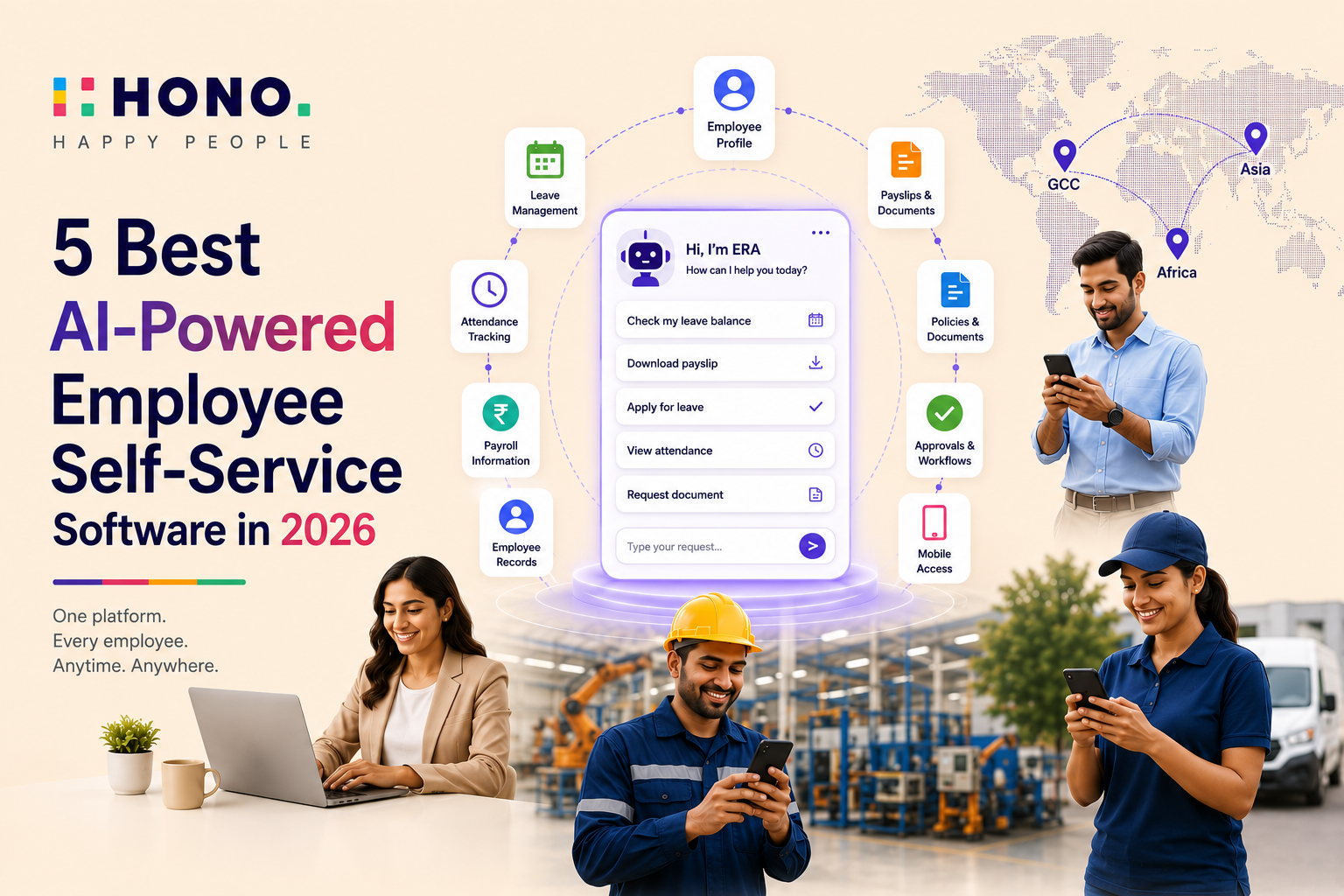
HONO is an AI-native HRMS covering 15+ modules of employee lifecycle in one platform. Its self-service layer is ERA, which is a top layer connected to all modules to perform task with one conversational interface. The HR engine still handles payroll, compliance, workflows, and records. The interface moves into the background.
An employee asks a question in plain language and gets an answer. Apply for leave, pull a payslip, check attendance, ask what a policy says. No menu to navigate, no module to find. ERA runs on Slack and Microsoft Teams, so employees use an app already on their phone.
That matters most for the workers a portal usually loses. A plant operator or field technician does not need a login habit, a laptop, or training. They send a message.
Behind it, every module reads one employee record. Data captured at onboarding flows through payroll, attendance, performance, and exit without re-keying. This removes the leave-balance-versus-payslip mismatch that forces manual reconciliation at month-end.
For multi-country operations, HONO runs localised payroll, statutory compliance, languages, and currencies across 50+ countries from a single system of record.
HONO is used by 300+ enterprises and over 1 million employees across APAC.
Core capabilities of HONO
- One employee record shared across payroll, attendance, performance, and exit
- Payroll handles PF, ESI, PT, TDS, and Form 16.
- Employee helpdesk, Learning management, Employee pulse
- Effective-dated changes with full audit history
- Role-based access with field-level security
- Hire-to-retire coverage from onboarding through offboarding
Best for: Enterprises with 1,000+ employees across South Asia, GCC, SEA, and Africa running large blue-collar, plant, or field workforces.
2. HROne
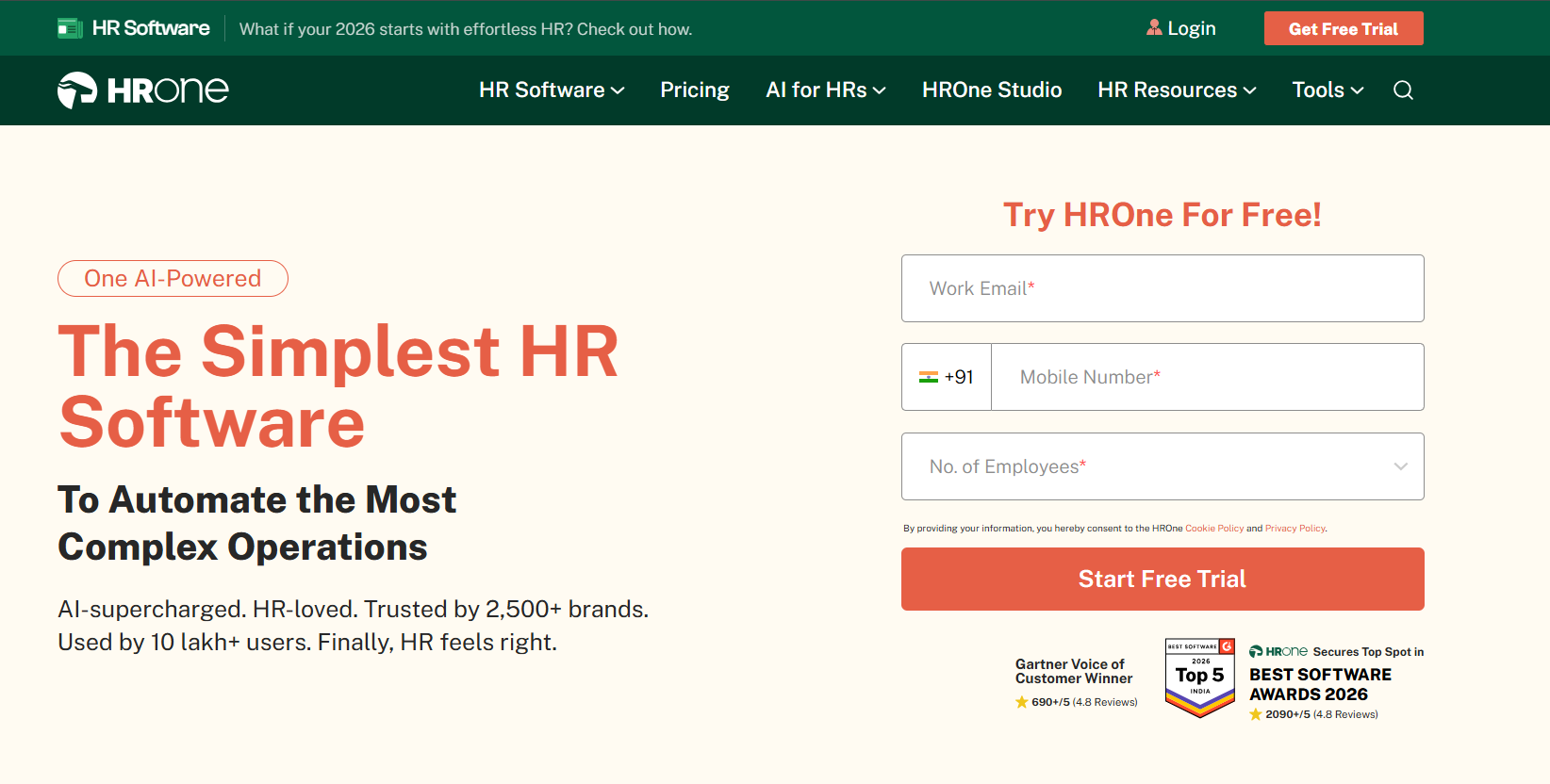
Verdict: A full HRMS where ESS comes bundled with engagement, helpdesk, and recruitment, built mainly for Indian teams.
Overview
HROne is a product of Uneecops Workplace Solutions, running self-service through an Inbox-style interface rather than a traditional dashboard. Employees download payslips, check leave balances, view attendance records, and update personal details on their own credentials.
The suite spans 10+ modules including payroll, attendance, recruitment, performance, helpdesk, asset, and expense. Attendance supports geofencing, live photo capture, and shift roster management, which helps for distributed Indian teams.
Key Features
- Inbox-based self-service for payslips, leave, and attendance
- Mobile app for attendance, leave, and approvals
- Pulse surveys, eNPS, and recognition
- Helpdesk module for HR queries
- Indian statutory payroll with multi-state tax handling
Best for: Indian mid-market companies wanting ESS alongside engagement and recruitment in one suite, with headcount above the 50-user minimum.
3. factoHR
.png)
Verdict: Payroll-first ESS. Functional rather than conversational, strongest where statutory accuracy matters most.
Overview
factoHR is an HRMS and payroll platform reporting 1,000+ clients and around 1.5 million employees. Self-service is built on top of the payroll engine, so what an employee sees ties directly to what payroll calculates.
Employees apply for leave, correct attendance, claim reimbursements, submit investment declarations, manage timesheets, and view performance review reports. Leave requests show who else on the team is off that day.
Attendance covers face recognition, geo-fencing, and biometric device integration, which suits manufacturing and field operations. Payroll handles PF, ESI, PT, TDS, and Form 16.
Self-service reaches employees through a web portal and iOS and Android apps. There is a chatbot, though the primary interaction model remains the dashboard.
Key Features
- ESS for leave, attendance correction, reimbursements, and declarations
- Investment declaration and tax deduction management
- Touchless attendance with face recognition and geo-fencing
- Travel and expense workflows
- Performance scores linked to payroll
Best for: Companies prioritising payroll accuracy and Indian statutory compliance, comfortable with a portal-based rather than chat-based experience.
4. Pocket HRMS
.png)
Verdict: Chatbot-led self-service for mid-sized teams.
Overview
Pocket HRMS runs self-service through smHRty, an AI chatbot that answers employee queries, and smHRt searcHR, a predictive search bar that pulls records, menus, and employee details as you type.
The ESS portal itself gives employees payslips, leave applications and balances, loan and PF details, full and final settlement information, and salary credit notifications. Attendance supports geotracking, selfie clock-in, and facial recognition.
WhatsApp payslip delivery reaches employees who will not open a portal. In June 2026, the company launched smHRt Agentic HR, a set of specialised agents covering payroll, leave, attendance, and employee records.
The chatbot sits alongside the dashboard rather than replacing it, so employees still navigate modules for most transactions.
Key Features
- smHRty chatbot for employee queries, with Indian language support
- smHRt searcHR predictive global search
- WhatsApp payslip delivery
- Role-based module access
- ML-based payroll error detection
Best for: Small and mid-sized Indian businesses wanting conversational assistance layered on a standard ESS portal.
5. Qandle
.png)
Verdict: A configurable mid-market portal that employees pick up quickly, with less depth at enterprise scale.
Overview
Qandle covers the employee lifecycle on one platform, with ESS connected to leave, payroll, attendance, performance, and document management.
Employees update personal information, download payslips and documents, apply for leave, request attendance corrections, submit reimbursements, read HR policies, view announcements, and check team calendars from a single interface.
The interface as easy enough to skip formal training, and cite configurable workflows and real-time notifications as strengths. The same reviews flag two recurring issues: parts of the interface feel dated, and reporting and analytics are thinner than buyers expect. Support feedback is mixed, with some users reporting slow response and delayed module rollouts.
Key Features
- ESS for payslips, leave, attendance correction, and reimbursements
- Document repository with policy access
- Configurable approval workflows
- Announcements and team calendar
- Mobile app for everyday requests
Best for: Mid-market teams wanting a workable ESS portal without enterprise-level configuration effort.
How to Choose the Right ESS Software for Enterprise?
Run these checks before you shortlist. Each exposes a gap that shows up only after rollout.
- Confirm ESS writes to payroll. Confirm if leave approval hit payroll. A scheduled sync or file export means monthly reconciliation.
- Demo mobile with a real field login. Check if it can be used on mobile from any place.
- Ask which channels employees can use. Slack or Teams removes the login barrier. Check whether it completes transactions or only sends alerts.
- Test the languages your workforce actually speaks. Run a live leave request in them, not a slide listing supported languages.
- Confirm multi-country coverage. Which countries live today, and do local rules ship out of the box or get built during implementation.
- Check what your headcount tier includes. Helpdesk, letters, and analytics are often add-ons.
Disclaimer
This guide was compiled by HONO. Features, pricing, and country coverage change. Verify current capability with each vendor before you buy.
Frequently asked
FAQs
See it live
Ready to see HONO in action?
Book a 20-minute demo tailored to your team's HR stack.
Request a demo
About the author
Mazna Majeed
Mazna is a strategic HR leader with over 10 years of experience driving talent success and organizational growth. As Head of Talent Acquisition and Operations at HONO, she leads HR initiatives across India and South-East Asia, including manpower planning, employee lifecycle management, talent development, engagement, and retention. Mazna is known for aligning people strategy with business goals, building inclusive high-performing teams, and strengthening culture to enable sustainable growth.