
Key Takeaways
- Back-office cost scaled directly with revenue until HONO’s seven-agent pipeline broke that relationship for good.
- One large AI prompt fails at scale; specialised agents with narrow responsibilities win.
- The highest-accuracy step in the pipeline uses no AI whatsoever.
- The routing decision, not the extraction, is where the financial savings actually live.
- Observability is what earns reviewer trust, making it a change-management tool, not just a technical feature.
- Projected savings exceed $1M annually, with an identical pipeline ready to roll across 43 more countries.
Why Processing Timesheets at Scale Becomes a Hiring Problem?
A single timesheet takes a few minutes to process. The problem is that timesheets do not arrive as clean web forms. In energy and engineering workforces, they arrive as email attachments: PDFs, scanned photos from remote sites, and occasionally sideways faxes with a handwritten signature. Each one represents real money. A week of hours at a specific rate code, multiplied by tens of thousands of active contractors, multiplied by the dozens of countries a large staffing firm operates in.
The math is straightforward and brutal. At 10,000 timesheets a month, even a three-minute average processing time means 500 hours of manual work. Every error creates downstream reconciliation time that compounds that number. And because volume scales directly with revenue, the only traditional lever available is headcount. The back office becomes a perpetual hiring exercise, growing in lockstep with a business it is supposed to serve.
McKinsey's research on G&A and back-office automation found that roughly 20 percent of tasks in a typical finance unit's record-to-report process are fully automatable, and nearly 50 percent are mostly so. Timesheet processing sits squarely in that category. The question was never whether automation was possible. It was whether the right architecture existed to do it reliably at global scale.
Why One "Do Everything" AI Prompt Is the Wrong Answer?
The obvious first instinct when applying AI to a document processing problem is to write a single prompt: hand the model the attachment, ask it to extract the hours, and book them. This approach works in demos. It fails in production.
A single large language model call against an email attachment produces confident output. It does not produce consistently correct output. It will hallucinate contractor names that are close but not exact. It will assign hours to a rate code the contractor is not entitled to. It will read a rotated page and return plausible-looking numbers from a document it effectively saw upside down. And because nothing in the pipeline audits these results independently, every error passes through silently.
This is the fundamental problem with what is sometimes called a "monolithic prompt" approach: the model cannot know what it does not know, and there is no downstream check to catch what it got wrong.
Agentic AI is the answer to this problem. Rather than asking one model to do everything, you break the work into discrete, specialised tasks and assign each one to an agent with a narrow scope. Each agent knows what good and bad output look like for its own step. Each agent produces a structured result the next agent and any human reviewer can inspect. Failures surface explicitly rather than propagating silently. The overall system becomes more reliable than any single model call could ever be, because reliability is built into the architecture rather than assumed from the model.
The Seven AI Agents Pipeline
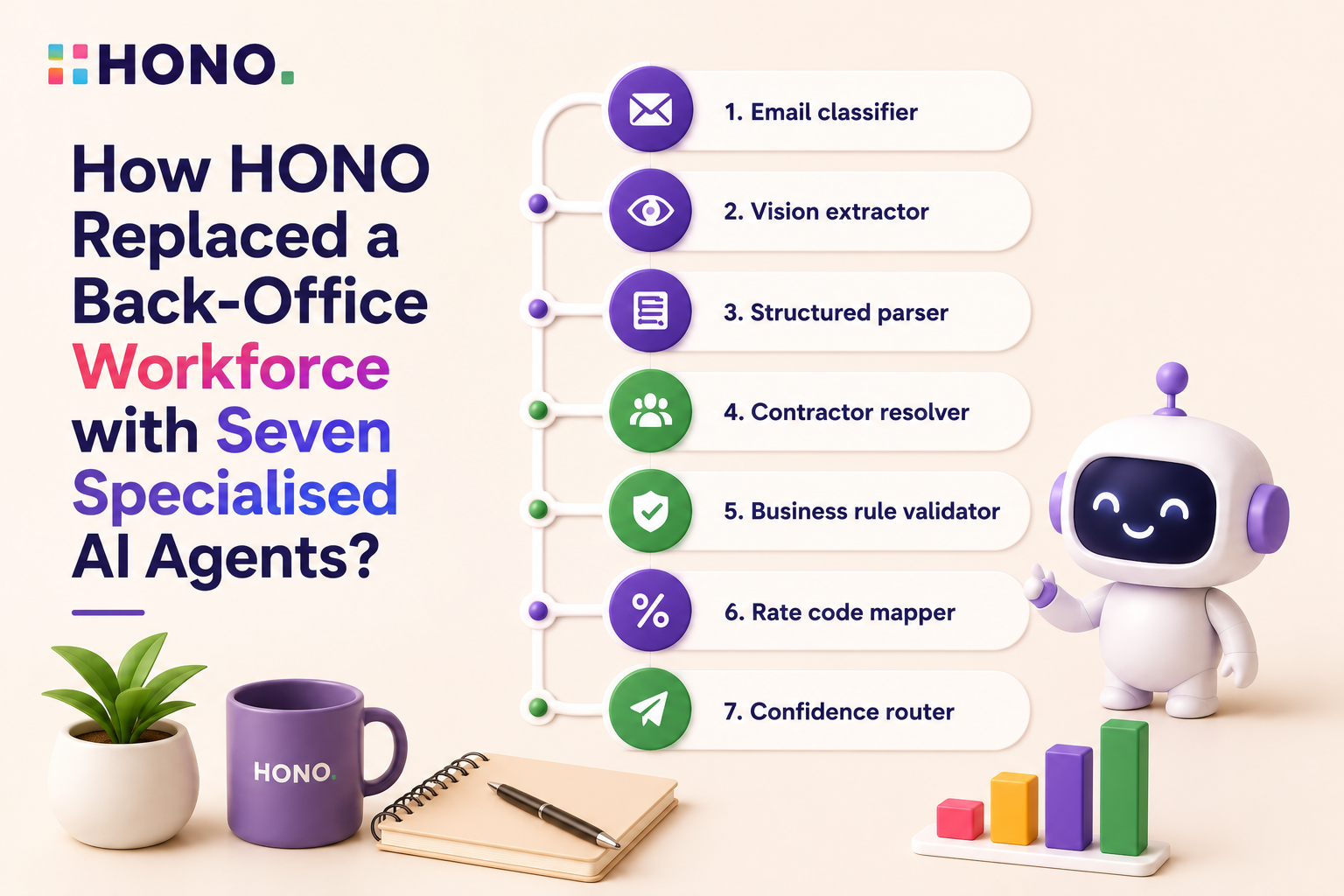
HONO's pipeline runs seven agents on every timesheet. Four of them use large language models. Three do not. That mix is deliberate.
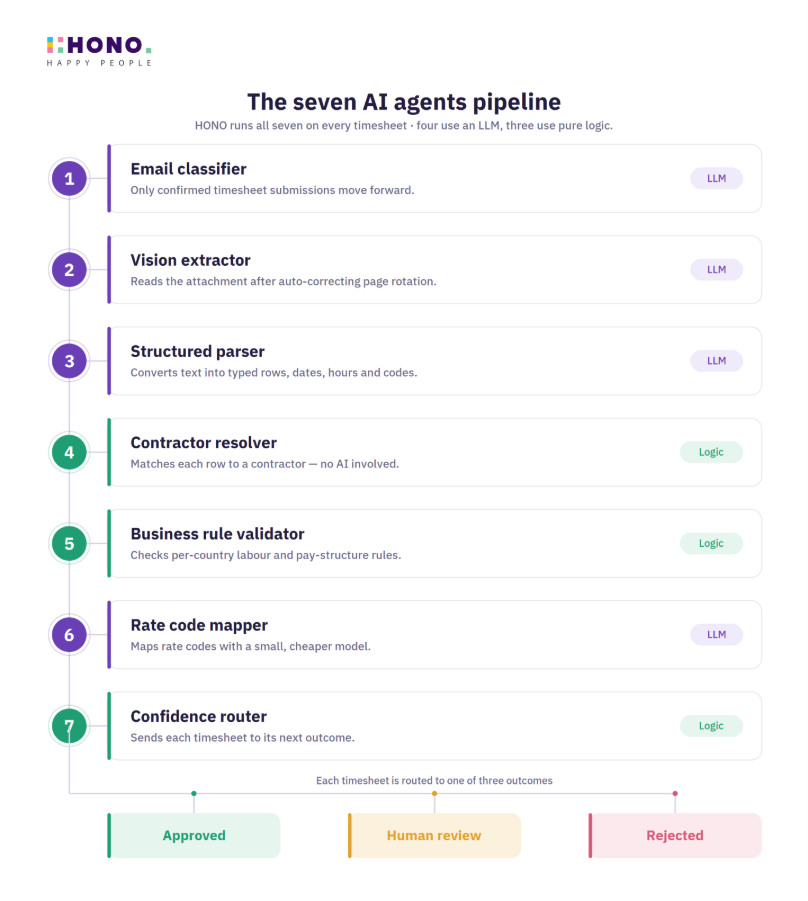
Agent 1: Email Classifier. Before any extraction happens, the system needs to know whether an incoming email is actually a timesheet submission. Inboxes fill with auto-replies, bounce notifications, accidental forwards, and signature receipts. The email classifier filters this noise. Only confirmed timesheet submissions move forward.
Agent 2: Vision Extractor. This agent reads the attachment, whether a PDF, a photo from a field location, or a scan. Crucially, before the language model sees the document, an orientation detection step checks the page rotation and corrects it automatically. A sideways fax no longer produces hallucinated numbers because the model saw it rotated 90 degrees. If this agent fails entirely, it short-circuits the pipeline: every downstream agent is stamped as "skipped" rather than running on empty input and returning false positives.
Agent 3: Structured Parser. Raw extracted text is not useful for payroll systems. The structured parser converts it into typed data: rows, dates, hours, rate codes, project codes, and contractor identifiers. This is schema-driven extraction, meaning the model is guided toward a specific output shape rather than left to decide what to return.
Agent 4: Contractor Resolver. This is the most important agent in the pipeline for accuracy, and it uses no AI at all. More on this in the next section.
Agent 5: Business Rule Validator. Pure logic, no model involved. This agent checks the extracted data against rules configured per country: working-day counts, weekend flags, missing-day detection, and consistency between hours and rate codes. These rules encode knowledge about labour law and pay structure that is too precise to leave to probabilistic inference.
Agent 6: Rate Code Mapper. A second AI pass, but using a smaller and cheaper model than the main extraction step. This agent matches each contractor's rate code to the appropriate row in the timesheet. Rate-code matching is genuinely a task where language models perform well: it is soft pattern matching across labels that people write inconsistently. A smaller model handles it at roughly one-fifteenth the cost of the main pipeline model, with a confidence floor built in. Any match below 60% confidence is surfaced as an ambiguity rather than passed through as a guess.
Agent 7: Confidence Router. The agent that decides what happens next. Every timesheet gets sorted into one of three outcomes: approved, sent to human review, or rejected. The thresholds that govern this decision are configured per country and stored as settings, not code.
Request a Demo To see HONO in action
The Most Important Agent Uses No AI at All
Matching a contractor name to the right contractor record is the step where a wrong answer pays the wrong person. That is not a probabilistic problem. It is an exact-match problem with a ground-truth answer sitting in a database.
The contractor resolver is a deterministic PostgreSQL query with fuzzy matching via the pg_trgm extension, scoped by country. It returns a confidence score based on similarity between the name as written on the timesheet and the name in the contractor register. If that score falls below a threshold, the agent fails the step explicitly. Downstream agents see a failed status and treat it accordingly.
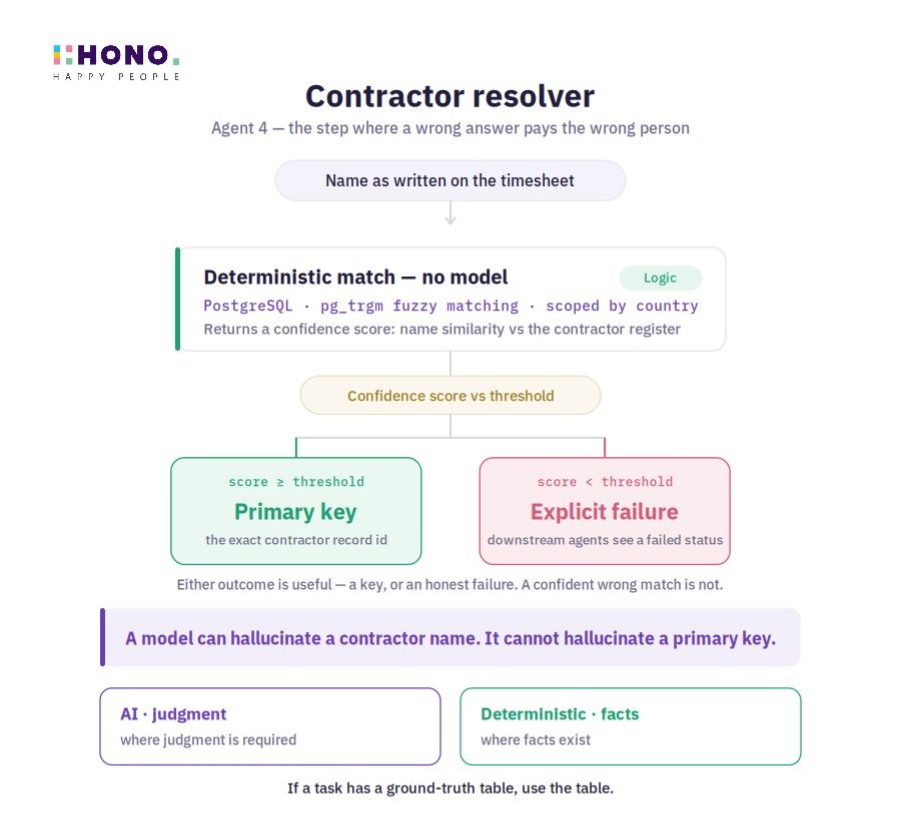
The design principle here is simple: if a task has a ground-truth table, use the table. A language model can hallucinate a contractor name. It cannot hallucinate a primary key. The contractor resolver produces a primary key or it produces an explicit failure, and either outcome is useful. A confident but wrong name match produces a payment to the wrong person, and that outcome is not recoverable cheaply.
This is the clearest illustration of the broader principle behind HONO's pipeline: AI handles judgment in the parts of the workflow where judgment is required. Deterministic systems handle facts in the parts where facts exist.
Where the Savings Actually Come From?
The financial case for this system lives in the seventh agent.
The confidence router reads the assembled result from every preceding agent: extraction confidence, contractor resolution status, rule validation flags, rate-code match confidence. It produces one of three decisions.
Approved timesheets clear every threshold. They export automatically to the payroll system on the next scheduled run. No human touches them.
Manual review timesheets have at least one step that flagged a warning or returned an ambiguity. They land in a verification queue, where a reviewer sees an indicator for each agent and can click into any step to understand what it found and what it decided.
Rejected timesheets hit a hard failure: a non-timesheet email, an unreadable scan, a contractor name with no match in the country register. A templated reply goes back to the sender. No human processes these manually.
The business punchline is in how the thresholds work. They are stored as configurable settings, one set per country. A market with stricter compliance requirements can tighten its auto-approve threshold with a single configuration change. No code is redeployed. The next batch of timesheets reflects the new threshold, and the auto-approve rate shifts measurably the following day.
This means the operational model is tuneable without engineering involvement. A country manager can respond to a regulatory change, a spike in errors, or a new client requirement by adjusting a setting. The system responds immediately. That is not a feature of the AI agents individually. It is a feature of how the routing decision is architected.
Why Back-Office Teams Actually Trust It?
Deploying AI into a workflow that experienced people have managed manually for years is a change-management problem as much as a technical one. A system that produces a green checkmark and a number does not earn trust. It provokes suspicion.
HONO's pipeline addresses this directly through observability, but the goal of that observability is not transparency for its own sake. It is to give reviewers a way to verify AI decisions in seconds rather than in minutes, so that trust is built through repeated positive experience rather than demanded upfront.
Every agent in the pipeline records what it saw, what it decided, and why. The verification interface shows a status indicator per agent. Clicking any indicator opens a drawer with the inputs and the reasoning. A reviewer who wants to understand why a timesheet was routed to manual review can trace it back through every step in the time it takes to read a few lines of output.
There is also a structural protection against the failure mode that erodes trust fastest: cascading false positives. When the vision extractor fails on an unreadable document, every downstream agent is stamped as "skipped" rather than allowed to fire on empty input. This matters because language models will return plausible-looking output even when given nothing meaningful to work with. A confident result based on nothing is worse than an explicit failure, because it looks correct until it is too late. The short-circuit node prevents this entirely.
Experienced reviewers are not asked to trust the system. They are given the tools to verify it quickly and efficiently. Over time, as verification consistently confirms the system's judgment, the working relationship between the reviewer and the pipeline shifts from suspicion to confidence. That is the change-management outcome the observability is designed to produce.
The Outcome, and What It Means for Multi-Country Operations
Two countries are live. The pipeline is identical for every additional one.
Onboarding a new country in HONO's system means adding a database configuration row, populating the rate-code library, and running a connection test. It does not mean a new engineering project. The pattern that works in country one works in country 43, because the architecture is designed around configurable tenant settings rather than hardcoded country logic.
Each country has its own rate-code library, its own working-week definition, its own labour rules, and its own threshold for what auto-approve should mean. The pipeline handles all of it through the same seven agents, with the per-country settings doing the work that would otherwise require custom code.
The projected savings of over $1M annually reflect the two live countries. The same calculation applied across a 45-country footprint changes the arithmetic of running a global contractor workforce entirely.
This is also the foundation of HONO's broader workforce management platform. The same multi-country architecture, the same agentic pipeline approach, and the same observability principles underpin HONO's payroll and workforce management products. A business that processes timesheets through this system is already operating on the infrastructure that handles the harder problems in global workforce management: payroll compliance, benefits administration, and contractor lifecycle management across dozens of jurisdictions.
If your organisation is managing contractor timesheets manually at scale, or building toward multi-country payroll operations, the HONO platform is worth a closer look.
Turn timesheets into automated software – Book your HONO demo today!
Frequently asked
FAQs
See it live
Ready to see HONO in action?
Book a 20-minute demo tailored to your team's HR stack.
Request a demo
About the author
Prasanth
Prasanth is a Disruptive Technology Specialist and technical leader who translates complex business needs into secure, innovative software solutions. A master at guiding and elevating development teams, he specializes in making high-level IT strategies clear, accessible, and highly impactful for the modern enterprise.