Direct answer: An enterprise AI HRMS should enable Agentic HR Transformation, moving beyond task automation to intelligent agents that orchestrate and execute end-to-end HR workflows. With HONO ERA, enterprises can move towards a connected, conversational and intelligent HR ecosystem that simplifies employee experiences, accelerates HR operations and keeps critical decisions under human oversight.
Introduction
Managing HR across a large Indian workforce is not straightforward. Payroll rules differ from state to state, and teams have to account for Professional Tax, PF, ESI and changes under the Labour Codes. At the same time, factory workers, field staff and contract employees may not have regular access to an HR portal. They are more likely to use their phones or WhatsApp to get things done.
Data protection adds another responsibility. India’s DPDP provisions are scheduled to take effect in May 2027, with penalties of up to ₹250 crore for certain violations involving personal data.
AI is another area where CHROs need to look beyond vendor claims. Many HRMS platforms now offer AI agents, but the actual capabilities can vary. Some simply answer employee questions, while others can take action across HR workflows.
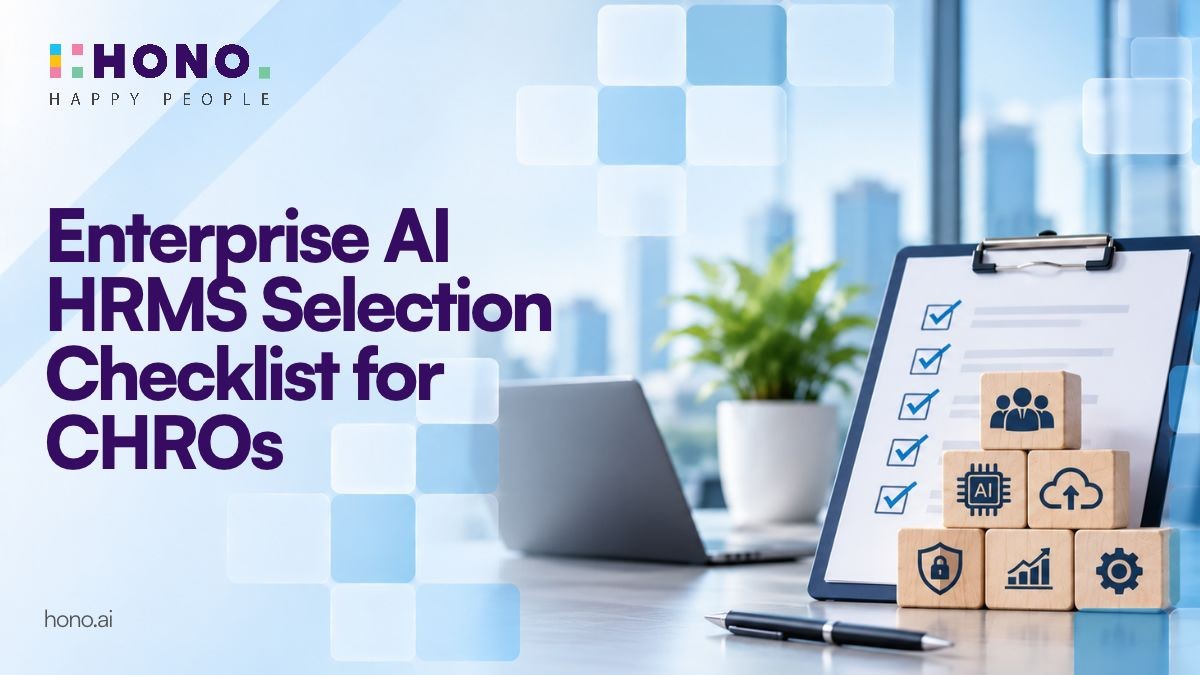
This checklist covers the questions worth asking before selecting an AI HRMS, what to look for in vendor responses and which claims need further validation.
Before You Book Any Demo: Your Pre-Selection Brief
Before approaching vendors, document the following details. This helps keep product demos focused on your actual workforce, systems and business priorities.
Brief item | What the CHRO should document? |
|---|---|
1. Company profile | Current and expected headcount, legal entities, states and countries of operation. |
2. Workforce mix | Number of office, frontline, shift, field and contract employees, including their preferred languages. |
3. Industry and compliance | Industry-specific requirements, contract labour arrangements, union rules and applicable statutory obligations. |
4. Key HR problems | Three priorities to solve, such as payroll errors, delayed hiring, high absenteeism or manual HR processes. |
5. Existing systems | Current HRMS, payroll, ERP, finance software, attendance devices, ATS and banking systems. |
6. Data and security | Data residency requirements, access controls, AI data usage restrictions and internal security requirements. |
7. AI expectations | Tasks AI can handle independently, actions requiring approval and decisions that must remain with people. |
8. Budget and timeline | Available three-year budget, expected go-live date and internal project owner. |
9. Decision-makers | Stakeholders from HR, finance, IT, information security, legal and operations who will evaluate the platform. |
10. Success measures | Two or three measurable outcomes, such as payroll processing time, hiring turnaround or HR query resolution time. |

The 12 Checks to Select Enterprise HRMS in India
Run each check live, with your own entities, states and people. Each one explains what to look for and how to test it.
1. Choose an AI HRMS That Completes Tasks, Not Just Answers Questions
For a full-suite HRMS, payroll, attendance, leave and performance should run on one unified platform with its own underlying engine, not depend on third-party tools and integrations to exchange data.
This matters in large enterprises where payroll, leave and attendance records must match across multiple entities, branches and states.
When evaluating a platform, check whether it can:
Work across modules: Use data from attendance, leave and payroll without relying on separate third-party systems.
Complete multi-step tasks: Shortlist candidates, check interviewer availability and schedule interviews without manual data transfer.
Explain its actions: Show which records it checked, what it changed and why, so HR can verify the outcome.
Capability to look for: A unified HRMS engine with AI agents that can coordinate tasks across modules and show what they have done.

2. An AI HRMS Must Follow Your Entity, Country and Role Structure
Enterprises operating across India, SEA and MEA often manage multiple legal entities, country-specific payroll rules, business units and different levels of HR access. An AI HRMS must follow the same access controls as the core HRMS. For example, an HR executive managing India operations should not automatically get access to employee salary records or payroll data for the UAE, Singapore or other business entities.
When evaluating a platform, check whether it can:
Follow role-based permissions: Give employees, managers and HR teams access only to the information their roles allow.
Separate entity-level data: Maintain country-specific payroll rules, statutory requirements, policies and employee records while providing consolidated reports to authorised regional teams.
Respect approval limits: Keep salary revisions, payroll releases and sensitive employee decisions subject to the required HR or finance approvals rather than allowing AI to execute them independently.
Capability to look for: AI that respects multi-country operations, entity-level data access, local compliance requirements and existing approval workflows.

3. Make Every AI and Employee Action Traceable
When AI updates an employee record, changes a leave balance or processes a payroll input, the system should record who requested it, what data was used and what action was taken.
This is important for Indian enterprises that need clear records for payroll audits, statutory inspections and internal compliance reviews. HR teams should be able to trace AI-driven changes just as they would track actions taken by an employee or manager.
When evaluating a platform, check whether it can:
Record all actions in one log: Keep AI and user activities together, with timestamps and details of who initiated each action.
Show why an action happened: Record the employee data, policy or business rule used by the AI before making a change.
Protect audit records: Restrict access to authorised users and prevent logs from being altered or deleted without trace.
Capability to look for: A tamper-resistant audit trail covering both human and AI actions, with clear records of the data, decision and outcome.

4. Ensure AI Answers Are Based on Your HR Policies
An AI HRMS should use your organisation’s approved HR policies to answer employee questions, not rely on general AI knowledge. If a policy does not cover a situation, it should refer the query to HR rather than make assumptions.
This is particularly important for Indian enterprises, where leave encashment, gratuity, notice periods and other entitlements can vary by employee grade, location, employment type and company policy.
When evaluating a platform, check whether it can:
Use approved policy documents: Fetch answers from the latest HR policies applicable to the employee’s entity and location.
Show the source: Link each answer to the relevant policy document and clause so employees and HR can verify it.
Escalate unclear cases: Refer exceptions or questions not covered by policy to the right HR team instead of generating an answer.
Capability to look for: Policy-based AI responses with source references, employee-specific rules and a clear escalation path to HR.

5. Connect Recruitment and Onboarding From Application to Day One
Recruitment should not end when a candidate accepts an offer. An AI HRMS should carry candidate information from job posting and screening through interview scheduling, document collection and onboarding, without recruiters repeatedly entering the same data.
For Indian enterprises hiring across multiple locations and business units, manual resume screening, interview coordination and joining formalities can delay recruitment and increase HR workload.
When evaluating a platform, check whether it can:
Create job descriptions: Generate role-specific JDs using job requirements and organisational details.
Screen and rank resumes: Parse CVs, match candidates against job requirements and explain why each candidate received their score.
Manage interviews: Shortlist candidates from the existing CV database, check interviewer calendars and schedule interviews.
Guide new joiners: Track joining documents, explain company policies, assign onboarding tasks and help employees complete joining formalities.
Final hiring decisions should remain with recruiters, with AI providing recommendations and a record of its screening criteria.
Capability to look for: Connected recruitment and onboarding agents that handle screening, interview coordination and joining formalities while keeping recruiters in control.

6. Bring Goals, Feedback and Performance Reviews Together
In large Indian enterprises, performance reviews often involve collecting information from multiple teams, managers and systems. When goals, feedback and performance records sit separately, reviews can become subjective and depend too much on a manager’s memory.
An AI HRMS should connect these inputs and give managers a clearer picture of employee performance.
When evaluating a platform, check whether it can:
Cascade organisational goals: Link company objectives to business units, teams and individual employees so targets remain aligned.
Help set measurable goals: Suggest employee goals based on business priorities, job roles and expected outcomes.
Bring review data together: Use goal progress, manager feedback, peer feedback and previous ratings to prepare performance reviews.
Flag rating inconsistencies: Highlight gaps between recorded performance and proposed ratings for managers to review.
AI can prepare review summaries and highlight patterns, but managers should retain control over final ratings and decisions.
Capability to look for: Connected goal management and AI-assisted reviews based on actual performance data, with managers making the final assessment.

7. Identify Skill Gaps and Prepare Future Leaders
For Indian enterprises with large workforces, losing an experienced manager or specialist can leave a critical role vacant for months. Yet many organisations still manage employee development and succession planning through separate spreadsheets and review documents.
An AI HRMS should use performance and skill data to identify development needs and help HR prepare employees for future roles.
When evaluating a platform, check whether it can:
Identify skill gaps: Compare employee skills, experience and performance against the requirements of their current or target roles.
Recommend relevant learning: Suggest courses and development plans based on identified gaps rather than offering the same learning catalogue to everyone.
Track successor readiness: Identify potential successors for critical roles and show who is ready now and who needs further development.
Create development plans: Link each successor’s skill gaps to specific training, mentoring and development activities.
Succession decisions should remain with HR and business leaders, with AI providing supporting data rather than making the final selection.
Capability to look for: AI-driven skill-gap analysis, personalised learning recommendations and succession planning backed by employee performance data.

8. Catch Payroll Errors Before Salary Disbursement
A payroll error discovered after salaries are credited can lead to employee complaints, recovery issues and compliance problems. An AI HRMS should validate payroll inputs and flag discrepancies before the payment file is released.
This is especially important in India, where payroll involves PF, ESI, Professional Tax, TDS and state-specific statutory requirements. Changes under the Labour Codes also make accurate wage calculations important.
When evaluating a platform, check whether it can:
Validate every pay run: Flag negative salaries, duplicate payments, missing deductions and incorrect calculations before disbursement, including bonus and off-cycle payroll.
Allow flexible pay rules: Let HR teams configure salary components and payroll rules without depending on developers for every change.
Keep statutory rules updated: Apply changes to tax slabs, contribution rates and statutory calculations, with a record of each update.
Handle the complete payroll cycle: Process arrears, loans, advances, reimbursements and full and final settlements within the same system.
AI should identify and explain payroll discrepancies, while authorised payroll or finance teams approve the final salary disbursement.
Capability to look for: Automated payroll validation, configurable pay rules and updated Indian statutory calculations, with human approval before salaries are released.

9. Connect Attendance, Shifts and Contract Workforce Payroll
For Indian enterprises in manufacturing, retail, logistics and other frontline sectors, a missed shift or incorrect attendance entry can affect both productivity and payroll. Managing permanent, contract and shift workers through separate systems makes it harder to track attendance and calculate wages accurately.
An AI HRMS should connect workforce scheduling, attendance and payroll, while helping supervisors identify staffing gaps before shifts begin.
When evaluating a platform, check whether it can:
Support different attendance methods: Handle biometric devices, facial recognition, RFID and geo-fenced check-ins across factories, offices and field locations.
Connect rosters to payroll: Track shifts, overtime, weekly offs and actual working hours so payroll reflects attendance records.
Manage contract workers: Maintain contractor details, attendance, work hours and payment records within the same platform.
Predict staffing gaps: Identify likely absenteeism and suggest replacement workers based on skills, availability and shift requirements.
Supervisors should retain control over shift changes and replacement approvals, while AI helps identify gaps and recommend suitable cover.
Capability to look for: Multi-method attendance, payroll-linked rosters, contract workforce tracking and AI-based absenteeism prediction.

10. Make HR Support Accessible and Employee Feedback Easier to Track
In Indian enterprises with large frontline and desk-based teams, employees regularly need help with payslips, leave balances, expense claims and company policies. If every query requires a portal login or an HR ticket, routine requests quickly add to the HR team’s workload.
An AI HRMS should make these services accessible through channels employees already use, while helping HR understand recurring concerns and employee sentiment.
When evaluating a platform, check whether it can:
Offer multilingual access: Let employees use WhatsApp, Teams, Slack or mobile to ask HR questions in their preferred language.
Manage employee requests: Log, assign and track helpdesk queries so requests are not missed and HR can identify recurring issues.
Automate employee surveys: Create pulse surveys, collect responses and summarise feedback to highlight concerns across teams.
Simplify expense claims: Read receipts uploaded from a phone, capture expense details and route claims for approval before payroll processing.
Support recognition and rewards: Manage employee recognition and rewards alongside performance and engagement records.
HR should remain responsible for acting on employee feedback, while AI helps collect, organise and highlight the issues that need attention.
Capability to look for: Multilingual employee access, a tracked HR helpdesk, automated pulse surveys and mobile-first expense and recognition management.

11. Check Integration Capabilities and Multi-Country Scalability
Large Indian enterprises rarely operate on a single business system. Finance may run on SAP or Oracle, accounting on Tally, while banks, attendance devices and legacy HR applications hold other parts of employee data. An AI HRMS must work with this existing setup without creating more disconnected systems.
When evaluating a platform, check whether it can:
Connect with business systems: Exchange payroll, employee and finance data with ERP, accounting software, banking systems and attendance devices without depending on manual file uploads.
Support Indian finance and payments: Handle integrations with Tally, SAP, Oracle and bank payment formats, including NEFT, RTGS and IMPS.
Connect AI agents to business data: Allow authorised agents to retrieve information from connected systems instead of giving answers based on HRMS data alone.
Manage multiple entities and countries: Maintain separate payroll rules, salary structures and policies while providing consolidated reports to regional and group leadership.
Offer a clear implementation and exit plan: Include data migration, parallel payroll runs, post-go-live support and the ability to export employee data in a usable format.
Capability to look for: Enterprise-ready integrations, multi-entity and multi-country support, a structured implementation plan and clear data ownership.

12. An AI HRMS Should Fit Your Existing Systems and Support Enterprise Scale
Large Indian enterprises rarely operate on a single business system. Finance may run on SAP or Oracle, accounting on Tally, while banks, attendance devices and legacy HR applications hold other parts of employee data. An AI HRMS must work with this existing setup without creating more disconnected systems.
When evaluating a platform, check whether it can:
Connect with business systems: Exchange payroll, employee and finance data with ERP, accounting software, banking systems and attendance devices without depending on manual file uploads.
Support Indian finance and payments: Handle integrations with Tally, SAP, Oracle and bank payment formats, including NEFT, RTGS and IMPS.
Connect AI agents to business data: Allow authorised agents to retrieve information from connected systems instead of giving answers based on HRMS data alone.
Manage multiple entities and countries: Maintain separate payroll rules, salary structures and policies while providing consolidated reports to regional and group leadership.
Offer a clear implementation and exit plan: Include data migration, parallel payroll runs, post-go-live support and the ability to export employee data in a usable format.
Capability to look for: Enterprise-ready integrations, multi-entity and multi-country support, a structured implementation plan and clear data ownership.

How to Score Vendors and Get the Right Sign-Off
Score each vendor against the 12 selection criteria. Use the weights below as a starting point and adjust them based on your pre-selection brief.
Evaluation area | Weight |
|---|---|
Payroll and Indian statutory compliance | 20% |
Data security, audit trails and access permissions | 20% |
AI agents and policy management | 15% |
Integrations and enterprise scalability | 15% |
Frontline workforce and employee experience | 15% |
Recruitment, performance and talent management | 15% |
Total | 100% |

Scoring method
Give each criterion a score:
0 – Does not meet: Capability is missing or depends on an unsupported workaround.
1 – Partially meets: Available with limitations or additional manual work.
2 – Fully meets: Available and demonstrated using your business requirements.
Do not shortlist a vendor that scores zero on data security, access permissions or audit trails, regardless of its overall score.
Contract and Implementation Red Flags When Buying an AI HRMS
A vendor demo may look impressive, but the contract often reveals what you will actually pay for and what control you will have after implementation. Before signing, check these points carefully.
AI charged separately: Check whether the AI features shown during the demo are included in the quoted HRMS price or sold as additional modules.
Uncapped usage charges: Some vendors charge per AI query, action or employee. Ask how the bill changes when usage increases and whether annual limits can be fixed.
Extra fees for entities and countries: Check whether adding a legal entity, state or country increases your licence or implementation cost.
Employee data used for AI training: Get written confirmation that your employee records, HR queries and documents will not be used to train the vendor’s AI models.
Unclear data hosting terms: The contract should specify where employee data is stored and require your approval before any change in hosting region.
AI updates without prior notice: Ask how model updates are communicated and whether you can review changes before they affect live HR workflows.
Limited data export: Ensure you can retrieve employee records, payroll history, documents and AI activity logs in usable formats if you change vendors.
Uncertain renewal pricing: Get clarity on price increases and negotiate pricing for the full three-year contract instead of relying on first-year discounts.
Where HONO Fits?
HONO is our product, so it should be evaluated against the same criteria as other vendors. Here are the capabilities documented in its platform.
AI across HR functions: ERA gives a headless ZERO UI experience that let’s run HR through conversation instead of navigating traditional dashboards. It’s specialist agents for payroll, recruitment, onboarding, performance, attendance, policies and employee helpdesk.
Recruitment and talent management: Agents support resume screening, interview scheduling, onboarding, goal setting, performance reviews, skill-gap analysis and succession planning.
Payroll and compliance: HONO runs its own payroll engine across 25+ countries, covering Indian requirements such as PF, ESI, Professional Tax, ECR, Form 16 and quarterly eTDS returns.
Workforce management: Supports biometric, facial recognition, RFID and geo-fenced attendance, shift planning, overtime and contract workforce management. ARASMAS predicts absenteeism and suggests replacement staff.
Employee experience: ERA works through WhatsApp, Teams and Slack. Supports 100+ languages, and handles HR queries, helpdesk requests, pulse surveys and expense receipts.
Data security and scale: Supports entity-level policies and country-specific data hosting. Certifications include ISO 27001, SOC 1 and SOC 2 Type II. ERA uses AWS Bedrock, with customer data not used for model training under applicable AWS policy.
Related articles:
Frequently asked
FAQs
See it live
Ready to see HONO in action?
Book a 20-minute demo tailored to your team's HR stack.
Request a demoAbout the author