What Is a SMART Goal?
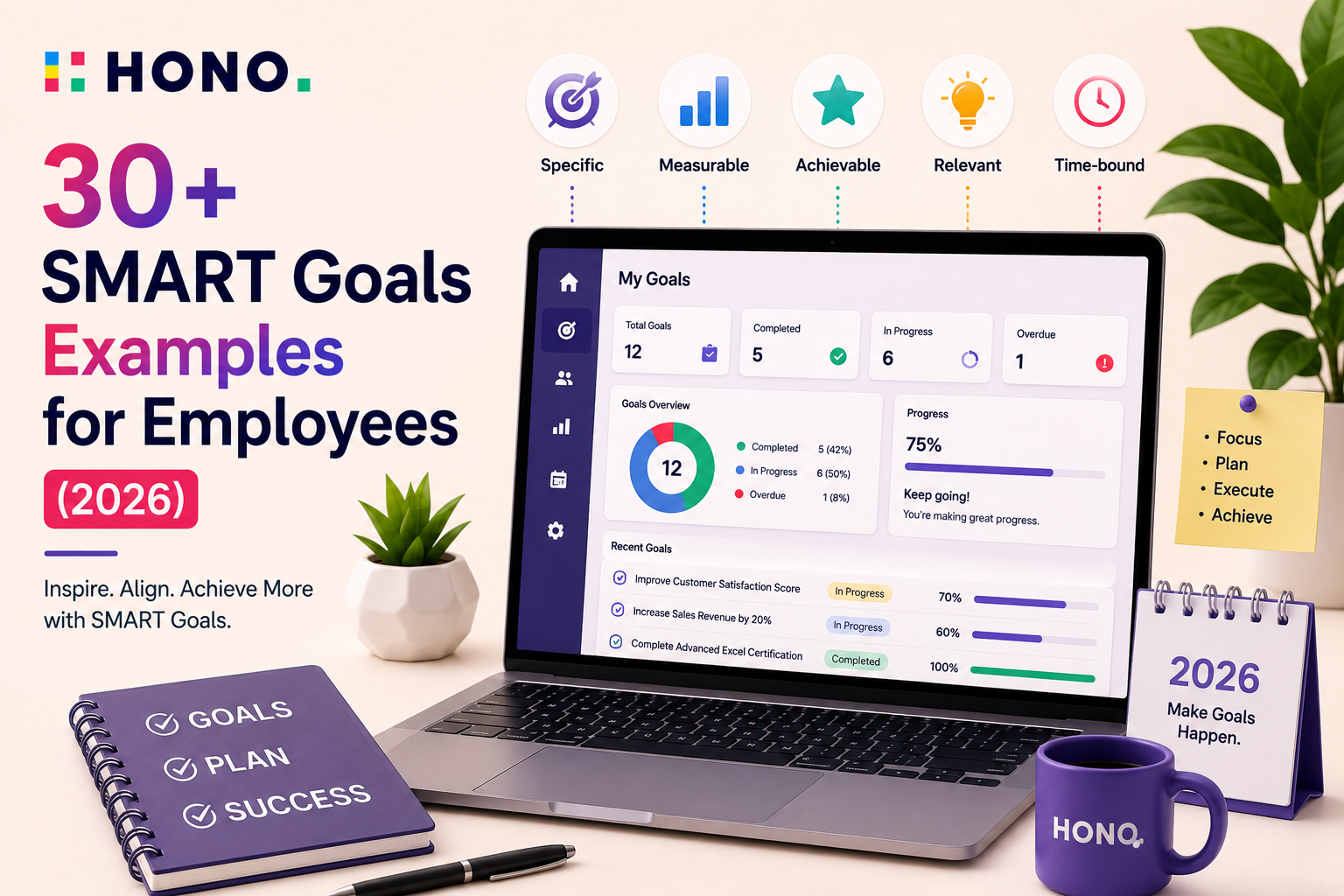
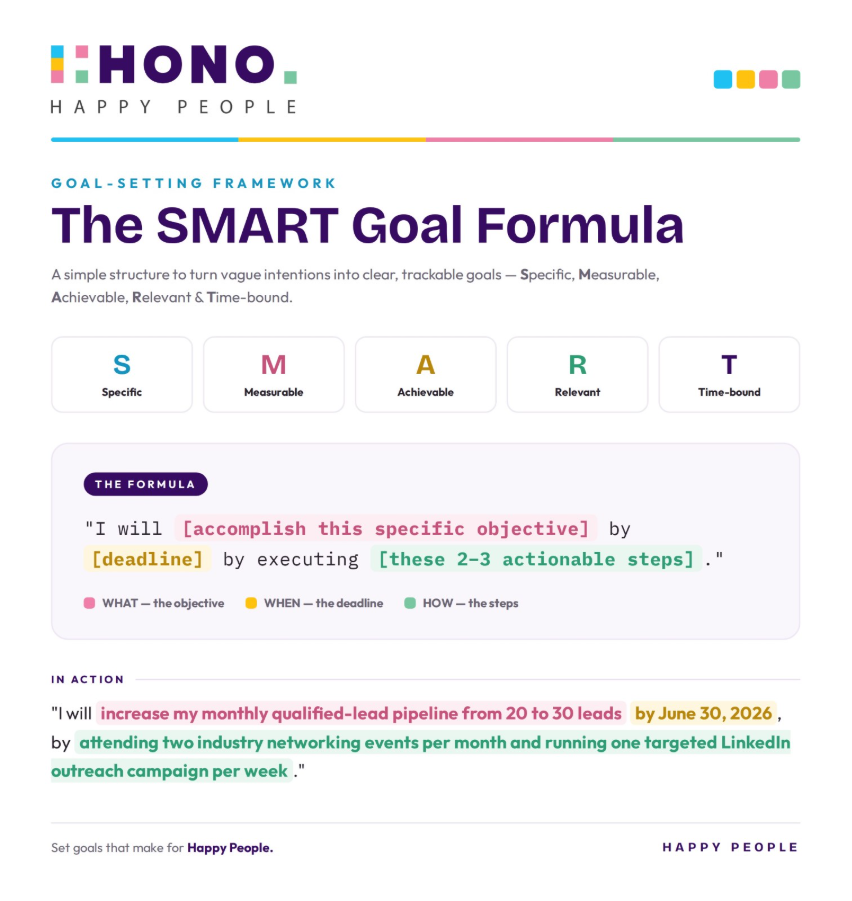
A SMART goal is a specific, measurable, achievable, relevant, and time-bound objective that defines exactly what success looks like for one employee, removing ambiguity from performance expectations so that both the employee and their manager can evaluate progress objectively.
| Letter | Stands For | What It Means | Real-Workplace Example |
|---|---|---|---|
| S | Specific | Names the exact outcome, team, or deliverable | "Reduce ticket backlog in the support queue" (not "handle more tickets") |
| M | Measurable | Attaches a number, percentage, or verifiable milestone | "…by 30%" so progress can be tracked weekly |
| A | Achievable | Stretches the employee without being unrealistic given their resources | Based on historical team data, 30% is ambitious but attainable |
| R | Relevant | Ties the individual goal to a team or company priority | Reducing backlog supports the company's Q3 CSAT target |
| T | Time-Bound | Sets a firm deadline to create urgency and a review date | "…by September 30, 2026" |
How Are SMART Goals Different From OKRs?
Both frameworks eliminate vague goal-setting, but they operate at different altitudes inside an organisation. SMART goals are a writing guideline for a single objective; OKRs are a management system that connects aspirational company objectives to multiple measurable key results. The most effective organisations use both simultaneously, OKRs at the strategic layer, SMART goals at the individual performance layer.
| Basis | SMART Goals | OKRs (Objectives & Key Results) |
|---|---|---|
| Purpose | Define clear, achievable individual/team targets | Align whole organisation toward ambitious stretch outcomes |
| Structure | Single goal with five qualifying criteria | One Objective + 2–5 measurable Key Results |
| Ambition level | Achievable (designed to be reached 100%) | Stretch (60–80% attainment rate is considered strong) |
| Scope | Individual contributor, team project, or role-level | Team, department, or company-wide |
| Cadence | Annual or per-review-cycle | Quarterly (sometimes monthly) |
| Visibility | Often private between employee and manager | Typically transparent across the organisation |
| Compensation link | Frequently tied to bonuses/appraisals | Usually not directly tied to pay |
| Flexibility | Fixed after sign-off | Designed to be revisited at mid-quarter check-ins |
| Best used for | Performance reviews, PIPs, onboarding goals | Company strategy, cross-functional alignment, growth initiatives |
HONO turns static text into a dynamic, continuous feedback loop using its automated configuration matrices. - See HONO in action
SMART Goals Examples by Department (At a Glance)
| Department | Goal Focus | Example Metric | Typical Timeline | Sample Liftable Goal |
|---|---|---|---|---|
| Admin & Operations | Process efficiency | % reduction in processing time | 90 days | Reduce invoice processing time by 25% by Q3 end |
| Sales & Biz Dev | Revenue / pipeline | New qualified leads per month | Quarterly | Grow qualified pipeline from 20 to 30 leads by June 30 |
| Customer Service | Satisfaction / speed | CSAT score; first-response time | 60–90 days | Raise CSAT from 82% to 90% by August 31 |
| Marketing & Content | Traffic / leads | Organic sessions; MQL count | Quarterly | Increase organic blog traffic by 20% in Q3 2026 |
| HR & People Ops | Retention / compliance | Turnover %; training completion | 6–12 months | Reduce voluntary turnover by 10% by December 31 |
| IT & Engineering | Quality / speed | Bug rate; deployment frequency | Sprint/Quarter | Reduce critical production bugs by 40% by Q4 |
| Managers & Team Leads | Team performance | Engagement score; output KPIs | 6 months | Raise team engagement score from 68% to 75% by H2 |
🤖 HONO Smart Take: "Stop fighting writer's block - type a simple idea, and let built-in AI instantly draft your perfectly structured SMART goals and milestones.
30+ SMART Goals Examples for Employees by Department
Each goal below meets all five SMART criteria. Adapt the metric to your baseline before rolling out to your team.
Admin & Operations Staff
Goal 1: Invoice Processing Speed
Reduce the average invoice processing cycle from 5 business days to 3 business days by September 30, 2026, by digitising paper intake using the company's existing document management system and introducing a daily reconciliation checklist.
Goal 2: Meeting Cost Reduction
Decrease recurring internal meeting hours by 20% by July 31, 2026, by auditing all standing meetings this month, cancelling any with no defined agenda, and shifting status updates to an async Slack channel.
Goal 3: Records Compliance
Achieve 100% compliance on document retention policies across all five operations folders by August 15, 2026, by completing a weekly audit of 20 files per week and flagging anomalies to legal within 24 hours.
Sales & Business Development
Goal 1: Qualified Pipeline Growth
Increase monthly qualified leads generated from 20 to 30 by June 30, 2026, by attending two industry networking events per month and sending personalised LinkedIn outreach to 15 target-ICP prospects per week.
Goal 2: Win Rate Improvement
Improve deal win rate from 22% to 28% by September 30, 2026, by completing a consultative selling workshop by July 15 and recording/reviewing two sales calls per week for coaching insights.
Goal 3: Revenue Quota Attainment
Achieve 105% of Q3 2026 revenue quota ($315,000 against a $300,000 target) by September 30, 2026, by prioritising the top 10 accounts in the pipeline for monthly executive check-ins and submitting detailed account plans by July 1.
Goal 4: CRM Hygiene
Ensure 95% of all opportunities in the CRM are updated within 24 hours of each customer interaction by July 31, 2026, by building a daily end-of-day CRM update routine and enabling automated overdue-field reminders.
Customer Service & Support
Goal 1: CSAT Score
Raise the team's average Customer Satisfaction (CSAT) score from 82% to 90% by August 31, 2026, by implementing a post-resolution follow-up message template and reviewing five low-scoring tickets per week for coaching patterns.
Goal 2: First Response Time
Reduce average first response time on email tickets from 6 hours to under 3 hours by July 31, 2026, by trialling a shared morning triage rotation for all incoming tickets from 8 AM–10 AM.
Goal 3: Ticket Deflection
Increase self-service resolution rate (tickets resolved via Help Centre without agent contact) from 18% to 25% by September 30, 2026, by publishing 12 new knowledge-base articles mapped to the top recurring ticket categories.
Goal 4: Escalation Reduction
Reduce tier-1 to tier-2 escalation rate from 15% to 9% by September 30, 2026, by completing the Advanced Product Troubleshooting certification by July 30 and running a weekly peer debrief on escalated cases.
Marketing & Content
Goal 1: Organic Traffic Growth
Increase monthly organic blog sessions from 25,000 to 30,000 by September 30, 2026, by publishing four SEO-optimised long-form articles per month targeting keywords with search volume between 1,000 and 5,000.
Goal 2: Email List Growth
Grow the newsletter subscriber list from 4,200 to 5,500 by August 31, 2026, by launching one new content lead magnet per month and adding a contextual pop-up on the three highest-traffic blog pages.
Goal 3: MQL Contribution
Deliver 80 marketing qualified leads (MQLs) from inbound content by June 30, 2026, by gating two existing high-performing guides behind lead capture forms and promoting them via three paid LinkedIn campaigns.
Goal 4: Social Media Engagement
Increase LinkedIn company page engagement rate from 1.8% to 2.5% by September 30, 2026, by posting five native content pieces per week (three thought-leadership posts, two product use cases) and responding to every comment within 4 hours.
HR & People Ops
Goal 1: Voluntary Turnover Reduction
Reduce voluntary employee turnover from 18% to 13% by December 31, 2026, by launching structured 30-60-90-day check-ins for all new hires, implementing quarterly stay interviews for top performers, and publishing career path frameworks by August 31.
Goal 2: Time-to-Hire
Decrease average time-to-hire for non-executive roles from 38 days to 25 days by September 30, 2026, by building a pre-screened talent pool of 50 candidates in the top three recurring roles and standardising the interview process to three rounds maximum.
Goal 3: Training Completion Rate
Achieve 95% completion of mandatory compliance training across all 120 employees by July 31, 2026, by sending automated reminders at Day 7 and Day 14 of the training window and escalating non-completions to line managers.
Goal 4: Engagement Score
Improve the company-wide employee engagement score from 68% to 74% by December 31, 2026, by launching quarterly pulse surveys, sharing results with managers within two weeks, and requiring each team to publish one action item per survey cycle.
Pro Tip: To ensure a goal is truly achievable, it shouldn't be evaluated in a vacuum. By leveraging HONO’s 360 Degree Feedback settings, organizations can pull in real-time performance insights from peers and cross-functional stakeholders.
IT & Engineering
Goal 1: Production Bug Reduction
Reduce the number of critical P1 production bugs per quarter from 12 to 7 by September 30, 2026, by implementing automated regression testing coverage for the top 20 high-risk modules by August 1.
Goal 2: Deployment Frequency
Increase deployment frequency from bi-weekly to weekly releases by August 31, 2026, by completing the CI/CD pipeline audit by July 15 and resolving the top five pipeline bottlenecks identified in the current system audit.
Goal 3: System Uptime
Maintain 99.9% system uptime for the core platform (up from 99.3% in H1 2026) by December 31, 2026, by implementing an incident response runbook by July 30 and completing infrastructure failover testing by August 15.
Goal 4: Code Review Turnaround
Reduce average pull-request review turnaround time from 48 hours to 24 hours by July 31, 2026, by establishing a team agreement that all non-urgent PRs receive a first-pass review within one business day.
Managers & Team Leads
Goal 1: Team Engagement
Raise direct-report team engagement score from 68% to 75% by December 31, 2026, by holding structured monthly 1:1s with each team member, acting on at least two specific feedback items per quarter, and completing a management development course by September 30.
Goal 2: Performance Review Quality
Ensure 100% of performance reviews are submitted on time and rated "complete" by HR (versus the current 72% rate) by the November 2026 review cycle, by setting calendar reminders six weeks before the deadline and using the new structured review template.
Goal 3: Team Output
Increase the team's sprint velocity from an average of 48 to 58 story points by September 30, 2026, by removing the top three identified blockers (dependency delays, unclear acceptance criteria, unplanned interruptions) by August 1.
Goal 4: 1:1 Consistency
Conduct structured 1:1 meeting with every direct report every two weeks throughout Q3 2026 (100% completion rate, up from 55%), using a shared agenda template to ensure each session covers progress, blockers, and one development topic.
Long-Term & Career-Growth SMART Goals
Career-development goals follow the same five criteria but extend across a multi-year horizon. Below is a sample career roadmap for an individual contributor (IC) moving toward a management track.
Career Roadmap: IC → Manager
| Stage | Focus Areas | Sample SMART Goal |
|---|---|---|
| Year 1: Build Foundations | Role mastery, cross-functional visibility, communication skills | Complete a project management certification (PMP or equivalent) by December 2026 and lead two cross-team initiatives, each delivered on time and within scope. |
| Year 2–3: Expand Influence | Informal leadership, mentoring, strategic thinking | Mentor two junior team members (documented monthly sessions) and deliver a department-level process improvement that reduces overhead by at least 15% by the end of Year 3. |
| Year 4–5: Transition to Management | People management, hiring, business acumen | Secure a team lead or manager role by Q2 of Year 5; complete a formal leadership development programme; achieve a direct-report team engagement score of ≥75% in the first annual review cycle. |
Weak Goal vs. SMART Goal
Vague goals fail at review time for one simple reason: without a defined metric and deadline, both the employee and manager can claim any outcome as a "win" or assign blame for any shortfall. Reviews become subjective, disputes arise, and motivation drops. Specificity is what makes accountability real.
| Weak Goal | Why It Fails | SMART Rewrite |
|---|---|---|
| "Communicate better with the team" | No metric, no frequency, no success criteria | "Send a structured weekly project update to all stakeholders every Monday by 9 AM, maintaining a team-rated clarity score of ≥4/5 in monthly surveys, by June 30, 2026." |
| "Be more productive" | Productivity is undefined; impossible to measure or evaluate | "Complete all assigned sprint tasks with zero carry-over for three consecutive two-week sprints by August 31, 2026." |
| "Improve customer satisfaction" | No baseline, no target, no timeframe | "Raise CSAT score from 80% to 88% by September 30, 2026, by implementing a post-ticket follow-up sequence within 24 hours of resolution." |
| "Get new hires up to speed faster" | Subjective: 'faster' compared to what? | "Reduce new-hire time-to-full-productivity from 90 days to 60 days by December 31, 2026, by redesigning the onboarding checklist and pairing each hire with a 30-day buddy." |
| "Be more organised" | No observable output or measure | "Use a task management tool to log all open tasks daily; achieve a weekly task-completion rate of ≥85% for 10 consecutive weeks by October 31, 2026." |
| "Increase sales" | No number, no deadline, no strategy | "Close $120,000 in new business revenue in Q3 2026 by running outbound campaigns to 40 target accounts per month and conducting weekly pipeline reviews." |
| "Write cleaner code" | 'Cleaner' is subjective; not measurable | "Reduce code review rejection rate from 35% to under 15% by September 30, 2026, by adopting the team's agreed style guide and completing a static analysis linting setup by July 31." |
| "Improve on the performance plan" | No behaviours named, no timeline, no target | "Achieve a first-call resolution rate of 75% (up from 58%) by August 31, 2026, measured weekly, by completing the Advanced Troubleshooting module by July 15." |
What Are the Common Mistakes Managers Make When Setting SMART Goals for Employees?
1. Setting Too Many Goals
The Problem: Managers assign 8–12 goals per review cycle, believing more goals equal more output. In reality, employees fragment their focus across too many priorities, deliver mediocre results on most, and burn out trying to track all of them.
The Solution: Limit each employee to 3–5 goals per cycle. Rank them by business impact and agree on the top priority with the employee before the period begins. Anything beyond five should be moved to a backlog and revisited next cycle.
2. The "Set It and Forget It" Trap
The Problem: Goals are written in January and revisited in December. By then, circumstances have changed, blockers were never addressed, and the review becomes a retroactive exercise in rationalization rather than a genuine performance conversation.
The Solution: Schedule mandatory mid-cycle check-ins (at least quarterly, ideally monthly). Use each check-in to assess progress, update metrics if business conditions have materially changed, and remove blockers. Progress logging even a simple weekly status update keeps goals alive between formal reviews.
3. Creating Overly Vague Metrics
The Problem: Goals are written in SMART format on paper ("improve customer satisfaction") but the metric is never pinned to a baseline number. Without a starting point, "improvement" cannot be verified.
The Solution: Before finalising any goal, confirm three things: the current baseline value, the target value, and the data source. If you cannot answer all three, the goal is not ready to be signed off.
4. Dictating Top-Down Objectives
The Problem: Managers hand employees a list of goals with no input from the people responsible for achieving them. Employees disengage because the goals feel imposed rather than owned. Research shows that goal setting improves worker performance by 12–15% compared to having no defined goals, even without financial incentives.
The Solution: Use a collaborative goal-drafting process. The manager provides the strategic context and non-negotiable constraints; the employee proposes the specific targets and action steps. The final goal is a joint agreement, not a directive.
5. Tracking Activities Instead of Impact
The Problem: Goals measure inputs ("attend three training sessions," "send 50 outreach emails per week") rather than outcomes. Employees complete the activities, but the underlying business problem is never solved.
The Solution: Rewrite every activity-based goal to measure the result the activity is meant to produce. "Send 50 outreach emails per week" becomes "generate 8 qualified discovery calls per week from outbound outreach." The activity can inform the strategy; the outcome must be the goal.
How to Write a SMART Goal for an Employee?
Writing a strong SMART goal takes fewer than 15 minutes when you have the right structure. The key is to anchor
each goal to a baseline number, a business priority, and a realistic deadline, in that order before you write a single word.
Step 1 — Start With a Business Priority
Before touching the SMART framework, identify which team or company objective this goal will support. Every employee goal should ladder up to something that matters at the department or business level. If you cannot name the connection in one sentence, the goal is not relevant enough to be worth the employee's quarter.
Step 2 — Define the Specific Outcome
Write the exact outcome the employee will produce, not the activities they will do to produce it. Use precise nouns: "qualified leads," "CSAT score," "ticket resolution rate." Avoid direction-words like "improve," "enhance," or "support" unless they are immediately followed by a number.
Step 3 — Attach a Baseline and a Target Metric
Pull the current baseline from your performance system, CRM, ticketing tool, or survey data. Set the target by referencing historical team data, industry benchmarks, or the minimum threshold that constitutes meaningful progress. A goal without a before-and-after number cannot be fairly evaluated.
Step 4 — Confirm Achievability and Relevance
Pressure-test the target against the employee's current workload, available tools, and skill level. If the target requires resources or authority the employee does not have, either adjust the target or remove the constraint. Then confirm the goal is relevant: does hitting this target meaningfully move a team or company metric?
Step 5 — Set a Deadline and Define Review Cadence
Assign a specific calendar date, not "end of year" or "next quarter," but a date. Then agree on how often progress will be reviewed (weekly, bi-weekly, or monthly) and where the data will live. A goal with a deadline but no check-in schedule rarely survives contact with daily work.
Tip: A goal truly matters when it connects directly to the bigger picture. Using HONO’s Category Flag and Perspective Masters, companies can instantly tag and group individual goals by overarching business priorities like Revenue, Team Culture, or digital transformation.
How to Track Employee SMART Goals? (and Where Software Helps)
Goals only lift performance when they are connected to consistent tracking, structured check-ins, and timely manager feedback. A goal written and filed away is not a performance tool - it is a liability at review time.
When evaluating any goal-tracking approach or tool, look for these four capabilities:
Cascade visibility
Can an employee see how their individual goal connects to the team or company objective above it? Visibility drives intrinsic motivation far more effectively than reminders alone.
Progress logging
Employees should be able to update their goal status (on-track, at-risk, completed) on a rolling basis, with numeric progress against the baseline. This removes surprises at review time and creates an audit trail for fair evaluations.
1:1 and check-in integration
The goal should appear in every manager-employee 1:1 agenda automatically. If goals live in a separate system from conversations, they become invisible between review cycles.
Analytics for managers
Managers need a view across their entire team showing which goals are on-track, at-risk, or stalled. Without this, coaching is reactive rather than proactive.
A note on tooling: HONO, an AI-native HRMS, includes a built-in goal-setting and OKR module alongside performance analytics, giving HR teams and managers a single platform for writing, tracking, and reviewing SMART goals at scale.
→ Book a demo with HONO to see goal tracking in action.
Conclusion
SMART goals are not a bureaucratic checkbox, they are the difference between a performance conversation that feels fair and one that ends in a dispute. The 30+ examples in this guide are designed to be adapted, not copied verbatim: swap the metric to match your baseline, adjust the timeline to fit your review cycle, and get explicit agreement from the employee before the period begins.
The formula is simple: specific outcome + measurable target + realistic actions + relevant priority + firm deadline. Apply it consistently, review goals regularly, and pair them with structured check-ins, and you will have the foundation for performance management that actually moves results, not just paper.
See it live
Ready to see HONO in action?
Book a 20-minute demo tailored to your team's HR stack.
Request a demo
About the author
Mazna Majeed
Mazna is a strategic HR leader with over 10 years of experience driving talent success and organizational growth. As Head of Talent Acquisition and Operations at HONO, she leads HR initiatives across India and South-East Asia, including manpower planning, employee lifecycle management, talent development, engagement, and retention. Mazna is known for aligning people strategy with business goals, building inclusive high-performing teams, and strengthening culture to enable sustainable growth.